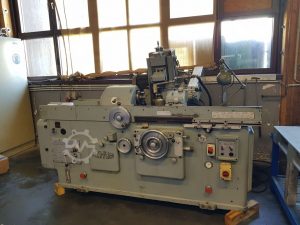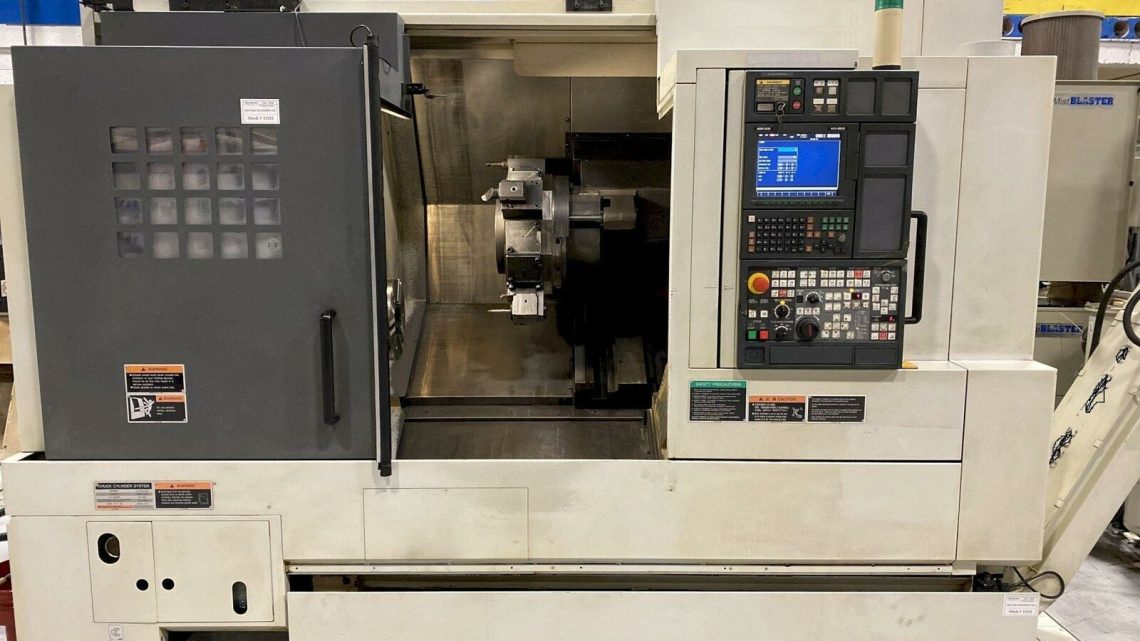
What Do Buyers Look for Before Investing in a Pre-Owned, Used, Secondhand, Surplus CNC Equipment Before Purchase Mori Seiki NL2500MC/700 CNC Turning Center made in Japan
When evaluating a pre-owned / used / surplus Mori Seiki NL2500MC/700 (or equivalent “NL2500MC” variant) CNC turning / multitasking center, you’ll want to approach the inspection with extra care. Machines like this combine multiple axes, live tooling, and demanding tolerances, so hidden wear or damage can erode a lot of value or force expensive rebuilds. Below is a detailed “due-diligence / inspection” guide (organized by subsystem) plus red flags, tips, and what to look for in what the seller claims.
Key Specs & Baselines (for comparison)
Before inspection, gather the nominal or factory specs of the exact variant you’re inspecting, so you have benchmarks to compare against. Some commonly listed specs for “NL2500MC/700” include:
| Parameter | Typical / Catalog Value* |
|---|---|
| Distance between centers / “700” length | ~ 700 mm (≈ 27.7″) |
| Swing over bed | ≈ 36.4″ (≈ 924 mm) |
| Swing over cross slide | ≈ 29.7″ |
| Turning diameter | ~ 14″ (≈ 355 mm) |
| Bar capacity / spindle bore | ~ 3.1″ / ~ 80–91 mm bore |
| Turret / live tooling | 12-station turret, live milling capability (6,000 rpm live tools) |
| Control & axes | MSX-850 / MSX-850II or MAPPS / MSX (e.g. MSX-850 / MSX-850-ii) controls are often associated |
| Power / motor spec | Main spindle motor ~ 25 hp (≈ 18.6 kW) in many listings |
| Rapid traverse (X/Z) | ~ 1,181 in/min (≈ 30 m/min) for X and Z |
* “Typical” values — always verify your specific machine’s nameplate or build sheet.
Use these to check against what the machine you inspect actually delivers (or claims) — large deviations are red flags.
Inspection & Testing Checklist: What to Look For / Test
Here’s an organized checklist (mechanical, motion, axes, tooling, electronics, auxiliary systems) for a machine like the NL2500MC. Bring precision measurement tools (indicators, test bars, gauges, data logging), and ideally, someone experienced with Mori Seiki / multi-axis lathes.
| Subsystem / Area | What to Inspect / Test | Why It Matters / What to Watch For |
|---|---|---|
| Machine History & Documentation | • Ask for total power-on hours and, if available, cutting hours (i.e. time under load) • Maintenance / service logs: lubrication, calibrations, rebuilds, past crashes • Records of component replacements (spindle, bearings, turret, live tools) • Original configuration vs aftermarket modifications • Reason for sale, usage profile (heavy production, light use, mixed work) | A machine’s life is often written in its logs. Lack of records is a big risk. |
| Frame, Base & Structural Integrity | • Inspect the bed, cross slide supports, column / base, mounting surfaces for cracks, repair welds, distortions • Check whether the machine is still level, whether the base and mounts have shifted • Check datum surfaces, rails, alignment geometry for signs of bending or warp • Look for signs of past collisions or hard impacts (dings, frame repairs) | Structural deformity is hard or impossible to fully correct; it undermines alignment and accuracy under load. |
| Guideways, Slides, Ball Screws, Bearings | • Traverse X, Z axes (and other axes, e.g. live tool axes) over full travel; feel for binding, unevenness, rough motion • Measure backlash, hysteresis, repeatability • Use test indicators to check straightness / flatness of slide movement • Inspect ball screws, couplings, linear guides, motor couplings, recirculating mechanisms, lubrication • Listen for grinding, chatter, irregular noise during motion | Worn motion elements produce dimensional error, poor surface finish, and inconsistencies. |
| Spindle & Live Tooling / Milling Heads | • Run the main spindle at slow, medium, and top speed — listen for noise, feel for vibration, detect hums • Measure radial and axial run-out using a precision dial indicator or test bar • Check spindle bearings for play / looseness • Inspect the spindle bore / through-hole for wear, scoring • Test live tool units (rotary milling / driven tool heads), their coupling, vibration, run-out, response • Check whether live tool units still achieve rated rpm and torque • Compare performance under load and under no-load | The spindle and live tooling are among the most expensive and critical parts. Any degradation here directly affects usable accuracy and performance. |
| Turret / Tool Holding / C-Axis / Tool Change | • Cycle the turret through full tool changes; test indexing under speed / load • Check tool indexing accuracy, repeatability, any mis-indexing or slow cycles • Inspect tool holders, gripping surfaces, sensors, mechanical alignment • If the turret supports C-axis, check C-axis indexing precision, backlash • Watch for collisions, interference, tool overrun • Check if tool presetter or automatic tool setting is included and functioning | A compromised tool change system reduces throughput and can damage tools or workpieces |
| Axes / Additional Motions (if present) | • If there are extra axes (Y, B, etc.), test their motion, backlash, repeatability • Verify that combined motions (turning + milling) align geometrically • Test interpolation moves that combine axes and watch for inconsistencies | Multi-axis performance is what gives these machines value — if one axis is weak, your combined capability is greatly hampered |
| Control / CNC Electronics / Wiring | • Open control cabinet(s); inspect wiring, connectors, signs of overheating, burnt tracks, corrosion • Check servo drive modules, I/O boards, CPU boards, spares • Run diagnostic mode, check alarm history, parameter logs • Test interface responsiveness, program execution, memory retention • Check whether control / software version is current or upgradable • Check communications (fieldbus, feedback, sensors) integrity | Electronics failures are costly, and for older models, finding replacement modules may be hard or expensive |
| Thermal / Stability / Drift | • Let the machine run (idle / light motion) for hours to warm up • During warm-up, perform repeated positioning tests to track drift • Execute test cuts early vs later and compare dimensional variation • If the machine has thermal compensation / correction features, verify they function properly | Even a machine that is geometrically perfect when cold can drift badly in practice — this is especially critical when tolerances are tight |
| Accuracy, Repeatability & Test Cuts | • Command repeated moves to the same location; measure dispersion (repeatability) • Perform circular interpolation, test cuts (turning + milling) across different zones • Use calibration / reference bars or gauges to quantify deviations from nominal • Test extremes of the working envelope (near limits) — not only the “sweet spot” • Compare multi-operation cuts (turning + milling) to check integrity across modes | These practical tests will reveal whether the machine meets your tolerance requirements in real use |
| Auxiliary Systems: Cooling, Lubrication, Chip Handling | • Inspect coolant pumps, lines, nozzles, filters, leaks • Check chip conveyor, chip removal systems, guarding • Verify lubrication / automatic lubrication systems, oil lines, valves, filters • Inspect enclosures, seals, covers, guards • Pneumatic / hydraulic systems (e.g. chucks, actuators) — check leaks, responsiveness | Even great mechanical systems fail without proper cooling or lubrication; chip buildup can damage parts |
| Safety, Guards & Interlocks | • Check emergency stops, door interlocks, safety circuits • Inspect shields / covers, tool change safety, spindle guard • Confirm safety wiring is intact and not bypassed • Match whether machine meets your region’s safety / electrical standards | Safety must be inherently correct; retrofits can be expensive |
| Spare Parts, Obsolescence & Support | • Ask for part numbers of critical components (spindle bearings, live tool modules, electrical boards, drive modules) • Research whether those parts are still in production or available via aftermarket • Find out whether Mori Seiki / DMG (or local channel) support is available for your region • Ask which wear parts / consumables have already been replaced • Try to have the seller include spare modules, tool holders, or extra parts | Even a well-functioning machine is useless if you can’t maintain or repair it in the future |
| Transport / Installation / Commissioning Risks | • Plan disassembly, packing, transport, and risk of misalignment • Assess whether your facility can accommodate size, weight, access, foundation • Factor in commissioning costs: leveling, alignment, checking backlash, calibration, test runs • Time for burn-in, fine adjustment, verifying multi-axis performance • Confirm utilities (power, cooling, compressed air, ventilation) compatibility | Sometimes the hidden costs of transport and re-commissioning eat so much margin that the “bargain” is gone |
Red Flags & Warning Signs
Here are signs that might disqualify a candidate machine — or at least force major discounting / contingency reserve:
- Spindle noise, vibration, or run-out beyond acceptable limits
- Live tooling units that fail to reach rpm or exhibit high vibration
- Turret mis-indexing, tool change errors, slow or failed cycles
- Axes motion that is rough, binding, or shows excessive backlash
- Significant thermal drift / dimensional shift over time or warm-up
- Electrical cabinets with burnt parts, patched wiring, missing modules
- Obsolete or un-replaceable electronic modules or drives
- Poor or absent maintenance / service history
- Structural damage (cracks, frame distortions, past collisions)
- Auxiliary systems (coolant, lubrication, chip handling) failing or missing
- Safety circuits bypassed or absent
- The seller refuses load tests, opening cabinets, or extended trials
Specific Issues & Pitfalls Known / Reported for NL / Mori Lathes
From community and user forums, here are some issues that have been encountered with Mori NL-series machines (and which you should specifically test for):
- Some users report that the machine “won’t let me use a turning tool unless the Y axis is zero-returned” — meaning constraints in the parameter settings / control logic can interfere with expected operation.
- Proximity switch / sensor failure in chuck actuation can hang the program (e.g. M11 command not completing because the machine doesn’t detect a fully open/closed state) — particularly in sub-spindle or dual chuck designs.
- Swarf or chips lodged in spindle tube or internal clearance zones can damage sensors or interfere with motion or proximity detection.
- Issues with parameter / PMC settings: some alarms or behaviors stem from control parameters being locked, changed, or mis-set (so the machine’s control logic itself can impose limitations).
- Wear or issues with the way-lube system: on some Mori machines, lube distribution is via manifolds; blocked or stuck lube lines / manifolds can cause under-lubrication, accelerated wear. (This is a more general Mori-series insight from user reports)
So when inspecting, don’t just test mechanical / motion — also carefully audit sensor feedback, limit switches, proximity sensor operation, and parameter settings.