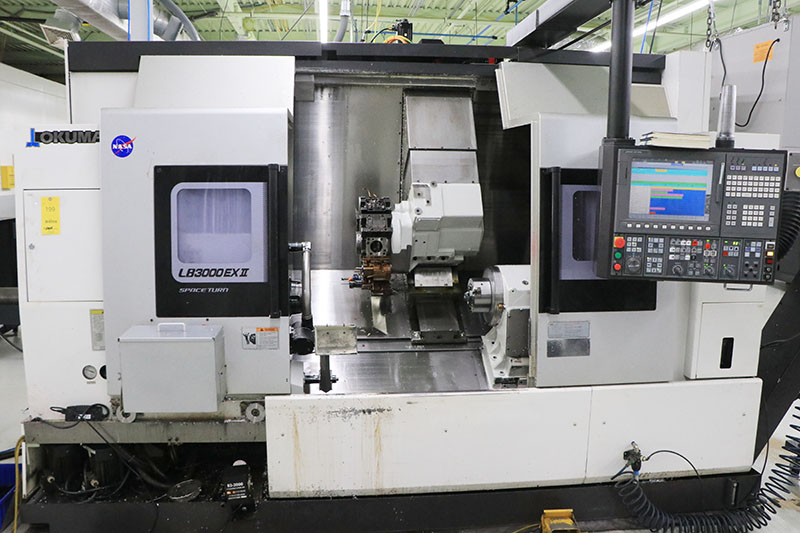
What Do Buyers Look for Before Investing in a Pre-Owned, Used, Secondhand, Surplus CNC Equipment Before Purchase Okuma LB-3000EX-II-MYW 800 CNC Turning Center made in Japan
If you’re considering buying a pre-owned / surplus Okuma LB-3000EX-II-MYW / 800 (or variant) CNC turning center, you’ll want to treat it almost like a hybrid between a lathe and multitasking mill—because this series supports Y-axis, sub-spindle, C-axis, live tooling, etc. The risks are higher, as more axes and functions mean more potential failure modes. Below is a detailed due diligence checklist plus specific pitfalls and red flags to watch for.
Key Features & Spec Benchmarks to Know Ahead of Time
Before inspection, arm yourself with the nominal specs (or those of the specific variant) so you can spot deviations. Here are some representative figures and features from listings and Okuma documentation:
- The LB-3000EX-II is part of Okuma’s “Space Turn / LB EX II” family with multitasking capability (MY, MYW versions).
- Typical key specs (for a MYW / 800 variant) in listings:
• Swing over bed: ~ 22.83″ (~ 580 mm)
• Maximum machining diameter on cross slide: ~ 13.39″ (~ 340 mm)
• Distance between spindles (for MYW configuration): ~ 42.72″ (~ 1,085 mm)
• X travel: ~ 10.24″ (~ 260 mm)
• Z (long) travel: ~ 39.76″ (~ 1,010 mm)
• Y-axis travel: ~ 4.53″ (+2.76 / –1.77) (~ 115 mm) for MYW version
• Spindle speeds: main spindle up to 5,000 rpm (or variants 4,200 / 2,800)
• Spindle bore (through hole): ~ 80 mm
• Turret: 12 positions, live tooling capability, C-axis indexing, sub-spindle (in MYW)
• Control: Okuma OSP (e.g. P300L / OSP-P300 / P300LA) in many listings
Knowing these lets you check whether the candidate machine is performing near spec or has drifted too far.
Comprehensive Inspection / Test Checklist
Below is a detailed checklist organized by subsystem. Bring metrology tools (indicators, test bars, dial gauges, data loggers) and, if possible, someone experienced in multitasking lathes to accompany you.
| Subsystem / Area | What to Check / Test | Why It Matters / What to Watch For |
|---|---|---|
| Machine History & Documentation | – Total “power on” hours, and if available, cutting hours – Maintenance logs (lubrication, calibration, spindle rebuilds, turret overhauls) – Crash / collision history, repairs done, modifications – Parts replaced (motors, encoders, spindles, tool holders) – Reason for sale – Whether the machine has always run in MYW / multitasking mode or only lathe mode | If a machine has been heavily used in milling / Y / live tooling mode, wear is higher. Lack of history is a major risk. |
| Frame, Base & Structural Integrity | – Inspect bed, columns, mounting surfaces, base for cracks, welds, distortion – Verify machine leveling, whether the foundation is still solid – Check alignment and squareness of hard datum surfaces – Look for signs of repair or structural shifting | Any structural deformation undermines geometric accuracy under load |
| Guideways, Slides, Ball Screws & Bearings | – Traverse X, Y, Z axes (and also sub-spindle / opposing spindle axes) over full travel; feel for binding, sticking, uneven load – Using indicators, measure straightness and smoothness of motion – Check backlash, hysteresis, repeatability in each axis – Inspect ball screws, couplings, linear guides, motor couplings, encoders – Listen for grinding, chatter, or irregular noise during motion | Wear here leads to part inaccuracy, chatter, long-term instability |
| Spindle(s) & Sub-Spindle (if present) | – Run main spindle at low, medium, high speeds; listen for bearing noise, vibration, hum – Measure radial and axial run-out with a precision indicator – Check spindle bearing play / looseness – Inspect through-hole, taper, and internal surfaces – For sub-spindle: perform similar tests – Compare consistency between spindles – Check seals, lubrication, coolant paths, spindle cooling (if any) | A spindle with degraded bearings or run-out can severely limit precision or require expensive rebuilds |
| Turret / Tooling / Live Tooling / C-Axis Indexing | – Test turret indexing: run multiple tool change cycles, under load, at speed – Check repeatability / accuracy of indexing – Inspect tool holders, gripper mechanisms, sensors, guides – Test live tooling (rotary milling / drilling) for vibration, run-out, stability – Check C-axis indexing accuracy / backlash – Inspect driven-tool drive motors, couplings, feedback encoders, cooling (if applicable) | Tooling system is often the failure point in multitasking machines; poor live-tool performance kills usability |
| Motion of Y-Axis / Y-Driven Components | – Move Y-axis through full +/- travel; check for smoothness, binding, backlash – Measure Y-axis repeatability via multiple moves – If Y is used for off-center milling / drilling, check that deviation is acceptable – Check encoder feedback, motor loads, current draw – Confirm mechanical alignment between main and sub operations involving Y (i.e. whether Y motion aligns coordinate systems properly) | Because Y-axis is often used under higher moment loads, wear here is particularly damaging |
| Control / CNC Electronics / Wiring | – Open electrical cabinets; inspect wiring, connectors, signs of overheating, burnt insulation – Check servo drive modules, I/O boards, control boards, spares – Review alarm history, diagnostic logs – Check whether software version is upgradable / supported – Test interface responsiveness, program loading, memory retention – Verify communication links (fieldbus, feedback, sensors) | Electronics failure is expensive and sometimes impossible to fix if spare parts are obsolete |
| Thermal Behavior / Stability | – Run the machine for 1–2 hours, do light idle motion, let the machine thermally stabilize – Periodically run repeated positioning tests to detect drift over time – Perform test cuts early vs late to see if geometry shifts – If the machine has thermal compensation subsystems (for example sensors in bed / structure), check whether they still function | Multitasking machines especially suffer from drift; if the machine can’t maintain stability, tolerances will deteriorate |
| Accuracy, Repeatability & Test Cuts | – Command the same coordinate repeatedly; measure the deviation (repeatability) – Run circular interpolation or test cuts to check roundness / taper / form errors – Perform realistic test parts involving turning + milling / drilling (if enabled) across the machine’s full envelope – Compare parts from main spindle and sub-spindle to detect differential errors – Test extremes of travel, not just the “sweet spot” – Use calibration / reference bars or gauges to quantify deviations | This is the ultimate proof: if the machine can’t hold tolerances in real work, it’s not worth buying |
| Auxiliary Systems: Cooling, Lubrication, Chip Handling | – Check coolant pump, nozzles, piping, flow rates, leaks – Inspect chip conveyor / removal path, evacuation, guarding – Check lubrication / auto-lube systems, oil lines, filters, valves – Inspect guards, covers, seals, safety doors – Pneumatic / hydraulic components (if any) for chucks, actuators, etc. | Even excellent mechanics fail under poor cooling or lubrication; chip accumulation can damage components |
| Safety, Guards, Interlocks & Compliance | – Verify emergency stops, door interlocks, safety circuits – Inspect guarding around moving parts, tool change areas, spindle enclosures – Check that safety wiring is intact and not bypassed – Confirm machine meets local safety / electrical regulations (especially if importing) | Safety must be baked in—retrofitting later is costly and legally risky |
| Spare Parts, Service & Obsolescence | – Ask for part numbers of critical components (spindle bearings, encoder modules, drive modules, turret parts) – Check whether those parts are still manufactured or available through aftermarket – Find out whether Okuma or third-party service support is available in your region – Ask which consumables or wear parts have already been replaced (and when) – Try to get spare tool holders, grippers, electronic modules included | Even a well-functioning machine is useless if you can’t maintain or repair it |
| Transport, Installation & Commissioning Considerations | – Plan disassembly, packing, shipping, and risk of misalignment – Ensure your facility can handle the machine (floor load, crane, access) – Consider commissioning costs (leveling, alignment, backlash compensation, calibration) – Budget time for tuning, test cuts, breaking-in – Confirm utilities (power voltage, cooling, air, exhaust) compatibility | These “hidden” costs often make or break the financial viability of a used-machine deal |
Red Flags & Deal-Breakers
These are issues that should either disqualify a machine or force a major price reduction / risk premium:
- Spindle vibration, audible bearing noise, or excessive runout.
- Tool turret mis-indexing, erratic indexing, dropped tools, or slow tool change cycles.
- Live tooling that performs poorly (high vibration, inaccurate, unstable cuts).
- Excessive wear or play in Y-axis or poor Y-axis behavior under load.
- Inconsistent performance or large deviations in test parts, especially after warm-up.
- Excessive drift in dimensional accuracy over cycles or warm-up period.
- Electrical cabinets with burnt wiring, patched circuits, missing modules, or corrosion.
- Missing or obsolete control modules, drives, or parts that you can’t source.
- Lack of maintenance history, or signs of neglect (dry guides, rust, lack of lubrication).
- Structural damage: cracked bed, worn datum surfaces, misalignment in frame.
- Auxiliary systems nonfunctional (coolant, lubrication, chip handling).
- Safety interlocks defeated, missing guards, or dangerous wiring.
- The seller refuses full access or test runs, or won’t allow you to open cabinets or test under load.
- The refurbishing cost (spindle rebuild, electrical repair, alignment) is likely to exceed the discount.