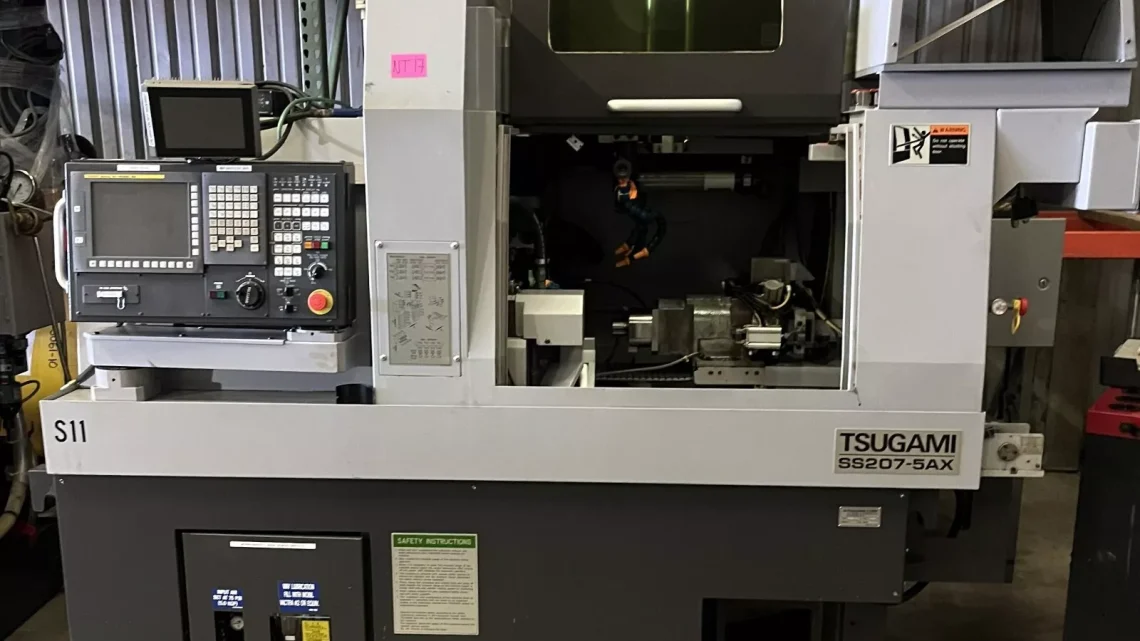
What Do Buyers Look for Before Investing in a Pre-Owned, Used, Secondhand, Surplus CNC Equipment Before Purchase Tsugami SS207-5AX CNC Swiss Sliding Head Lathe made in Japan
When considering a pre-owned / used / surplus Tsugami SS207-5AX (or SS207-II-5AX, B-axis sliding head Swiss lathe variant), buyers should exercise extra caution. Swiss sliding-head, multi-axis lathes are complex machines, and failures or wear in a few critical components can be extremely expensive or even impossible to remedy reliably. Below is a detailed, targeted checklist plus general advice to help you evaluate whether a used SS207-5AX is a safe and smart purchase.
Typical Specifications & Capabilities (for benchmarking)
Before inspection, collect the exact model variant and options, and compare to factory spec to spot discrepancies. Some published values for the SS207-5AX / SS207-II-5AX:
- Bar / stock capacity: 20 mm (0.787 in)
- Working length (with guide bushing): ~ 210 mm (8.65 in)
- Working length (in chucker (non-guide bushing) mode): ~ 45 mm (1.77 in)
- Control: FANUC 31i-B5 (or equivalent)
- Number of tool positions (standard): ~ 37 tools
- Spindle & live tool speeds:
• Main spindle: 200 – 10,000 rpm
• Live tool spindle ranges (front, B-axis, back): up to ~ 8,000 rpm (varies by tool) - Rapid traverse / feed rates: e.g. 35 m/min in linear axes, others less
- Machine weight & footprint: ~ 3,745 kg (8,267 lb)
- Power requirement: ~ 12.4 kVA, compressed air ~0.4 MPa, coolant tank ~260 L
- Controlled axes: typically 7 axes (X1, Z1, Y1, X2, Z2, Y2, B)
- Features: B-axis swiveling live tool functionality, modular tool zones, ability to run in guide bushing or chucker mode (optional)
- Other features: thermal displacement compensation, simultaneous 5-axis machining, optional accessories (back tool spindle, multipurpose tool spindles)
Knowing these spec targets gives you a baseline to judge whether the machine on offer is “as advertised,” or whether some components have been downgraded or heavily modified.
Detailed Inspection Checklist for SS207-5AX (Swiss / Sliding-Head + B-Axis)
Below is a breakdown of the areas to inspect (mechanical, electronic, accuracy, support) along with what to watch for and red flags.
| Subsystem / Area | What to Inspect / Test | Warning Signs / Red Flags | Notes / Specific Tests |
|---|---|---|---|
| Frame / Structure / Base | Look for cracks, weld repairs, distortion, signs of collisions or impact | Weld repairs especially near headstock, tailstock, or bed are risky — hidden stress | Check that bed rails are straight, no twist; check bolt holes, leveling pads |
| Inspect guideway surfaces on the sliding headstock / guide bushing area | Scratches, pitting, corrosion can degrade concentricity | Use a straightedge, feel runover with feeler or dial gauge | |
| Check alignment / squareness of headstock to bed, tailstock, turret planes | Misalignment suggests previous repairs or damage | Use gauges / indicators for geometric checks | |
| Sliding Headstock / Guide Bushing / Bar Slide | Move the sliding headstock along full travel, feel for binding, stiction, non-uniformity | Rough spots or variable friction suggest wear, lubrication issues, damage | Do this slowly and record “feel” at intervals |
| Inspect guide bushing mechanism (if present) — check wear, condition, concentricity | Worn or loose bushing housings lead to poor part finish | Run test bar / dummy, measure eccentricity vs over travel | |
| Check lubrication / coolant to guide bushing paths | Insufficient flushing or lubrication can accelerate wear | Run coolant, check pressure, flow, leakage | |
| Spindles & Bearings (Main, Secondary, Live Tool Spindles) | Run each spindle (main, sub, live tool) at multiple speeds; listen for noise, vibration, heat | Humming, grinding, roughness, hot bearings indicate wear or damage | Use accelerometer or vibration meter if available |
| Measure spindle runout (with a precision bar or test mandrel) | High runout degrades finish and tool life | Test at multiple positions along length | |
| Check spindle axial / radial play | Excessive play is unacceptable in precision machining | Use known standards or dial indicators | |
| For the B-axis live tool spindle: test angular indexing, smooth transitions, torque under load | Sloppy B-axis behavior will wreck 5-axis parts | Run a complex contour toolpath if possible | |
| B-Axis / Rotary / Indexing Mechanics | Cycle the full B-axis swing across its full range; record backlash, repeatability | High backlash or inconsistent motion is a major red flag | Test at multiple points in the arc |
| Check coupling / gear engagement in the B-axis | Gear chatter or misalignment implies wear or poor maintenance | Listen and record under load | |
| Check encoder feedback and alignment in the rotary path | Erroneous feedback kills contouring accuracy | Use diagnostic mode or measure with external equipment | |
| Tool Zones / Live Tools / Tool Changer | Cycle all live tools (front, back, B-axis) repeatedly; observe consistency, misfires, delays | Jams, mis-indexing, hesitation, misalignment are problematic | Run through full automatic cycles many times |
| Inspect tool pockets, taper interface (ER16, ER11, etc.), locking mechanisms | Wear or damage in tool pockets degrades repeatability | Use test gauges for taper surfaces | |
| Check quick-change cartridges (if used) for wear or looseness | These are frequently replaced or modified — ensure compatibility and precision | Swap in/out tools, measure runout | |
| Control / CNC / Electronics / Wiring | Power up control, run homing & reference cycles | Inability to reference or home reliably is critical | Test in all axes including B-axis |
| Load test program (e.g. simple Swiss part or multi-axis contour) and run it | Look for axis stalling, error alarms, overruns, derating | A real cutting test is more revealing than “air moves” | |
| Review wiring loom, connectors, cables — look for signs of overheating, rewiring hacks, brittle insulation | Bad wiring is one of the most common failure causes in older machines | Open control cabinet, inspect each board, fans, backups | |
| Check cooling / cabinet air handling, filters, fans, dust, cleanliness | Overheating, clogged fans accelerate failure | Run machine for a while to see thermal stability | |
| Hydraulics / Pneumatics / Coolant / Auxiliaries | Test coolant pump, flow, pressure; check lines, filters, nozzles, flushing | Weak flow or contamination is a sign of neglect | Use dye to trace leakage, measure flow rate |
| Check central lubrication systems (ways, slides, tool zones) | Missing or failing lube is a major risk | Look for low oil levels, broken lines | |
| Inspect chip management, conveyors, wash systems, door interlocks | These “auxiliary” parts often get overlooked but failing ones hinder daily use | Turn them on, run them, inspect routing | |
| Accuracy / Calibration / Testing | Perform positional accuracy tests in linear axes (X, Z, Y) — gauge blocks, telestand, dial indicators | If deviations are far from spec, repairs may be costly | Test at multiple positions along travel |
| Run repeatability tests (move-out / return) in each axis including B-axis, measure deviations | Poor repeatability bodes trouble for complex parts | 5-axis work is extremely unforgiving | |
| Run a real part (Swiss style) with full B-axis contouring, then measure finished geometry, surface finish, angular features | This is the definitive test | Compare to your tolerance envelope | |
| Usage History / Maintenance / Wear Indicators | Ask for cutting hours, not just powered-on hours | Cutting hours are far more meaningful for wear estimation | Compare cutting hours vs year of manufacture |
| Ask which components have been replaced (spindle bearings, guideway refurb, B-axis gearbox, encoders, etc.) | Knowing what’s new vs old helps you assess remaining life | Request documentation if possible | |
| Inspect for signs of abuse: excessive chips in slides, poor coolant maintenance, grinding or hard materials use | Heavy usage in abrasive materials accelerates wear drastically | Examine surfaces, chips, coolant traces | |
| Parts / Support / Documentation | Confirm availability of spare parts (control boards, motors, couplings, live tool spindles, B-axis gear sets) | Obsolete or hard-to-get parts reduce long-term viability | Especially proprietary live tool / B-axis parts |
| Ensure you receive full documentation: operation manuals, wiring diagrams, parts catalogs, CNC parameter listings | These are often lost in used machines and without them, servicing becomes significantly harder | If documentation is missing, deduct in your offer | |
| Check whether the current control version, firmware, and features are still supported (or upgradable) | Older control versions may be locked or unsupported | Ask manufacturer / distributor about backward support | |
| Facility / Installation / Infrastructure | Verify that the machine’s electrical requirements (voltage, phase, amps) match your shop | Retrofitting power is expensive | Check for power supply, protection, grounding |
| Confirm space, floor capacity, crane / rigging access, doorways, clearances | Swiss / sliding-head lathes are compact but must be precisely aligned | Plan for leveling, vibration isolation, foundation | |
| Check cooling system, compressed air supply (for tool clamping, chip blow-off) | Edge cases: air pressure dips, moisture in lines, inadequate cooling | Monitor during operation | |
| Commercial / Contract Safeguards | Negotiate a conditional acceptance clause: final payment only once performance metrics are met | Prevents buyer being stuck with a non-performing machine | Include benchmarks (accuracy, repeatability, throughput) in agreement |
| Insist on a run-in / burn-in period under load | Some defects only manifest under sustained use | Use your own production program if possible | |
| Clarify warranty / guarantee period (even for used machines) | Some sellers offer limited warranties on major components | Strive for coverage on spindle, B-axis, drive systems | |
| Define responsibility for transport, rigging, installation, calibration, alignment costs | These “hidden costs” often push used machine purchases over budget | Get quotes in advance | |
| Specify liability during transit / transit insurance | Many machines get damaged in shipping | Document machine condition with photos before shipment |
Unique Risks & Pitfalls for Swiss / Sliding-Head + B-Axis Machines
Because of their mechanical complexity and precision requirements, Swiss sliding-head machines with B-axis capabilities carry additional risk:
- B-axis wear or misalignment: The rotary / tilt mechanism is often the most delicate and expensive to repair. Small errors here result in angular contour deviations, which may ruin a high-precision part.
- Live tool integrity: The live tools (front, rear, B-axis) tend to suffer heavy wear because they are actively cutting while rotating and often under high loads or torque. If these spindles are worn, repair or replacement costs are very high.
- Guide bushing wear: The sliding head / guide bushing interface is critical for concentricity. If worn, you’ll lose part quality, and re-bushing or re-machining may be costly.
- Conversion / modular accessories: Many SS207-5AX machines may have optional features (e.g. chucker kit, additional tool spindles). If these are missing or improperly integrated, capabilities are limited or inconsistent.
- Control / firmware lock-ins: Some features (e.g. advanced 5-axis interpolation or B-axis synchronization) may be firmware-locked or require paid upgrades. Confirm full feature access.
- Obsolescence / parts discontinuation: As the machine ages, certain specialized parts (especially for the B-axis mechanism, live tool spindles, custom platens) may no longer be manufactured or expensive to source.
- Thermal drift and stability: Swiss machines are very sensitive to temperature changes (in guideways, headstock, slide rails). If the machine does not have good thermal compensation or has suffered thermal damage, you might see drift over long runs.
- Hidden modifications / retrofits: Previous owners may have done non-OEM modifications (e.g. replacing bearings, adapting non-standard tool spindles) that degrade performance or complicate servicing. Always verify modifications with documentation.
- High precision tolerances: Because Swiss machines typically produce small, high-precision parts, even small deviations (in microns) can ruin usability. The margin for error is low compared to larger machining centers.