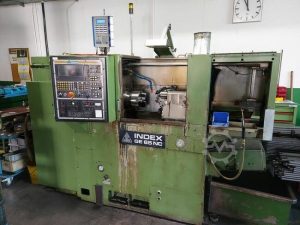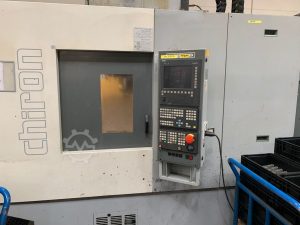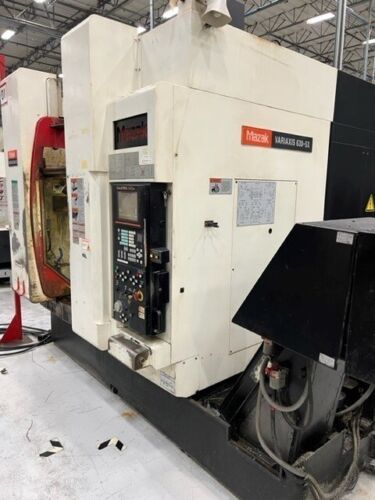
What Do Buyers Look for Before Investing in a Pre-Owned, Used, Secondhand, Surplus CNC Equipment Before Purchase Mazak Variaxis 630-5X CNC 5-Axis Vertical Machining Center made in Japan
When evaluating a pre-owned 5-axis CNC vertical machining center such as a Mazak Variaxis 630-5X (or its variants), a buyer needs to be especially diligent — these machines are complex, expensive to repair, and require tight tolerances. Below is a detailed, specialized checklist (plus general CNC buying guidance) to help you evaluate whether a used Variaxis 630-5X is a good investment, what risks to watch for, and what “red flags” to avoid.
Typical Specifications / Baseline for Mazak Variaxis 630-5X
Before inspection, collect published specifications for the variant you’re evaluating (year, options). Some typical data for the 630-5X (to use for benchmarking) are:
| Spec | Typical Value / Range* | Notes / Source |
|---|---|---|
| X-axis travel | ~ 630 mm (24.8”) | Must verify layout, possible variant differences |
| Y-axis travel | ~ 765 mm (30.12”) | Standard for many Variaxis 630-5X units |
| Z-axis travel | ~ 510 mm (20.08”) | Some versions may have extended Z travel |
| Spindle speed | 12,000 rpm typical | Some later models may have higher speeds or upgraded spindles |
| Tool magazine / ATC capacity | 30 – 80 tools (varies by variant) | Check whether dual magazines or expanded capacity were included |
| Table / pallet size & load | ~ 500 × 500 mm, ~ 500 kg load | Some variants use dual pallet systems or different table layouts |
| A-axis tilt / C-axis rotation | A-axis: –120° to +30°; C-axis 360° contoured | Must verify “contouring / simultaneous 5-axis” capacity, not just indexing |
| Rapid traverse / feed rates | Varies by model / servo drive, but should be comparable to new units if not degraded | Older machines may have degraded performance |
| Power / electrical spec | Usually 380–400 V, 3-phase; check amps, transformer needs | Upgrades or mismatches are expensive |
| Weight & footprint | Very heavy; machine may weigh 10–20+ tons | Need rigging plan and foundation readiness |
* These are typical values; always verify what the specific machine should be, especially considering options and upgrades.
Having these spec targets in advance lets you spot deviations (e.g. someone swapped in a lower power spindle, or someone claims tool capacity that doesn’t match the magazine hardware).
Specialized Inspection Checklist for a Variaxis 630-5X (5-Axis)
When you physically inspect (or send a trusted technical evaluator), go through these areas:
1. Structural & Mechanical Integrity
- Frame / column / base: look for repair welds, cracks, distortion, signs of collision or misalignment
- Machine leveling / base mounting: check if the machine is well leveled, whether prior leveling shims are intact
- Way surfaces / guideways: check for scoring, pitting, wear, corrosion
- Way covers / bellows: inspect for tears, gaps, broken covers that expose the guides to chips
- Saddle / cross-slides / dovetail surfaces: inspect for wear, misalignment, binding or stiffness
- Ball screws / nut assemblies: check variation in backlash across travel, test for “dead zones” or rough segments
2. Spindle / Bearing / High-Speed Behavior
- Run the spindle at multiple speeds (low, mid, high) and listen/feel for abnormal noise, vibration, or heat
- Measure spindle runout (e.g. on a precision bar or test mandrel)
- Check for bearing chattering or periodic variations (especially under load)
- If the machine has a dual-range or gear/spindle shift, test in each range
- Check spindle front bearing housing or support surfaces for discoloration (overheating)
- If the machine has a high-frequency spindle (upgrade), check for proper balancing and motor health
3. 5-Axis / Rotary Table / Trunnion / Tilting Mechanism
- Tilt axis (A-axis): test the full motion range, check for backlash, smoothness, binding, “dead spots”
- Rotation axis (C-axis / continuous 360°): test full rotation, continuity, indexing, excessive play
- Synchronism / coaxiality: check that the tilt and rotation axes remain precisely aligned with the spindle over their entire sweep
- Axis drives / motors / encoders / gearing: verify the state of gearboxes, couplings, servo feedback accuracy
- Tilting/trunnion mechanics: look for wear, play, lubrication status
- Indexing torque / stiffness: tilt + rotate axes must be stiff under cutting load, not just positioning
4. Tool Changer / Magazine / Tool Handling
- Cycle the ATC many times, observe any misfeeds, jamming, hesitation
- Check each tool pocket for wear, looseness, alignment
- Inspect the tool magazine carousel for wobble, wear or bent arms
- Verify tool change timings (tool-to-tool and chip-to-chip) and consistency
- Check tool shank to spindle interface (BT/HSK/Big-Plus etc.) condition, keying, locking mechanism
- If the machine had dual magazines or ability to swap magazine banks, confirm that hardware is present and functioning
5. Control System / Electronics / CNC / Wiring
- Power up the machine, bring axes online, test homing, reference cycles, limit switches
- Load and run a simple test program (or part of your own test program)
- Validate all axes movement, interpolation, coordinated multi-axis motion
- Inspect wiring, connectors, loom for brittleness, corrosion, overheating or “repairs”
- Check control cabinet cooling / filters / fans / dust / debris / signs of heat damage
- Confirm spare control modules, power supplies, memory backup, PLCs, etc.
- Evaluate software version and compatibility, ability to back up or clone controls
6. Hydraulics / Pneumatics / Coolant / Auxiliaries
- Test hydraulic supply (if used for tool clamps, workholding, fixtures) for pressure stability, leaks
- Inspect pneumatic lines, valves, accumulators, condition
- Test coolant pump, filters, cleanliness, flow rate, pressure
- Check high-pressure coolant (if applicable through spindle) operation
- Inspect chip conveyor, flushers, chip removal, coolant disposal / filtration
- Check that way lubrication / grease / oil systems are functioning properly
7. Accuracy / Calibration / Reference Tests
- Use gauge blocks, ballbars, laser interferometer or other metrology tools to test positional accuracy over travel in each axis
- Check backlash in each axis (in both directions) at multiple positions
- Perform “real-world” test cuts — e.g. a complex 5-axis contour, measure results, surface finish, edge conditions
- Check repeatability tests (e.g. move out and back, measure deviation)
- Check thermal drift: run idle then warm-up test, then cut and measure changes
8. Usage / History / Wear Indicators
- Ask for cutting hours not just “on-time” hours — cutting load hours are more relevant
- Compare hours to machine age: heavy duty use with high hours is riskier
- Ask what parts were replaced (ball screws, bearings, servo motors, encoders, way surfaces, spindle rebuilds)
- Look for signs of abuse or hard use: heavy materials, abrasive chips, poor maintenance
9. Spare Parts, Service, Documentation
- Confirm availability of spare parts (especially for control, servo drives, encoders, spindle parts)
- Request all manuals, electrical diagrams, parts catalogs, wiring schematics, control software backups
- If some parts were “upgraded” or replaced with aftermarket, make sure compatibility and documentation are clear
- Check whether Mazak (or local agents) still support that model or control version in your region
10. Power / Infrastructure / Installation Readiness
- Confirm machine’s voltage, phase, fuse rating, power draw
- Check that your facility can provide adequate power, cooling, compressed air
- Evaluate machine footprint, weight, crane / rigging needs, floor strength
- Ensure clearance for doors, ceiling height, overhead cranes, movement during installation
- Plan for leveling, foundation, anchoring
11. Warranty / Acceptance / Contractual Protections
- Insist on a run-in period / acceptance test under your load and program before final payment
- Where possible, negotiate a limited-used machine warranty (e.g. certain components for a limited time)
- Include in the contract that the machine must meet certain performance specifications (accuracy, repeatability, spindle noise, etc.)
- Clarify who handles delivery, rigging, alignment, calibration cost
- Agree on liability during transit / damage / insurance
Specific Risks & Red Flags Unique to 5-Axis Machines
Because 5-axis machines are mechanically and electronically more complex than 3-axis machines, the risk—and the cost of mistakes—is higher. Some critical red flags:
- Excessive play or wear in rotary / tilt axes — even small errors in tilt/rotation degrade 5-axis cuts severely
- “Drift” or misalignment between axes over long motion (co-axis precision)
- Bearings or gearboxes in rotary axes nearing end-of-life (often expensive to rebuild or replace)
- Control versions or boards that are obsolete or hard to source
- Incomplete tool probe, work probe, high-pressure coolant, or missing accessories that degrade capability
- Missing or “home-brew” retrofits without documentation
- Control or software locks (e.g. certain features disabled)
- Incompatibility with your CAM / programming ecosystem (e.g. inability to post-process your toolpaths for this machine)
How to Use This Checklist in Practice
- Pre-visit research — gather all specs, serial numbers, known options in advance
- Bring or hire a technical expert who knows Mazak / 5-axis systems
- Do full cycles / run sample parts rather than just idle axis moves
- Compare measured performance vs spec — if deviations are large, use as leverage in negotiation
- Estimate refurbishment / repair cost — a small spindle or axis repair may cost tens of thousands
- Negotiate conditional purchase — e.g. final payment withheld until acceptance tests passed