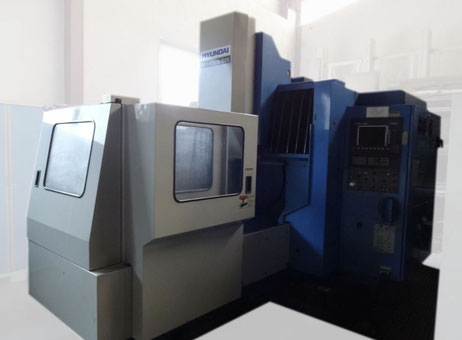
What Do Buyers Look for Before Investing in a Pre-Owned, Used, Secondhand, Surplus CNC Equipment Before Purchase HYUNDAI SPT-V32S/605 CNC Vertical Machining Center made in South Korea
Here’s a comprehensive checklist of what a prudent buyer should look for when considering a pre-owned / used / surplus CNC vertical machining center like the Hyundai SPT-V32S/605 (or similar models) before committing. Many of these points are general (applicable to any CNC machine), and some are specific to the vertical machining center class or even to Hyundai / Korean-made machines.
Key Specifications to Know First
Before going on-site, collect as much machine spec data as possible to set expectations and red-flags:
- Machine model, year, serial number
- Control system (brand, model, version)
- Axis travel (X / Y / Z)
- Table size, maximum payload
- Spindle taper, spindle speed range, spindle motor power
- Tool changer type and capacity
- Rapid feedrates, cutting feedrates
- Machine footprint, weight
- Power requirements (voltage, phase, amps)
- Accessories (coolant system, chip conveyor, air blast, chip flushing, enclosure)
- Maintenance / service history
For example: the SPT-V32S/405 has table dimensions 650 × 1,240 mm, axis travels 1,000 / 700 / 460 mm, spindle 22–3,150 rpm, 15 kW motor, ISO-50 taper, hydraulic tool clamping.
Knowing the “ideal” spec helps you spot discrepancies (e.g. someone claiming very high usage but mismatched spindle, swapped parts, etc).
On-Site / Inspection Checklist
When inspecting the machine in person (or via trusted technical representative), go through these areas thoroughly:
| Subsystem | What to Check / Test | Why It Matters / What to Watch Out For |
|---|---|---|
| Frame & Structure / Visual | Look for cracks, repair welds, misalignment, distortion, rust, corrosion, signs of collisions or impact damage | Structural integrity is fundamental; a bent frame will compromise all accuracy |
| Check machine leveling surfaces, base, column | Poor base or previous repair may degrade performance | |
| Way Surfaces / Guide Rails / Linear Components | Inspect for scoring, wear, pitting, rust | Excess wear leads to backlash, loss of precision |
| Move axes manually (power off) and feel for binding, rough spots | Smooth travel is crucial | |
| Inspect way covers (do they properly protect the guides?) | Damaged covers permit debris ingress | |
| Ball Screws / Lead Screws / Nuts | Measure backlash at multiple positions in each axis | Excessive backlash is often expensive to correct |
| Listen / feel for “notchiness” or angular variation along travel | Indicates wear zones on screw or nut | |
| Spindle & Bearings | Run spindle at low, mid, and high rpm and listen for abnormal noise, vibration | Bearing wear or internal damage often shows up audibly or via vibration |
| Measure spindle runout (e.g. with a dial indicator) | High runout degrades part quality | |
| Check temperature of spindle housing after running for a few minutes | Overheating may indicate bearing wear or lubrication issues | |
| If machine has multiple spindle ranges / gears, shift and test all | Gear engagement problems or wear may only show in one range | |
| Tool Changer / Tool Magazine / Tool Change Mechanism | Cycle the automatic tool changer many times, observe alignment, smoothness, failures | Tool change faults lead to downtime |
| Check all tool pockets for wear or damage | Worn / loose pockets degrade repeatability | |
| Control / CNC / Electronics / Wiring | Power up the control, test axes movement, homing, limit switches, reference sensors | Faulty electronics, limit switch failures are critical |
| Check control memory, program transfer functions, any I/O diagnostics | You want a working, reliable control system | |
| Inspect wiring harnesses, plugs, connectors for brittleness, corrosion, signs of overheating | Poor wiring is high risk | |
| Verify that electrical panels are clean, dust-free, no burn marks or capacitor swelling | Early warning of power or component stress | |
| Hydraulics / Pneumatics / Coolant | Inspect hydraulic lines, look for leaks, check pressure and stability | Leaks or poor pressure degrade tool clamping or other systems |
| Examine coolant system, filters, pumps, piping, nozzles, chip flushing | A poorly maintained coolant system leads to corrosion, contamination | |
| Test chip conveyor, coolant pump flow, flushing nozzles | These “auxiliary” systems are critical for daily usability | |
| Alignment / Accuracy Tests | Use gauge blocks or a calibration artifact to check positional accuracy in all axes | Validates whether the machine holds tolerance |
| Perform a reference part cut (if possible) and measure tolerances on machined features | Real world test is often the final arbiter | |
| Operational Hours / Usage History | Ask for “cutting hours” (not just time powered on) | Cutting hours reflect true wear |
| Compare hours to age—older machines with low hours are more favorable | Excessive hours for age is a red flag | |
| Service / Maintenance Records / Documentation | Demand maintenance logs, repair history, parts replacement records | Helps you assess how well it’s been cared for |
| Check for availability of operation manuals, parts list, wiring diagrams, control schematics | Without those, repairs and troubleshooting become much harder | |
| Parts Support / Spares / Consumables | Check whether the control, spindle, motors, etc. still have parts support | Some older machines or niches lose supplier support over time |
| Ask which wear parts may already have been replaced (ways, spindle bearings, screws, etc.) | Replaced parts might extend usable life | |
| Software Versions / Upgradability | Check what control version is installed and whether upgrade path exists | Modern CAM / interfacing may demand newer control features |
| Electrical / Power Compatibility | Confirm that the machine’s voltage, phase, and electrical needs match your facility | Wrong power specs may require expensive rework |
| Footprint / Space / Rigging Constraints | Ensure the machine actually fits in your workshop, including doors, crane clearances, floor load limits | A capable machine may be useless if you can’t physically install it |
| Safety / Guards / Interlocks | Inspect safety guards, door interlocks, emergency stops, limit protection | Safety compliance reduces risk and liabilities |
Commercial / Contractual Considerations
Beyond technical inspection, you also want to ensure legal, logistical, and financial protections.
- Warranty / Guarantee / Return Period
Negotiate a limited warranty (even for used machines) or “run-in” guarantee. - Acceptance Testing / Factory Acceptance
Agree that before final payment the seller demonstrates full functionality under load, with your test program if possible. - Price vs Refurbishment Cost
Estimate repair / spare parts / refurbishment costs and adjust your offer. If corrective work is extensive, it can erase the savings of buying used. - Spare Parts / Accessories Included
Ask whether tooling, fixturing, probes, collets, extra motors, or spare parts are included. - Transport / Rigging / Setup Costs
Heavy CNC machines need professional rigging, disassembly, reassembly, alignment — budget for that. - Commissioning / Calibration / Alignment
After installation, you’ll need calibration, alignment, leveling — ensure someone experienced is on hand. - Documentation / Transfer of Rights
Ensure you receive all manuals, drawings, control software, licenses, and they can legally be transferred. - Liability / Insurance During Transit
Specify who is responsible for damage during transport. - Depreciation / Resale Value / Obsolescence Risk
Understand how quickly the machine might become obsolete (e.g. control becomes unsupported) and consider that in your ROI calculus.
Specific Risks / Pitfalls for Korean / Hyundai SPT-series Machines
While many factors are universal, there are specific things to watch when dealing with Hyundai / Korean machines or SPT series:
- Parts availability: Depending on region and model year, some parts (especially control modules, spindles, drives) may be harder to source or more expensive.
- Control version differences: Hyundai (or partner) may have used their own/custom control interfaces; compatibility or updates may be limited.
- Aftermarket modifications: Check whether key components (spindle, screws, guides) have been swapped with non-OEM parts, which can affect reliability or service.
- Previous usage material: If the machine was used for heavy or abrasive work (casting, hard materials, continuous production), wear may be higher.
- Localization / documentation: Original manuals, parts lists or schematics may be in Korean and hard to translate or adapt.
- Obsolete electronics: For older Hyundai machines, the control electronics and boards may be out of production, making repairs difficult.
Red Flags (Deal Killers or Big Risks)
Watch out for:
- No or incomplete documentation (manuals, wiring, control diagrams)
- Evidence of collision damage, repair welds, misalignment
- Excessive spindle noise, vibration, heat
- Axes that bind or have very sloppy travel
- Worn or damaged way surfaces or screws
- Faulty / inconsistent tool changer
- Control is locked, no access to PLC or control code
- Power / electrical requirements incompatible with your shop
- Age too great relative to usage (i.e. very old machine with high cutting hours)
- No parts support or obsolescent control
- Seller refuses or cannot allow test under load or acceptance test
- Hidden costs: transport, reinstallation, recalibration