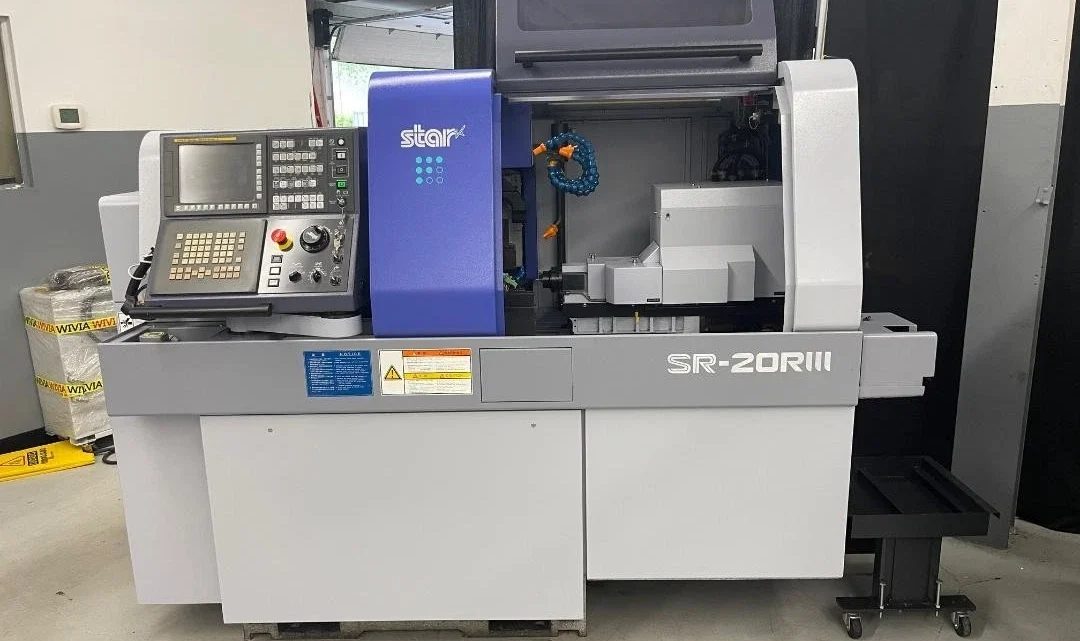
What Do Buyers Look for Before Investing in a Pre-Owned, Used, Secondhand, Surplus CNC Equipment Before Purchase STAR SR-20RIII CNC Swiss Sliding Headstock Lathe with IEMCA Ideal 325 Bar Feeder made in Japan
Here’s a detailed, specialized checklist and set of considerations for assessing a STAR SR-20RIII CNC Swiss / sliding-headstock lathe combined with an IEMCA Ideal 325 (or similar) bar feeder. Swiss machines and bar feeders are complex systems with close coupling, so the inspection must be rigorous.
Understanding the Machine & Matching to Your Needs
Before going on an inspection, have clarity on what you need and what this machine offers. Some relevant published specs for the SR-20RIII:
- The SR-20RIII is a Swiss-type automatic lathe with a 20 mm capacity (approx. 0.78″) max turning diameter.
- Many used listings show it paired with bar feeders, live backworking, etc.
- For example, one listing: 2009, Fanuc 300iS-A control, 4/4 spindle sleeve holders, etc.
- Another listing: 2012 SR-20RIII with IEMCA Ideal 325 magazine bar loader.
Therefore, your inspection must verify that the machine as offered genuinely meets those specifications (e.g. 20 mm diameter, speeds, sleeve holders, control, etc.) and whether there are add-ons or modifications.
Key Inspection & Buyer Criteria
Here’s a structured checklist, specific to Swiss / sliding headstock machines + bar feeders:
| Subsystem | What to Inspect / Test | Why / What To Watch For |
|---|---|---|
| Mechanical / Structural | – Frame, base, column: cracks, repairs, distortion, corrosion. – Guide bushings / guide rails: wear, scoring, lubrication, alignment. – Slide mechanisms (X, Z, etc.): smoothness, backlash, play. – Sleeve holders / front & rear spindle sleeves: condition, indexing, fit. – Tool turrets / tool slides: indexing precision, wear. – Backworking / sub-spindle mechanisms (if present): alignment, motion clarity. – Tailstock / support devices (if used): quill travel, alignment. | Swiss machines run close tolerances; wear in guide bushings or slides degrades precision. Any slack or misalignment will show up as surface finish issues or dimensional drift. |
| Spindles, Sleeves, Bearings | – Run main spindle at various RPMs; listen for noise, vibration, warming. – Check runout (radial / axial) at spindle nose, sleeve end. – Inspect bearings for play or measurable looseness. – Sleeve bearings / sliding sleeves: check concentricity, wear. – Check lubrication / bearing oil / grease systems. | Spindle bearing failure is very expensive; worn sleeves or bearings degrade surface finish and accuracy. |
| Motion Drives / Motors / Encoders | – Jog axes through full travel; feel for smoothness, no jerks. – Check backlash, hysteresis. – Inspect motors, servo drives, couplings, belts (if any). – Encoder feedback signals, resolution, any drift. – Cable routing, connector integrity. | Drives & encoders are crucial for precise motion. Any electrical noise, aging, or degeneration causes positioning errors. |
| Control & CNC Electronics | – Boot up the CNC (Fanuc or whatever the head is) and check for error codes, alarms. – Test operator panel keys, displays, MPG / manual pulse generator. – Load a simple program, run test moves. – Verify parameter backups, software version, and ability to transfer / copy configs. – Check limit switches, home switches, safety interlocks. – Inspect control cabinet: dust, wiring condition, heat marks, cooling fans. | If the control is unreliable or cannot be serviced or supported, the machine is worthless. Make sure the OEM or third-party support is available. |
| Bar Feeder (IEMCA Ideal 325) | – Confirm mechanical compatibility: the feeder must match the lathe spindle bore, collet system, synchronizing signals. The feeder should be sized for the bar diameter range you plan. – Inspect feeder magazine, bars (stock), rails, pusher, guides, telescopic feed parts. – Test pusher motion, indexing accuracy, vibration, smoothness. – Check any collet opening / closing sequence, remnant ejection, cutoff / sensor devices. – Look for wear, misalignment, bent parts, lubrication, binding. – Confirm electrical / PLC / interface to the lathe is functional. – Review the maintenance / wear parts (e.g. support pads, rails) and availability. | If the bar feeder is out of sync or worn, feeding will misfeed, chatter, or cause part failure. You want the feeder and lathe to operate as a tightly integrated system. |
| Lubrication, Coolant & Fluid Systems | – Check coolant system: tank, pump(s), hoses, filtration, flow, contamination. – Inspect central lubrication or oil / grease lines, reservoirs, pressure, leaks, cleanliness. – Check hoses, seals, fittings for leaks or degradation. – Check chip / swarf management (chip conveyor, traps, guards). | Swiss machines have small clearances; coolant and lubrication must be well filtered and consistent. Poor fluid quality or leaks accelerate wear. |
| Alignment, Accuracy & Performance Tests | – Run sample parts using materials you intend to use; check dimensional accuracy, surface finish, repeatability. – Measure straightness, concentricity, roundness, runout across multiple parts. – Cycling tests: run extended sequences to test thermal stability, drift, repeatability over time. – Test backworking operations (if present) to ensure precision across operations. | Only under real load will hidden issues (drift, misalignment, vibration) reveal themselves. |
| Performance Under Load / Extremes | – Push the machine near its rated capacity (spindle speed, feed rates, depth of cut) and observe behavior. – Watch for overheating, vibration, stalls, abnormal behavior. – Test corners, reverse moves, rapid traversal to see if motion drives lag or overshoot. | Machines may look fine at idle but fail when stressed. |
| Maintenance / Usage History & Documentation | – Ask for full logs: hours (total runtime, cutting hours), repairs, part replacements, overhauls. – Review any modifications or non-OEM retrofits; get documentation for them. – Ensure you obtain all manuals, wiring diagrams, PLC code, parts lists, alignment procedures. – Confirm whether software licenses / control codes are transferable. | Without documentation and history, you’re taking on hidden risk. |
| Service & Parts Support | – Check whether the Star / FANUC / OEM support network is active in your country. – Investigate availability of spare parts (spindle bearings, sleeves, motors, drives, control boards, collets). – Get cost estimates for key high-cost spares (e.g. spindle rebuilds, feeder components). – Ask if there are experienced technicians locally who can service / align the machine. | Even a well-functioning machine is useless if you can’t support it. |
| Physical & Site Requirements | – Confirm the machine weight, floor requirements, foundation, leveling. – Check the power requirements (voltage, phases, current) and ensure compatibility. – Assess cooling / hydraulics / air supply / chip removal infrastructure in your facility. – Evaluate whether the machine can physically be rigged, transported, and reinstalled in your space. | Even a perfect machine fails if your site can’t support it or you cannot reassemble / align it properly. |
| Test / Acceptance Agreement & Warranty | – Arrange for an acceptance test period (e.g. a few weeks of running) before full payment. – Include clauses in the contract about defects discovered later, warranty on key components, performance guarantees. – Insist that the seller aids in reinstallation, alignment, calibration. | Reduces your risk of hidden failures after purchase. |
Special Considerations / Risks for Swiss + Bar Feeder Combinations
Because Swiss machines and bar feeders are intimately linked, there are some additional red flags and pitfalls:
- Synchronization & timing errors: If the feeder and lathe are not synchronized correctly, you may get misfeeds, collet open during feed, collisions, or vibrations.
- Wear in the bar feeder guides or pusher: Even minor wear accumulates over many cycles.
- Feeder compatibility with bar size / length: If your production uses bar diameters or lengths not well suited to the feeder, performance suffers.
- Feeder control / interface issues: PLC or digital interface mismatches or aging electronics between feeder and lathe can cause miscommunication.
- Vibrations or bending in long bar feed: If feeder support is weak or misaligned, bars may vibrate or whip, degrading accuracy.
- Hidden feeder alarms or intermittent faults: Forums show issues like “Movement With open Collet” error or “Beating Feed” errors in bar feeders.
- Bar remnant ejection / cutoff mechanisms: Ensure remnant handling is reliable; jammed remnants can ruin cycles.
- Feeder maintenance and spare parts: Feeder wear parts may be expensive; ensure parts are available.
- Retrofitting / modification risk: Some machines may have been modified; ensure modifications were properly done and documented.
- Machine upgradability: Control upgrades, live tooling, Y-axis, etc. If you ever want more capability, check that the base machine can accept upgrades.
Risk Prioritization & What to Push On During Negotiation
When you do your inspection, you’ll likely find some defects or areas needing repair. Some issues are “deal-breakers,” others are negotiable. Here’s a rough prioritization:
- Spindle / bearing issues, or major wear in sleeves → Very expensive; demand discount or replacement.
- Motion / drive / encoder faults → Bad positioning; low confidence in dimensional performance.
- Control / CNC / electronics unreliability → No use if machine can’t run reliably.
- Bar feeder faults or mismatch → The machine may be useless in production without a working feeder.
- Mechanical wear in slides, guides, bearings → Can often be refurbished, but cost must be known.
- Missing documentation, parts support gaps → High risk; factor into price heavily.
- Site / installation or transport risk → If you cannot install or align properly, effective performance may suffer.
During negotiation, ask the seller to discount for needed repairs, provide spare parts, and guarantee alignment / performance for a limited period. Insist on being allowed to run a full set of test parts.