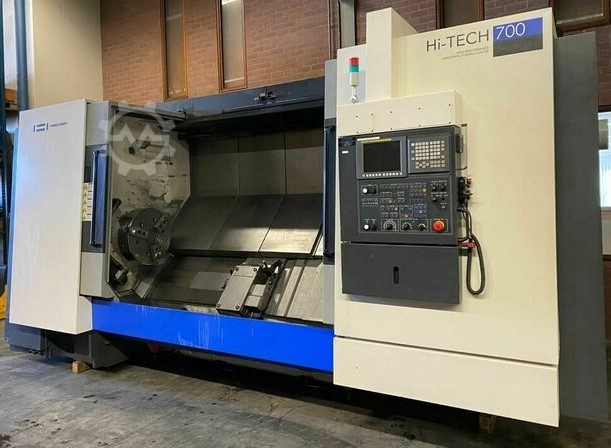
What Do Buyers Look for Before Investing in a Pre-Owned, Used, Secondhand, Surplus CNC Equipment Before Purchase HWACHEON Hi Tec 700 CNC Lathe made in South Korea
When considering a pre-owned / used / surplus CNC lathe like a Hwacheon Hi-Tec / Hi-TECH 700, you should do a very thorough evaluation. A lathe has many subsystems (mechanical, spindle, controls, tooling, support, etc.), and any weakness can become a costly headache. Below is a detailed checklist / set of considerations tailored (with examples) toward the Hi-TECH 700 (or similar heavy horizontal lathes). Use this as a framework when you go inspect or negotiate.
1. Understand the Machine’s Specifications & Your Requirements
Before evaluating condition, you must confirm the machine’s baseline specs and whether they meet your needs. For the Hi-TECH 700, typical specifications (from the manufacturer) include:
- Swing over bed: ~900 mm
- Max cutting diameter: ~680 mm (or up to ~700 mm in some configurations)
- Maximum cutting length (distance between centers): ~1,866 to ~1,986 mm
- Spindle motor: typically 37 / 30 kW (or optionally 45 / 37 kW)
- Chuck sizes, turret stations, guideway type (box guideways), slant-bed design to reduce thermal distortion
So you should have:
- A clear idea of the maximum part diameter, length, material types, tolerances, throughput you intend to run
- A comparison of the used machine’s specs vs your production needs
- Any optional features present on the offered unit (e.g. upgraded spindle, extra turret stations, sub-spindle, C-axis, Y-axis, tool presetter, tailstock enhancements)
If the machine doesn’t meet your core requirements—or would require expensive upgrades to do so—it may not be worthwhile.
2. Mechanical & Structural Integrity
This is foundational: even if the electronics are perfect, mechanical wear or damage severely impacts accuracy and reliability.
Base, Bed & Frame
- Check for cracks, repairs, welds, bending, or distortion on the bed, base, column, castings.
- Inspect the slant bed structure (the Hi-TECH 700 has a 45° slanted unibody bed design to reduce thermal distortion) for alignment and integrity.
- Look for corrosion, rust, pitting, or environmental damage (especially in humid or open shops).
- Ensure that the machine is rigid (no looseness in large cast parts, no audible creaks under load).
Guideways, Slides & Box Guideways
- Since the Hi-TECH uses box guideways on its sliding surfaces (for rigidity and vibration damping) inspect for wear, scoring, pitting, or misalignment.
- Move carriage and cross slide manually (if possible) and feel for binding, stickiness, or abrupt spots.
- Check lubrication / oiling paths, wipers, way covers, seals, and scrapers.
- Verify that leadscrews, ball screws, or feed screws (if used) have minimal backlash or play.
Turret, Tooling & Indexing
- Examine the tool turret: check indexing speed, indexing precision, backlash, mechanical play, and smoothness.
- Confirm all stations hold tools securely without slop.
- For heavy tooling or long tools, verify turret rigidity under load (no deflection).
- Check tool change mechanisms, tool holders, locking systems.
Tailstock & Support Components
- If the unit has a tailstock, check for smooth quill travel, minimal play, correct locking, and alignment with the spindle axis.
- Inspect steady-rest, follow-rest (if present) for integrity and alignment capability.
- For parts with long overhangs, verify that parts remain stable and vibration is controlled.
Spindle Assembly & Bearings
- The spindle is among the most critical elements. Any damage or wear here is costly.
- Run the spindle at different speeds and listen for unusual noise, grinding, or vibration.
- Check for radial and axial run-out (using dial indicators) at the chuck and at the end of the spindle hole.
- Inspect bearing housing, seals, lubrication system (oil-jet cooling if present) for signs of leaks or degradation.
- Ask for spindle service history (bearing replacements, balance, rebuilds).
Drive Motors, Gearboxes & Transmission
- If the lathe uses a built-in gearbox (for torque at low speed), inspect gears, lubrication, and gear shifting mechanism.
- Check motors (servo, spindle, feed) for heating, insulation condition, vibration, noise.
- Inspect belts, pulleys, couplings, and mechanical linkages for wear or misalignment.
3. Control, Electronics & Software
A perfect mechanical lathe is useless if the control or electronics are compromised.
CNC Controller & Interface
- Power up the controller and let the system boot. Verify no persistent alarms or error codes.
- Test panel keys, joystick or manual pulse generator (MPG), displays, readouts, emergency stop, and other operator interface buttons.
- Check continuity of communication channels (USB, network, serial ports) if present.
- Confirm the software version, customizations, parameter backups, and ability to transfer / back up the configuration.
- Ensure the control supports the features you require (e.g. canned cycles, thread cycles, subprograms, look-ahead, optional sub-programs).
- If the controller is an older generation, check whether spare modules or upgrades are still available.
Electrical Cabinet, Wiring & Power Systems
- Inspect inside electrical cabinets: look for burned wires, loose connections, signs of overheating, dust, corrosion, water ingress, rust.
- Verify proper grounding, shielding, cable management, wire routing.
- Verify fan / cooling in control cabinets is functioning (fans, filters).
- Test drives, amplifiers, power supplies, and servo units under load; check current draw, voltage stability, and thermal behavior.
- Test sensors, limit switches, home switches, interlocks, safety circuits for correct behavior.
Sensors & Interlocks
- Test limit and home switches, position sensors, linear scales or encoders (if present) for accuracy, repeatability, and reliability.
- Check door safety switches, guards, cover interlocks, emergency stop circuits.
- For optional advanced sensors (like tool load sensors, vibration monitoring), verify functionality.
4. Operational & Performance Tests
You need to see the machine work, under real conditions if possible.
Test Cuts / Machining Trials
- Bring samples of the material(s) you intend to work (e.g. typical steels, stainless, alloys) to perform sample cuts.
- Check dimensional accuracy, surface finish, tolerances, straightness, roundness, and repeatability across multiple parts.
- Test high-speed, heavy-cut, and fine-cut scenarios. See how the machine behaves under stress (heat, vibration).
- Check cutting stability (chatter, deflection) especially for longer parts or heavy cross-sectional cuts.
- Evaluate cycle times vs spec values; see if you can meet your throughput goals.
Positioning Accuracy & Repeatability
- Use precision gauges/dials or CMM to verify commanded positions vs actual positions.
- Test repeated moves (go to position, retract, return) to check for drift, backlash, hysteresis.
- Check alignment between spindle axis and bed/guide axis by making test cuts or measuring with dial indicators.
Thermal Stability & Consistency
- Run a longer job (e.g. several hours) and watch for dimension drift, thermal expansion, spindle heating, control drift.
- Monitor the cooling system; check coolant temperature, flow, stability.
- See if there is variation in dimensions before/after warm-up, or between morning and afternoon sessions.
Load Testing Under Full Utilization
- Apply maximum or near-maximum recommended loads, see if the machine behaves stably (no motor stall, gear slip, vibration)
- Check torque-limited zones, feeding under heavy load, etc.
5. Maintenance History, Documentation & Parts Support
Even a flawless machine mechanically is a risky buy if you can’t maintain or repair it.
- Require the full maintenance logbook / service records — including bearing changes, major repairs, alignments, gearbox maintenance, etc.
- Ask for past breakdowns / root causes and how they were resolved.
- Confirm whether machine has been modified (non-OEM parts, retrofits) and whether documentation for changes is available.
- Make sure all manuals, schematics, wiring diagrams, parts lists, alignment procedures, software parameter lists come with the machine.
- Confirm that critical components (spindles, bearings, motors, control boards, replacement modules) are still available or have aftermarket equivalents.
- Investigate whether there is technical support (either from Hwacheon, distributor, or third-party service firms) in your region.
- Ask if control software or license can be legally transferred, updated, or backed up.
6. Logistics, Installation & Infrastructure Requirements
These are practical but often overlooked items that can derail the project.
Foundation, Floor & Vibration Control
- The machine is large and heavy; the floor or concrete slab must support its weight and resist vibration.
- Check whether the existing shop floor is suitable or needs reinforcement.
- Plan for leveling, anchoring, vibration damping, and alignment.
Power & Utilities
- Confirm the machine’s electrical requirements (voltage, phases, current, frequency) and ensure compatibility with your plant’s supply.
- Check if you’ll need transformers, new wiring, panels, UPS, or surge protection.
- Verify the cooling / coolant / lubricating systems: water supply, chiller, coolant purity, piping, flow.
- Ensure you have sufficient compressed air, coolant pumps, filtration, and chip / coolant recycling / disposal systems.
Chip Removal, Coolant & Filtration
- The lathe may come with chip conveyors, sumps, coolant filtration, mist collectors, etc. Confirm their condition and usability.
- Inspect coolant for contamination; check condition of tanks, pumps, hoses, filters.
- Make sure chip handling (conveyor, removal) is working reliably.
Rigging, Transport & Reassembly
- Plan how the machine will be disassembled, transported, and reassembled without damage (especially critical alignments).
- Confirm that delicate parts (spindles, way surfaces, sensors) will be protected.
- Ensure that the seller will provide alignment jigs, leveling bolts, shims, assembly instructions, and possibly support during installation.
- Allow for commissioning time (alignment, calibration, test cuts) after installation.
Acceptance Testing / Warranty / Guarantee
- Negotiate a test/acceptance period (e.g. first 30–90 days) during which you can reject or adjust the machine.
- If possible, include a limited warranty on key subsystems (spindle, gearbox, control) or guarantee of performance (accuracy, repeatability).
- Lock in terms in the purchase contract — e.g. if critical parts fail soon, seller must assist or compensate.
7. Financial & Risk Analysis
You should treat this purchase as a project with risk, not just a machine buy.
- Estimate the remaining useful life of key components (spindle bearings, gears, drives) and factor that into your total cost.
- Obtain repair / replacement cost estimates for any issues found (bearing replacement, spindle rebuild, control board faults).
- Compare your total landed cost (machine price + refurbishment + transport + installation + downtime risk) against new or refurbished alternatives.
- Model the return on investment (ROI) considering realistic production volumes, downtime, maintenance, etc.
- Negotiate based on observed deficiencies: the seller should discount for wear, parts needing replacement, calibration, alignment, etc.
- Include in the contract clauses about acceptance, performance guarantees, and liability for undisclosed latent defects.
8. Typical Failure Modes & Red Flags (for Heavy CNC Lathes)
Here are common issues or warning signs to watch out for:
- Excessive wear or scoring on bed / guideways
- Spindle bearing wear, run-out or noise
- Gearbox chatter, gear tooth wear
- Turret slop, indexing errors, mis-indexing
- Poor or inconsistent lubrication / oiling
- Control board / drive unit failures
- Sensor, encoder, limit switch failures
- Thermal drift, alignment drift under heat
- Hidden corrosion, misalignment from previous transport
- Software incompatibility, missing parameter backups
- Parts no longer available (especially for older control or drive electronics)