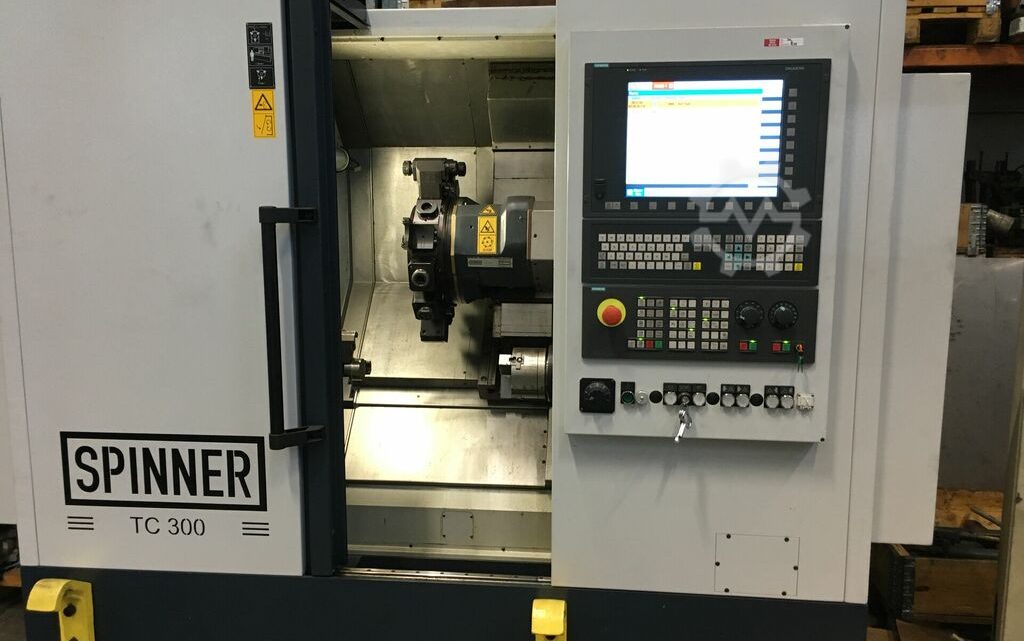
What Do Buyers Look for Before Investing in a Pre-Owned, Used, Secondhand, Surplus CNC Equipment Before Purchase SPINNER TC300-52-SMCY CNC Turning Center made in Germany
If you’re considering buying a used / surplus SPINNER TC300-52-SMCY (or similar SPINNER TC-series) CNC turning center, here is a robust due-diligence checklist and guidance. Because such machines often include multiple spindles, Y-axis, driven tools, etc., there are many potential failure points. Use this as your evaluation framework.
Reference Specs & What to Use as Benchmarks
Before inspection, get the exact variant and options (year, installed extras) so you know what “normal” should be. Here are some benchmark data for a SPINNER TC300-52-SMCY machine:
- Model details from listings: “SPINNER TC300-52 SMCY, sub spindle, Y axis, driven tools”
- Travels / capabilities: X = 180 mm, Z = 450 mm, Y = ±40 mm
- Swing / turning diameter ~ 300 mm (max), turning diameter ~ 250 mm, bar capacity 52 mm
- Spindle data (main): 5,000 rpm, 15 kW, torque ~ 95 Nm
- Sub spindle: up to 7,000 rpm, 6 / 7.8 kW power (100% / 40%)
- Turret: 12 stations, tool type VDI 25, driven tool capability (rotary tooling) with ~ 3 / 4.6 kW motors
- Dimensions & weight: ~ 2,100 × 1,500 × 1,800 mm, ~ 3,700 kg
- Control: Siemens 840D SL “ShopTurn” (in at least one example)
Use these as baseline expectations. If the machine you’re evaluating deviates significantly (in travel, spindle speed, power, control type), ask for proof (drawings, load tests, data logs).
Inspection & Evaluation Checklist
Below is a structured set of what to check, test, and verify. Bring measuring tools (dial indicators, test bars, thermal gun, etc.) and, if possible, a trusted machinist or inspection specialist.
| Subsystem | Checks / Tests | Why It Matters / What to Watch Out For |
|---|---|---|
| Documentation & History | • Obtain original factory build / option sheet, manuals, electrical schematics, parts lists • Service & maintenance logs: spindle rebuilds, turret repairs, tool change repairs • Usage history: hours, types of parts produced, materials, workload cycles • Any modifications (e.g. retrofit of drives, control, spindle changes) • Photos / videos of the machine running | You want certainty about what you’re getting; undocumented modifications or lack of maintenance are big risk factors |
| Structural / Frame Integrity | • Inspect the machine casting, bed, base, column for cracks, weld repairs, distortion • Check alignment of the main axes and straightness of guideways • Examine bolted connections, covers, guard panels for misfit or damage • Check for looseness or shifting in major structural parts | Structural damage or deformation can degrade accuracy, introduce vibration, or require costly repairs |
| Main Spindle & Sub Spindle | • Run spindle (no load) across speed range, listen for unusual noises (rumble, bearings) • Use test bar or precision indicator to measure radial/axial runout • Check for axial play (push/pull), lateral looseness • Inspect seals, lubrication lines, cooling of spindle • Ask whether the spindle(s) have had bearing replacement or rebuild | Spindle health is critical in turning machines. Even moderate spindle wear can degrade surface finish, increase vibration, reduce tool life |
| Axes / Motion Systems (X, Y, Z, etc.) | • Jog axes fully in both directions at multiple speeds; note any binding, stalls, jerkiness • Measure backlash, repeatability, and linear positional accuracy via indicators • Inspect ball screws, nuts, couplings, support bearings for play or wear • Check guideways / slides / ways for scoring, pitting, corrosion, wear • Check lubrication (automatic / manual) and confirm oil / grease reaches sliding elements • Test limit switches, homing routines, reference sensors | Motion quality directly affects your ability to produce accurate, repeatable parts. Worn axes lead to variable dimensions and difficulty in tuning |
| Turret / Tooling / Driven Tools | • Rotate turret (manual / JOG) through all tool stations; listen for indexing errors • Check turret indexing repeatability, backlash, and clamping force • Inspect tool holders, pockets, guide surfaces, sensors for wear or damage • Test live tooling (if present) under light load to check motor, vibration, coupling • Measure tool change times and compare to spec • Confirm compatibility of tool holder style (VDI, BMT, etc.) • Ensure turret drive, sensors, and firing interactions are functioning | The turret is one of the highest-wear subsystems; errors here lead to misalignment, crashes, or poor throughput |
| Control / CNC / Electronics / Wiring | • Power up control and test menus, overrides, soft keys, command axes movement • Review alarm / fault history logs • Inspect control cabinet: wiring harness, connectors, insulation, signs of heat damage • Check servo drives, amplifiers, encoders, signal cables • Confirm software / firmware versions and whether updates / backups exist • Run axis motion and tool change commands under control (without load) • Inspect any modifications or non-OEM wiring patches | Faulty or obsolete electronics are a major risk in used machines — replacement modules are often costly or no longer produced |
| Coolant / Chip Handling / Auxiliary Systems | • Inspect coolant tank, pumps, piping, filters, nozzles for leaks, contamination, corrosion • Run coolant and check flow, pressure, coverage, absence of air ingestion • Test chip conveyor, chip removal / chute • Inspect lubrication system (for slides, turrets, etc.) • Check auxiliary systems (air lines, hydraulic components, etc.) for leaks or faults | Poor coolant / chip management degrades tool life, contributes to contamination, and increases maintenance burden |
| Operational / Test Machining | • Run dry motions (axis moves, turret indexing, tool changes) and watch for anomalies • Perform sample turning operations: simple parts to test surface finish, dimensional accuracy, repeatability • Test under more aggressive cuts to probe spindle stability, vibration, tool deflection • Conduct extended cycle tests to observe drift, thermal effects, consistency • After warm-up, re-run sample parts and compare to cold runs to detect drift or tolerance shift | Real cutting tests are essential — hidden issues often only appear under load or during extended operation |
| Safety & Guards / Compliance | • Ensure guards, enclosures, protective covers, doors, shields are present and functioning • Test emergency stop (E-stop) and ensure axes cease motion promptly • Verify interlocks (doors, covers) are operational and not bypassed • Check grounding, insulation, exposed wiring, and electrical safety • Confirm whether machine meets local safety / regulatory standards (CE, ISO, local) | Proper safety systems are critical; a machine with disabled or missing interlocks is both risky and potentially noncompliant |
| Parts Support, Spare Modules & Obsolescence | • Check whether SPINNER (or distributors) still support spare parts (spindles, turrets, electronics, controllers) • Confirm whether control modules, drives, sensors are still available or there are aftermarket equivalents • Request whether the seller includes spare parts or backup modules • Diagnose whether any nonstandard parts or custom modifications complicate servicing • Ensure control software / licenses are intact and transferable | The best machine is useless if you can’t maintain or repair it when a component fails |
| Transport, Installation & Total Cost | • Assess machine weight, footprint, and whether disassembly is required for transport • Confirm your shop’s crane / rigging capacity, floor strength, and installation clearance • Plan leveling, calibration, alignment, and commissioning work • Ensure your utilities (power, cooling, air, drainage) match the machine’s needs • Budget refurbishment: seals, wear parts, calibration, cleaning, filter replacement • Consider downtime, test cycles, and insurance / packaging for sensitive parts | These “invisible” costs often exceed the price difference between two machines |
| Contract / Warranty / Acceptance Terms | • Insist on a conditional acceptance period (delivery + testing window) • Require seller to disclose known defects, repair history, modifications in writing • Negotiate limited warranties for key subsystems (spindles, control, turret) if possible • Define responsibility for transport damage, installation, calibration • Tie payment release to successful acceptance / performance in your facility | A robust contract protects you from hidden defects or misrepresented condition |
Key “Red Flags” That Warrant Concern or Walk-Away
When inspecting in person, these issues should raise serious concerns (or trigger deep discounting or rejection) if found:
- Spindle with significant noise, axial/radial play, or vibration
- Axis motion with sticky zones, erratic acceleration, or inconsistent response
- Excessive backlash in one or more axes
- Turret mis-indexing, tool change failures, or poor clamping force
- Driven tools not functioning or showing vibration or error under load
- Control electronics with missing modules, burnt boards, or signs of overheating
- Wiring harnesses with splices, insulation damage, or poor repair work
- Safety interlocks disabled or bypassed, missing guards, or manipulated safety systems
- Structural damage: cracks, welds, deformations, misalignment
- Poor coolant / chip handling: clogged filters, leaks, contamination
- Inability to perform test machining or refusal by seller to allow full functional test
- Key parts or modules unobtainable or obsolete
- Machine performance (speed, accuracy) far below claimed spec
- Thermal drift or instability even in short cycles
If multiple “red flags” appear together, the risk of costly rework or early failure escalates sharply.
Strategy & Priorities for Evaluation
- Confirm variant & installed options (e.g. Y-axis, sub-spindle, driven tooling) — some units may be downgraded or missing features.
- Focus first on spindle(s) and axes — if those core systems are compromised, the machine is unlikely to be reliably useful.
- Test turret and driven tools — these are frequent failure points in multi-feature lathes.
- Do real spindle / turning tests — under load and multiple cycles.
- Verify control, electronics & spare parts availability — ensure the machine can be serviced in your region.
- Require contractual protections — test-rights, warranties, disclosure, payment tied to acceptance.
- Include startup & refurbishment cost in your budgeting — plan for calibration, alignment, wear-part replacement, tuning.