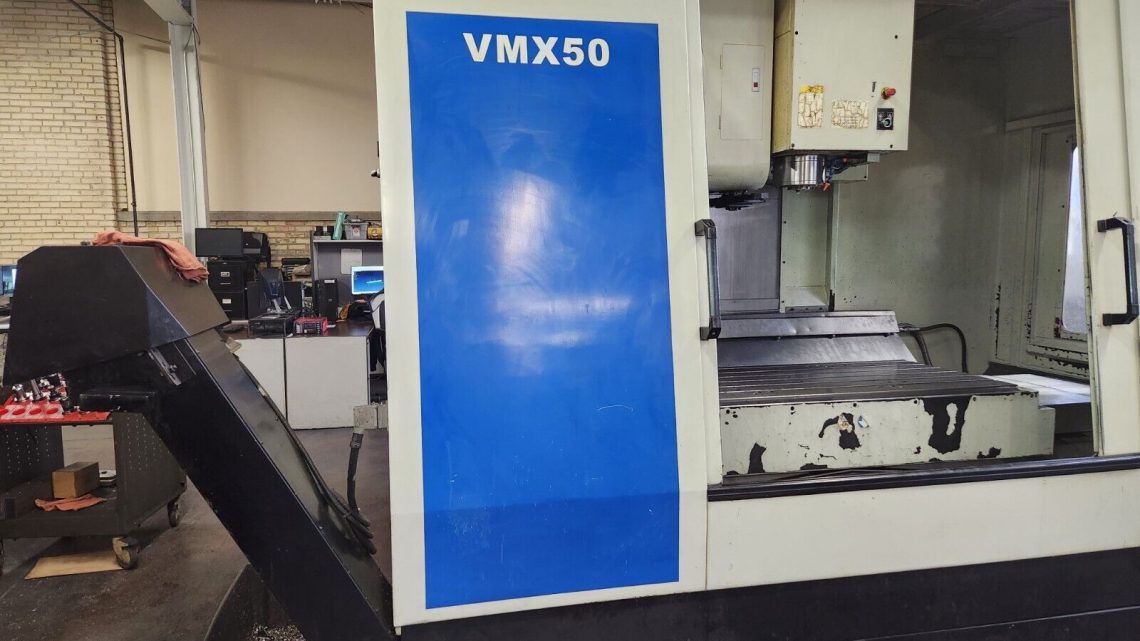
What Do Buyers Look for Before Investing in a Pre-Owned, Used, Secondhand, Surplus CNC Equipment Before Purchase Hurco VMX50 CNC Vertical Machining Center made in Germany
If you’re evaluating a used Hurco VMX50 (or a VMX50 / VMX series vertical machining center) for purchase, here’s a detailed due-diligence checklist—covering what buyers typically look for, what to test, red flags, and recommendations. Because the VMX50 is a relatively large, capable VMC, the scope is broad. I’ll also include reference specs so you have a benchmark.
Reference Specs & What to Use as Benchmarks
Before going onsite, gather the exact configuration (model year, options, control type) so you know what you should expect. Here are some published / used-machine specs of VMX50 machines to guide you:
| Spec | Typical Value / Range |
|---|---|
| X × Y × Z travels | 50″ × 26″ × 24″ (≈ 1270 mm × 660 mm × 610 mm) |
| Table size | 59″ × 26″ (≈ 1500 × 660 mm) |
| Spindle speed | Often up to 10,000 rpm in used listings |
| Spindle motor / taper | Many units use ~ 25 HP spindle motors, CAT/BT 40 taper in many listings |
| Rapid traverse (X/Y) | ~ 1,181 in/min (≈ 30 m/min) for X/Y, Z slower (e.g. 787 in/min) |
| Max table load | Several listings show table load capacity ~ 3,000 lbs (≈ 1,360 kg) |
| Control / CNC | Many machines use Ultimax control or Hurco’s WinMax variants |
Use these as rough “sanity checks.” If the machine you inspect claims wildly different numbers (e.g. 20,000 rpm, or 100% higher travels) without documentation, that’s a red flag.
Buyer’s Inspection & Evaluation Checklist
Here is a systematic list of what to inspect, test, and verify when evaluating a used VMX50 (or similar large VMC).
1. Documentation & History
- Machine build sheet / specification sheet: obtain original factory options and configuration so you can confirm installed features.
- Service / maintenance logs: spindle rebuilds, preventative maintenance, axis repairs, control upgrades.
- Usage profile: materials worked, cycle types, shifts, heavy/difficult jobs, cooldown routines.
- Major repairs / incidents: collisions, spindle crashes, coolant leaks, etc.
- Photos / video of the machine running (especially axis motion, tool changes) to detect oddities before physical visit.
- Software / control backup: ensure CNC parameters, programs, calibration data are backed up and transferable.
If the documentation is missing or incomplete, risk increases significantly.
2. Structural Integrity & Machine Frame
- Inspect the bed, column, base for cracks, welds, distortions, or signs of overloading or repair.
- Check that the machine sits square, level, and that no warping or twist is evident.
- Use precision straightedges or granite surface plate to check flatness and trueness of major guideways or surfaces.
- Check all housing covers, guards, and access doors for damage, signs of abuse, or missing parts.
- Observe for looseness in bolted joints, misaligned covers, or evidence the machine has been moved roughly.
A machine with structural problems is likely to exhibit alignment drift and degrade long-term.
3. Spindle & Bearing Condition
- Run the spindle (no-load) through its rpm range and listen carefully for:
- Rumble, growls, knock noises
- Variation in vibration or irregular hum
- With a test bar or precision indicator, measure axial and radial runout at the spindle nose / taper.
- Check for axial play (gentle push/pull) or lateral looseness.
- Inspect spindle taper and mating surfaces (for wear, nicking, corrosion).
- Check the sealing systems around the spindle and any lubrication / cooling lines.
- Ask for history: has the spindle ever been rebuilt or serviced?
- Under light cutting load (if possible), monitor temperature, stability, and vibration.
Spindle problems are among the most expensive failures in a used vertical machine.
4. Axes (X, Y, Z) & Motion Systems
- Jog each axis through full travel (both directions) at various speeds; note any stiction, jerkiness, binding, dead zones.
- Use a dial indicator or a gauge to check for backlash, repeatability, and return-to-zero accuracy.
- Inspect ball screws, nuts, support bearings, couplings, and check for wear or looseness.
- Inspect linear guides, way surfaces, slideways for scoring, pitting, wear, or corrosion.
- Test the lubrication / automatic lubrication systems (if present) and ensure lubrication reaches the critical surfaces.
- Check limit switches, home reference sensors, and ensure consistent referencing and homing routines.
- For the Z axis, check spindle-to-table clearance, minimum/maximum distances, and smooth vertical movement.
Wear or play in axes shows up directly in part quality, especially for larger travels.
5. Tool Magazine / Tool Change & Tool Holding
- Cycle the tool magazine / carousel / arm through all tools; note hesitation, mis-indexing, or errors.
- Inspect tool holders, gripper arms, sensors, pockets, and ensure firm seating / clamping.
- Measure or time tool-change (chip-to-chip / tool-to-tool) and compare with expected spec.
- Test tool change under different orientations or when axes are in certain positions.
- Check for compatibility with your tooling (BT/CAT taper, length, weight limitations).
- Inspect the magazine rack, slides, rails, and ensure minimal wear or play.
A failing or slow tool changer is a major productivity bottleneck and crash risk.
6. Control, Electronics, Drives & Wiring
- Power up the control; verify interface, screen readability, function of manual jog keys, override controls, menus.
- Check error / alarm logs in the CNC — look for recurring or serious faults.
- Inspect electrical cabinet: wiring harnesses, connectors, buses, insulation, signs of overheating, patch wiring.
- Check drives (servo drives, amplifiers, inverter modules), motor controllers, encoders, feedback wiring.
- Confirm software / firmware version; ensure no critical modules missing or damaged.
- Check that all I/O (inputs/outputs, sensor connections) are intact and functional.
- Run dry-motion commands (axis moves, tool change, homing) and watch for anomalies or errors.
- Inspect cooling / fan / ventilation in the electrical cabinet—overheating or poor cooling is a risk.
Faulty or obsolete electronics can be a showstopper in used equipment.
7. Cooling, Thermal Stability & Environmental Systems
- If the machine has spindle cooling or coolant chiller, inspect it; confirm it operates properly and maintains temperature.
- Look for heat management systems (e.g. cooling of axes or hydraulic circuits) and verify they work.
- Monitor machine thermal behavior: how much the machine drifts in position / alignment after running for some time.
- Inspect coolant system, pumps, nozzles, filters, tank, and check for leaks, contamination, or sludge.
- Ensure chip removal / chip conveyor / coolant filtration systems are functional and effective.
Thermal drift and cooling inadequacies can degrade precision, especially in longer jobs.
8. Operational / Test Machining Trials
- First run dry / no cutting motions: axis moves, tool changes, homing, etc., to find any mechanical anomalies.
- Then perform test cuts / machining on representative materials and geometries to validate:
- Accuracy (dimensional)
- Repeatability over multiple cycles
- Surface finishes
- Behavior under heavier cuts (vibration, chatter)
- Run longer cycle tests to look for drift or cumulative error as the machine warms up.
- After a warm-up period, re-run reference machining tasks and compare results to cold tasks to detect drift or changes.
- Test machining with different tool types, feed rates, and try tool changes mid-sequences.
- Monitor spindle behavior, axis coordination, responsiveness, and error reporting.
Real cutting tests often reveal hidden mechanical, control, or thermal issues that static checks don’t show.
9. Safety & Guards / Compliance
- Verify all doors, access panels, safety guards, interlocks, and shields are present, intact, and functional.
- Test emergency stops from multiple locations; ensure all motion ceases.
- Ensure that all safety switches are not bypassed or disabled.
- Inspect electrical enclosures, wiring insulation, grounding, and ensure no exposed live circuits.
- Confirm that the machine can (or already does) comply with local regulatory / safety standards (CE, ISO, OSHA, etc.).
A machine without proper safety is too risky to use (and may be illegal in your jurisdiction).
10. Spare Parts, Serviceability & Obsolescence Risk
- Check whether Hurco (or its service network) continues to support spare parts (spindles, drives, controls, wear parts).
- Ensure critical control modules, electronics, drives, encoders are still available or have aftermarket equivalents.
- Ask whether the machine includes spare modules, boards, or consumables.
- Check whether previous owners installed nonstandard or modified parts (which might complicate servicing).
- Verify whether the control software / license is transferable and that no “black box” or proprietary modules are lost.
Even a well-behaved machine becomes problematic if you can’t maintain it later.
11. Infrastructure, Installation & Total Cost
- Determine machine weight, footprint, and whether disassembly / special rigging is needed for transport.
- Confirm your shop has adequate crane / hoist capacity, floor strength, and clearance.
- Check whether the foundation leveling, anchoring, vibration isolation are required.
- Ensure your utilities (power, coolant, air, drainage) match the machine’s requirements.
- Budget time/cost for alignment, calibration, leveling, and commissioning after installation.
- Estimate refurbishment: seals, wear parts, calibration, cleaning, filter replacement.
- Consider downtime risk at startup and trial runs.
- Plan for insurance and protection of sensitive components (spindles, wiring) during transit.
Often, the cost to bring a used machine “into production shape” is significant and must be included in your total cost.
12. Contractual Safeguards & Acceptance Criteria
- Negotiate a conditional acceptance period—after delivery you must be allowed to test the machine in your facility before final acceptance.
- Require full disclosure, written condition statements, repair history, and list of known defects.
- If possible, obtain a limited warranty (spindle, control, drives) from the seller.
- Define who is responsible for transport damage, installation, alignment, calibration, and rework.
- Structure payment terms so that part of payment is withheld until successful acceptance testing.
- If possible, include penalty or remedy clauses if performance specifications aren’t met.
A good contract protects you against hidden defects or seller misrepresentations.
Key “Red Flags” & Warning Signs
While inspecting, if you see any of the following, you should demand deep justification or consider walking away:
- Spindle with noticeable play, noise, or vibration
- Axis motion with jerkiness, sticking, or “dead spots”
- Excessive backlash or inability to return precisely
- Tool changer mis-indexing, hesitation, or inconsistent behavior
- Control or electronics with missing modules, burned boards, or signs of heat damage
- Wiring with poor splices, insulation damage, or evidence of modifications
- Safety gates or interlocks bypassed or disabled
- Structural damage, weld repairs, deformation in frame or covers
- Thermal instability or drift during test cuts
- Performance (speed, accuracy) significantly lower than claimed specs
- No ability or refusal by seller to allow test machining under load
- Spare parts unobtainable or expensive
- Machine missing critical units (cooling, chip conveyor, guards) without disclosure
Multiple issues of this kind compound risk heavily.
Priorities & Strategy for Buyers
- Confirm configuration & variant: Make sure the machine is what the seller claims (options, control, spindle, etc.).
- Spindle and axes: These are the heart of the machine — if they are compromised, no amount of cosmetic fix helps.
- Control and electronics: A machine is useless if its brain or drives fail or are unserviceable.
- Test machining: Always insist on real cuts under load to validate performance, stability, and error behavior.
- Parts & support availability: If you can’t get repair parts, downtime may kill the ROI.
- Contractual protections: Don’t accept the machine “as-is” without testing rights, warranties, and clarity on defects.
- Budget for startup cost: Expect to spend on calibration, alignment, replacing wear parts, and break-in adjustments.