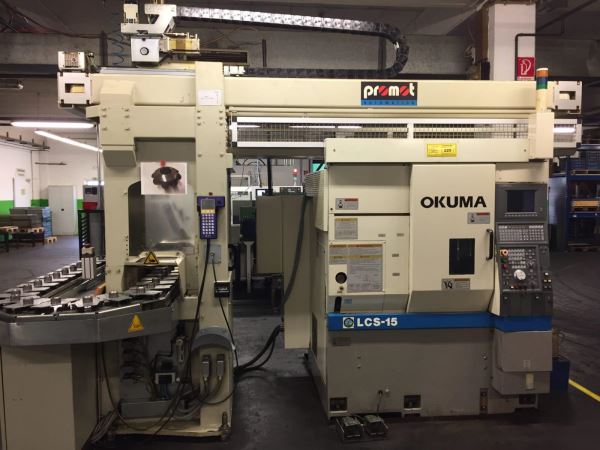
What Do Buyers Look for Before Investing in a Pre-Owned, Used, Secondhand, Surplus CNC Equipment Before Purchase OKUMA LCS-15 CNC Lathe with Automatic Loading Robot made in Japan
Below is a detailed due-diligence / “what to look for” checklist when evaluating a used / surplus OKUMA LCS-15 CNC lathe with automatic loading robot. The presence of the robot loader adds extra complexity and risk, so I’ll call out those points too. Use this as a guide during inspection or in your acceptance tests.
1. Know the Baseline / Benchmark Specs First
Before you go on site, get the exact variant of the machine (model year, options, robot loader make & model, control version). Also collect published specs for OKUMA LCS-15 so that you can check whether what is claimed is realistic. Some reference data:
- In used listings, the OKUMA LCS-15 is shown with turning diameter ~ 270 mm, turning length ~ 280 mm.
- Spindle speed ~ 4,200 rpm is common in several listings.
- Spindle power (drive motor) around 7.5 kW is listed in some ads.
- Typical turret = 12 stations in many LCS-15 ads.
- The lathe often uses the OSP-700L control (or variant) in LCS-15 units.
- Bar loader / automatic loading robots are often included or paired with LCS-15 machines.
These are your “sanity check” values. If the seller claims something wildly different (e.g. turning diameter of 450 mm, or spindle rpm beyond feasible limits), be skeptical and demand proof (drawings, test reports, logs).
2. Key Subsystems to Inspect & Test
Below is a systematic breakdown of what to check — mechanical, control, motion, the robot loader, etc. Bring measuring tools (dial indicators, test bars, thermal gun, etc.) or bring a knowledgeable machinist/inspector if possible.
| Subsystem | What to Check / Test | Why / What to Watch For |
|---|---|---|
| Documentation & Machine History | • Acquire build sheet / serial number / option list (to see exactly what was installed) • Maintenance records, repair logs, spindle rebuilds, turret repairs, robot repairs • Usage profile: running hours, shifts, parts made, load type • Modifications / retrofits (control upgrades, added sensors, robot changes) • Videos / photos of machine in operation (axes motion, robot loading) | Good documentation reduces risk of hidden surprises or unreported damage. |
| Structural Integrity & Frame | • Inspect the bed, headstock, tailstock supports, saddle for cracks, weld repairs, signs of past collisions • Check the alignment of bedways, squareness of axes, flatness of slides • Examine tightness of bolted joints, base integrity, rigidity across the structure • Check for any drift or bending, especially if machine had been moved or transported | Structural deformation or misalignment under load will degrade accuracy and tool life. |
| Spindle / Bearings / Runout & Play | • Run the spindle (no load) through rpm range; listen for bearing noise, unusual vibration • Use test bar or precision indicator to measure radial & axial runout • Test for axial play (gentle push/pull) or lateral looseness • Inspect seals, lubrication lines, spindle cooling (if any) • Ask whether the spindle has been rebuilt or had bearing replacement | The spindle is a critical, high-cost component. Wear or damage here severely impairs performance. |
| Axes & Motion / Ballscrews / Guides | • Jog X and Z axes full travel in both directions, at multiple speeds; feel for stiction, jerkiness, dead zones • Measure backlash, repeatability, positioning accuracy with dial gauges or measuring devices • Inspect ballscrews, nut play, support bearings, couplings • Examine linear guides, ways, slides for wear, scoring, corrosion • Test lubrication / automatic oiling systems • Check limit switches, homing routines, reference sensors • If Y-axis (if any) or C-axis (if variant), check those too | Precision in axes is vital for actual parts. Wear or play causes dimensional error, chatter, and inconsistent quality. |
| Turret / Tooling / Tool Change | • Rotate the turret through all stations; listen for hesitation, misindexing • Check turret indexing accuracy, repeatability, and clamping force • Inspect tool holder pockets, sensors, guide surfaces, springs • Test tool change performance, including in various machine positions (e.g. Z up/down) • Check compatibility of your tooling (holder type, size, length) • Time tool change cycles and compare to spec | A faulty or slow tool changer reduces throughput and may lead to tool misalignment / crashes. |
| Control, Electronics, Drives | • Power up the control (OSP or variant); test display, menu, manual/automatic modes, override controls • Review alarm and error history logs • Inspect electrical cabinet: wiring, connectors, insulation, heat damage, dust • Check servo drives, amplifiers, motor controllers, encoders • Run axis moves / tool changes from control (dry) and look for error / lag • Check for modifications or non-OEM wiring patches | The control and electronics are a common failure or obsolescence risk. Missing boards or unrepairable modules can cripple a machine. |
| Coolant, Chip Handling, Aux Systems | • Inspect coolant tank, pumps, piping, filters, nozzles for leaks, sludge, corrosion • Run coolant and verify good flow, coverage, no cavitation • Test chip conveyor / chip removal systems • Inspect lubrication systems for guides / turret etc. • Check pneumatic/hydraulic lines (for chuck, tailstock, robot) for leaks or damage | Poor coolant or chip handling degrades tool life and can damage machine subsystems. |
| Robot / Automatic Loading System | • Inspect the robot loader (arm, gripper, rails) for wear, play, alignment, backlash • Run the robot through its loading/unloading cycles (simulate workpiece transfer) • Check the robot’s path (collision avoidance, programming) • Inspect wiring, sensors, encoders, safety interlocks on the robot • Confirm compatibility between the robot’s reach and your workpiece size • Check synchronization between robot timing and machine cycles | The loader is an added complexity. If it fails or is misaligned, your automation benefit is lost and integration issues may cause scrap or collisions. |
| Test Machining / Functional Trials | • First run dry / motion-only sequences: axis moves, turret changes, robot cycling • Then do real machining tests with representative parts / materials • Measure dimensional accuracy, repeatability, surface finish • Run extended cycles to observe drift or creeping errors • Re-run parts after warm-up to check thermal drift • Test robot-lathe interaction under load (e.g. pick/place while lathe cycles) | This is the ultimate proof — many subtle defects show only under load or during production cycles. |
| Safety & Guards / Compliance | • Verify all guards, covers, interlocks, safety doors are present and functional • Test emergency stop (E-stop) from different stations • Check whether safety circuits or interlocks are bypassed • Inspect wiring insulation, grounding, exposed parts • Confirm that machine and robot meet local machine / safety regulations (CE, ISO, etc.) | A machine missing safety features is a liability — and may be illegal to operate. |
| Parts Support & Obsolescence | • Check if OKUMA or authorized suppliers can still provide spare parts (spindles, drives, control modules, robot parts) • Verify whether your robot model is still serviceable or supported • Ask if the seller includes spare modules, parts, belts, gripper extras • Inspect whether any custom or nonstandard parts were used (robot modifications, custom adapters) • Check software licensing / backup for control and robot | Even if everything is fine now, a machine becomes useless if you cannot repair it later. |
| Logistics, Installation & Total Cost | • Determine the machine footprint, weight, robot reach, and whether disassembly is needed • Confirm your facility can support rigging / crane / foundation • Plan for leveling, alignment, calibration, and startup • Ensure your power, compressed air, coolant, drainage match machine needs • Budget for refurbishment (wear parts, seals, bearings, calibration) • Account for downtime risk, test cycles, insurance, packaging for delicate parts | The cost to “get it running” may be a large portion of your total investment. |
| Contract, Warranty & Acceptance Terms | • Insist on a conditional acceptance / test period after delivery • Require the seller to disclose all known defects / maintenance / modifications in writing • Seek a limited warranty on key subsystems (spindle, control, robot) if feasible • Define responsibility for transport damage, installation, calibration • Tie final payment to successful acceptance testing in your facility | A robust contract protects you from hidden defects or misrepresentation. |
3. Red Flags & Warning Signs to Watch
If you find any of these during inspection, proceed with caution or consider walking away unless the discount is deep and repair path is clear:
- Spindle with significant noise, play, or vibration
- Axes that stutter, bind, have “dead spots” or inconsistent motion
- High backlash or inability to maintain repeatability
- Turret mis-indexing, tool change failures, or clamping problems
- Robot loader that fails cycles, mis-grips, or collides
- Control electronics with missing modules, signs of overheating, or burnt boards
- Wiring splices, insulation damage, or patchwork wiring
- Safety interlocks bypassed, missing guards, disabled safety features
- Structural damage, cracks, weld repairs, sagging or misaligned bed
- Poor coolant / chip removal systems (clogging, leaks, contamination)
- Test parts out of tolerance or drifting over cycles
- Spare parts not available for robot or control
- Performance vastly below claimed specs
Every red flag increases your repair / risk burden. Multiple red flags often compound into unanticipated costs.
4. Strategy & Priorities for the OKUMA LCS-15 With Robot
- Confirm variant / options first (especially robot model, reach, motion limits) — not all LCS-15s come with the same loader or options.
- Spindle, axes, turret should be top priority — if these core functions are impaired, the machine has limited value.
- Robot loader needs to be fully operational and integrated — if the automation fails, you lose the main advantage of this combo.
- Test machining and cycle integration between robot and lathe is essential to see if synchronization and path timing are smooth.
- Control / electronics & parts support are critical—robot + machine control multiplies the number of components that could fail.
- Contractual protections (test period, warranties, disclosures) are more important when a robot is involved.
- Budget for refurbishment, calibration, integration tuning — combining machine and robot alignment is complex.