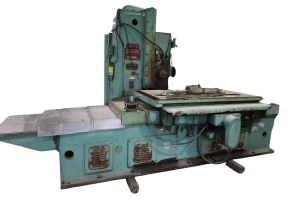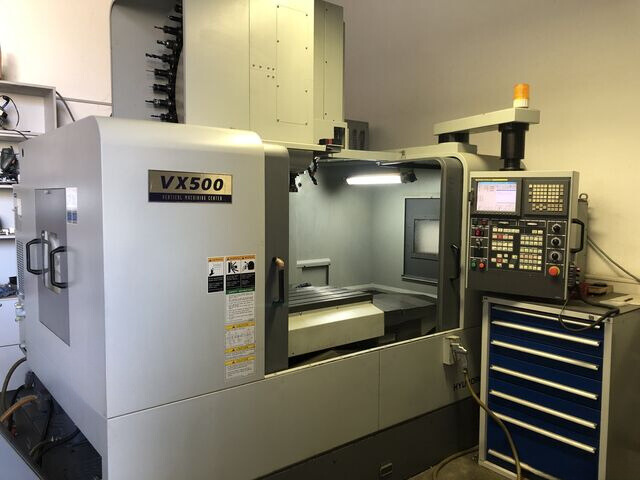
What Do Buyers Look for Before Investing in a Pre-Owned, Used, Secondhand, Surplus CNC Equipment Before Purchase HYUNDAI-KIA VX500 CNC Vertical Machining Center made in South Korea
When evaluating a pre-owned / used / surplus vertical machining center like the HYUNDAI-KIA VX500 (South Korea), it’s crucial to perform thorough due diligence. Compared to simpler machines, VMCs have many interacting subsystems (spindle, axes, tool changer, coolant, control, etc.), so defects in any area can significantly degrade performance or incur high repair costs. Below is a detailed checklist and guidance for what sophisticated buyers examine — a “what to look for” framework you can bring to inspections or negotiations.
Typical Specifications & Context for the VX500
Before diving into checks, it helps to know what the “as built” or typical specifications are (so you can compare what you’re offered vs. what the machine should be capable of). Here are some sample specs found in listings and manuals:
- Table size: ~ 47.2″ × 19.7″ (≈ 1,198 mm × 500 mm)
- Travels: X ~ 41.7″, Y ~ 20.1″, Z ~ 25.0″
- Spindle speed: up to ~ 10,000 rpm (some variants)
- Spindle power: often ~ 15 hp (continuous) in certain listings
- Tool changer: 24-station ATC common in many VX500 machines
- Weight / footprint: in used listings ~ 16,500 lb (≈ 7,500 kg)
- Control types: many units are equipped with Fanuc 0i-MC / 0i-MD or similar CNC controls
- Additional features: many VX500s include spindle chillers, chip conveyors, possibly 4th axis, etc.
Use these as reference points: when the seller gives you specs, check for significant deviations or missing systems.
Comprehensive Inspection / Evaluation Checklist
Below is a detailed set of areas to verify — mechanical, electrical, control, and operational. Use this systematically when evaluating a candidate VX500 (or similar VMC).
| Area | What to Check / Ask | Why It Matters / What to Watch Out For |
|---|---|---|
| Documentation & History | • Request the original manuals, wiring diagrams, maintenance logs, service records, and any refurbishments or upgrades. • Ask for the machine’s uptime, hours, and if it has been heavily used or abused. • Inquire whether parts or components (spindle, control boards, drives) have been replaced. • Ask about modifications or retrofits (e.g. spindle upgrade, control swap). | A machine with a documented history is lower risk. Missing information or unknown modifications increase uncertainty and risk. |
| Structural & Mechanical Condition | • Inspect the machine’s base, column, saddle, and head for cracks, welding repairs, distortions, or signs of collision. • Check way surfaces (on saddle, column, table) for wear, scoring, corrosion, pitting, or damage. • Inspect way wipers, scrapers, seals, and look for signs of lubrication failure. • Check the spindle housing and head casting for any visible damage or signs of effect from vibration or overload. | Structural integrity is foundational for accuracy; excessive wear or deformation can lead to runout, chatter, or misalignment. |
| Spindle & Bearings | • Run the spindle at various speeds and listen for unusual noises (rumbling, whine, knocking). • Use a dial indicator to check spindle runout (axial & radial) with a test bar or known reference. • Check for axial/play in the spindle—push/pull gently to feel for looseness. • Inspect spindle lubrication system and cooling (if applicable); check filters, seals, and oil flow. • Ask if the spindle bearings have ever been replaced or serviced; get documentation if yes. | Spindle bearings are among the most expensive and critical components. Defective bearings reduce machining accuracy, surface finish, and can lead to catastrophic failure under load. |
| Axes (X, Y, Z) & Ball Screws / Guides | • Jog axes through full travel and observe for smoothness, stiction, chatter, binding, or “dead” spots. • Use a dial indicator to check backlash, positioning accuracy, and repeatability. • Check for wear or damage to ball screws, linear guides, and support bearings. • Inspect lubrication to screws and axes; confirm the automatic lubrication (if present) works properly. • Check end stops, limit switches, homing, and encoder signals. | Excessive backlash, wear, or inaccuracy in axes can severely degrade part tolerances and surface quality. |
| Tool Changer / ATC / Tool Magazine | • Cycle the ATC through all its stations and watch for misloads, slow indexing, crashes, or hesitation. • Check the condition of tool pockets, clamping mechanisms, and sensors. • Test tool changes under both no-load and light load conditions. • Inspect the magazine for wear, rack damage, and check for alignment and positional accuracy. • Ensure the tool change time is acceptable and matches expectations. | Malfunctioning ATC or worn tool magazine can cause tool crashes, misfeeds, or unexpected stoppages during production. |
| Coolant / Chip Handling / Auxiliary Systems | • Inspect the coolant tank, pumps, piping, filters, and look for sludge, rust, or contamination. • Run coolant and confirm good pressure, flow, distribution, and no leaks. • Examine chip conveyors, scrapers, guards, and ensure chips move away cleanly. • Test any coolant chiller / spindle cooling systems if fitted. • Check air lines, compressors, and auxiliary systems for leaks, contamination, and reliability. | Poor coolant or chip management can reduce tool life, damage surfaces, or clog subsystems. Auxiliary systems are essential for stable, reliable operation. |
| Electrical / Control / CNC / Drives | • Power up the control and test all axes homing, move commands, display functions, and user interface. • Inspect for error logs or fault history in the CNC. • Examine the control cabinet: wiring harnesses, connectors, fuses, breakers, cable integrity, signs of overheating, dust, or poor maintenance. • Check servo drives, motor controllers, inverters, encoders, limit switches, and their wiring. • Confirm software version/firmware updates, compatibility, and whether spare boards/modules are available. • Check backup / memory retention, and whether installed programs (part programs) can be transferred. | The electronics are often the most vulnerable area in a used machine. Obsolete or damaged controllers and drives can be extremely expensive or impossible to replace. |
| Operational Testing / Machining Trials | • Run the machine “dry” (no material) through full traverses, speed changes, tool changes, and verify smoothness. • Perform test cuts using representative workpieces from your intended production (same material, size, tolerances). • Measure part accuracy, surface finish, repeatability, and consistency across multiple cycles. • Monitor thermal drift over time — see how accuracy changes as the machine warms. • Observe for chatter, vibration, tool deflection under load, or axis lag under cutting forces. • Cycle for several hours to detect creeping issues, oil pressure drops, or control errors. | This is the “real test” — behavior under load is where most hidden defects reveal themselves. |
| Safety & Compliance | • Ensure that all safety guards, interlocks, emergency stop circuits, and shielding are present and functional. • Verify the machine meets local safety regulations (e.g. CE, OSHA, ISO) as applicable. • Check whether any safety circuits were bypassed or modified. • Inspect electrical grounding, cover panels, and ensure the machine’s safety zones are intact. | A machine lacking proper safety systems is a legal and operational risk. |
| Parts Support & Obsolescence Risk | • Confirm spare parts availability: ball screws, spindle bearings, electronic modules, drives, tool changer parts, etc. • Determine whether the control system or electronics are still supported by HYUNDAI-KIA (or their successors) or third-party suppliers. • Ask whether the seller includes spare parts or back-up modules. • Check for custom modifications or nonstandard parts that may complicate future servicing. | Even a technically sound machine is at risk if you can’t repair or maintain it over time. Parts support is critical to long-term viability. |
| Transport / Installation / Infrastructure | • Understand the machine’s weight, dimensions, and rigging requirements. Ensure your facility can handle moving it. • Determine whether foundation or anchoring is required. • Assess whether disassembly & reassembly will be needed and whether proper documentation / technicians will support this. • Plan power, cooling, coolant supply, and air utilities at your site. • Budget time for alignment, leveling, calibration, and break-in after installation. | Many used machines show up damaged during shipping or misaligned after installation; these costs are often underestimated. |
| Contract Terms & Acceptance Conditions | • Negotiate a conditional acceptance clause, giving you a window to test and reject the machine if it fails to meet key performance criteria. • Try to obtain a limited warranty on crucial systems (like spindle, control, drives) if possible. • Define responsibilities (transport damage, installation, calibration, spare parts). • Require the seller to disclose known defects in writing. • Set up a clear remedy or refund process if major defects are found. | Good contractual terms help you mitigate risk and hold the seller accountable. |
Particular Risks / Challenges for VX500 & Similar VMCs
When dealing with the VX500 (or similar mid/large vertical machining centers), some additional considerations often come into play:
- Spindle overhauls: many used VMCs have original spindles pushed heavily. Replacing or refurbishing a high-speed spindle is expensive.
- Control obsolescence: older HYUNDAI/KIA controls or even Fanuc 0i-MC versions may become less supported; firmware, boards, memory units may be scarce.
- Tool changer and magazine wear: magazine racks, indexing systems, sensors wear out over time, and misfeeds or crashes are common in poorly maintained units.
- Thermal drift in tall machines: VX500 has substantial Z-travel; heat expansion particularly in the column or head can lead to drift over long cycles.
- Coolant contamination & bearing damage: poor coolant maintenance often leads to contamination that invades spindle or linear guide systems.
- Custom / undocumented mods: prior owners sometimes retrofit additional features (4th axis, probing, custom wiring) — these can introduce hidden compatibility issues or maintenance burdens.
- Calibration & geometric accuracy: over time, geometric alignment (squareness, perpendicularity, pitch, roll) may drift; precision measurement tools (laser interferometer, ball bars) should be used to verify final accuracy.
Example of Major “Red Flags”
While inspecting a candidate, these are deal-breaker level or high-risk signals:
- Spindle has excessive play or rattling, or shows signs of bearing failure
- Significant noise, vibration, or grinding during spindle rotation
- Axis motion is erratic, sticky, or “dead zones” exist
- ATC fails, misloads, stalls, or shows signs of rack damage
- Control or drive electronics are missing, damaged, or obsolete (with no replacement path)
- Wiring harnesses are cut, poorly re-spliced, or show heat damage/insulation breakdown
- Safety guards or interlocks are removed or bypassed
- No documentation or history, or the seller refuses to allow test machining
- Repair history includes undocumented “jerry-rig” fixes or nonstandard components
- Excessive rust, contamination, or coolant sludge in obscure parts
- The seller refuses your rights to reject based on post-delivery functional testing
Summary & Recommendations
- Use the “as-built” VX500 specs (table size, travels, spindle rpm/power, ATC, control type) as your benchmark.
- Conduct a thorough mechanical, electrical, and operational inspection using the checklist above.
- Always test machine under load with representative workpieces to surface hidden problems.
- Negotiate purchase terms that include conditional acceptance, limited warranty if possible, and protections against undisclosed defects.
- Ensure that you or your technical partners have access to replacement parts and technical support (control boards, drives, spindle components, tool changer parts).
- Prepare for transport, installation, alignment, calibration, and acceptance testing.