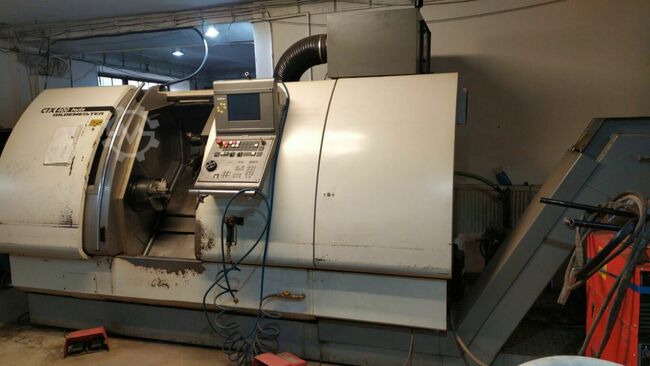
What Do Buyers Look for Before Investing in a Pre-Owned, Used, Secondhand, Surplus CNC Equipment Before Purchase Gildemeister CTX 400 TWIN CNC Turning Center 2 Turrets 2 Spindles made in Germany
When evaluating a pre-owned / used / surplus multi-spindle / twin-turret CNC turning center such as the Gildemeister CTX 400 Twin (2 turrets, 2 spindles), a buyer must be extra diligent, because the complexity (multiple spindles, turrets, driven tools, C-axes, etc.) compounds the risks. Below is a detailed checklist and best practices for what experienced buyers look for — effectively a “due diligence” guide.
Key Specifications & Baseline Reference
Before anything, you should gather the “as built” specs and then verify that what you are being offered matches (or is acceptable) relative to those.
Some typical/reference specs for a Gildemeister CTX 400 / CTX 400 Twin / CTX 400 Serie 2 machines:
| Parameter | Typical Value / Range* |
|---|---|
| Swing over bed / maximum turning diameter | ~ 500–570 mm (over bed) |
| Swing over cross slide / over guideway cover | ~ 420 mm |
| X-axis travel (cross / radial) | ~ 220 mm |
| Z-axis (longitudinal) travel / between centers | ~ 635 mm |
| Turrets / tool positions | 12 positions common, possibly with driven (live) tooling in several stations |
| Spindle speed range | 25 – 5,000 rpm (stepless) |
| Spindle power / drive | ~ 21–22 kW typical drive for main spindle |
| Spindle bore / bar pass | ~ 79 mm (in some machines) |
| Control system | e.g. Heidenhain 4290, Heidenhain iT-Turn, or variants thereof |
- These are reference values. The actual machine you inspect may differ (e.g., swapped control, modified travel, additional axes). Always verify.
Knowing these baseline values helps you detect exaggerations or misrepresentations in the listing.
Detailed Inspection & Evaluation Checklist
Below is a structured checklist (mechanical, hydraulic, electrical, control, operational) specifically tuned to a twin-turret, twin-spindle CNC lathe. Use this when visiting the machine or prior to committing.
| Category | What to Check / Ask / Verify | Why / What to Watch Out For |
|---|---|---|
| Documentation & History | • Acquire all manuals, wiring diagrams, parts lists, maintenance logs, service/repair history, and any refurbishments or upgrades done. • Determine machine age, actual hours (if available), and major overhauls (e.g. spindle rebuilds). • Ask whether control software is original or has been modified. • Confirm the machine’s source (factory, distributor, second-hand dealer). | A machine with good documentation and known service history gives you confidence in what you’re buying. Unknown or undocumented modifications often harbor hidden problems. |
| Structural & Machine Frame Condition | • Check for frame distortion, warpage, cracks, or signs of re-welding. • Inspect bed ways, guideways, cross slides, and turret slides for scoring, pitting, corrosion, or uneven wear. • Make sure all covers, way wipers, seals, and splash guards are present and functional. • Check turret bores and turret indexing surfaces for damage or wear. | Any structural damage or misalignment can severely affect machining accuracy, introduce vibrations, or lead to future failures. |
| Spindles / Bearings | • Run each spindle (main, sub) at various speeds and listen for unusual noises (rumble, chirp). • Check axial and radial play in spindle shafts (with a dial indicator, gently push/pull). • Verify spindle runout (e.g. using test bars or indicators). • Check spindle lubrication systems, cooling (if applicable), and spindle seals. • Confirm whether spindles have been rebuilt or had new bearings fitted; check records. | Spindle bearings are among the most expensive and critical components. Wear here degrades precision, surface finish, and may require costly repairs. |
| Turrets & Tooling / Driven Tools | • Cycle turret(s) through all positions; observe indexing speed, accuracy, backlash, repeatability. • Test live / driven tooling (if present) under mild load; check gears, couplings, torque, vibration. • Inspect turret sensor systems, turret locking mechanisms, and cam / indexing mechanism. • Check whether tool holders are VDI, DIN standard, etc., and whether they match what you use or plan to use. • Inspect for wear, chipping, or damage to tool holders and interface surfaces. | Poor turret mechanics or tool drive issues reduce usable productivity and may require expensive rebuilds. In twin turret machines, synchronization and reliability are especially critical. |
| Motion Axes, Ball Screws & Linear Guides | • Jog each axis (X, Z, Y if present) through full travel; check for smoothness, sticking, backlash, stiction, vibration. • Use a dial indicator to check backlash / play in ball screws or drives. • Check for wear / scoring on linear guides and support surfaces. • Confirm lubrication of ball screws and guide ways; check whether automatic lubrication is functioning. | Worn motion components affect accuracy, repeatability, and may lead to chatter, poor tolerances, or rapid deterioration. |
| Control / CNC / Software / Electronics | • Power up the control and verify all axis homing, motion, command execution, alarms, user interface. • Check for error logs; review any recorded fault history. • Confirm software version, firmware updates, backup, compatibility with your CAM or programming environment. • Inspect electrical cabinets: wiring, connectors, fuses, circuit breakers, cooling inside cabinet, dust / contamination. • Check servo drives, motor controllers, encoders, limit switches, and cable condition. • See whether spare control boards, modules, or parts are available or already supplied. | The control electronics are often a weak point in used machines. Obsolete modules, unsupported software, or damaged wiring can render the machine unusable or expensive to repair. |
| Coolant / Chip Management / Auxiliary Systems | • Inspect coolant tank, pumps, filters, piping, and check for contamination, sludge, or corrosion. • Run coolant and observe flow, pressure, leaks, spray distribution. • Inspect chip conveyor(s), chip scraper surfaces, and whether they work smoothly. • Ensure lubrication systems (ways oil, spindle oil, turret lubrication) are active and working. • Check air lines, hydraulic lines, supply pressure, and air quality (dry, clean). | Poor coolant and chip handling degrades machine efficiency, can damage bearings or guides, and may require extra refurbishment. |
| Electrical / Power Infrastructure | • Check the machine’s electrical supply requirements (voltage, phase, current) and whether your facility can meet them. • Inspect power cables, ground connections, panel subassemblies, and inverter systems. • Check for overheating signs (discolored wires, insulation damage) in cables or control cabinet. • Test emergency stop, safety interlocks, and ensure proper grounding. | Electrical faults or mismatch can lead to unstable operation, damage to components, or safety hazards. |
| Operational Testing / Performance Trials | • Run the machine “dry” (no load) through various sequences: full traverses, tool changes, turret cycles, spindle revs. • Perform test machining of representative parts / materials (your typical workpiece) and inspect dimensional accuracy, surface finish, repeatability, and consistency across cycles. • Check synchronization between spindles / turrets (if the machine is capable of parallel operations). • Observe thermal behavior over time (does accuracy drift as the machine warms up?). • Run the machine over multiple cycles to see if any creeping, pressure loss, or drift issues occur. | Actual machining tests reveal functional issues not visible in static checks. Real-world performance is the ultimate test. |
| Safety & Compliance | • Verify all safety guards, interlocks, and emergency stop circuits are present and effective. • Check whether the machine meets local safety regulations / standards (e.g. CE, OSHA, ISO) in your country. • Inspect whether any safety circuits or wiring have been bypassed or tampered with. • Confirm shielding, splash guards, chip shields, and operator protection systems are intact. | A machine without proper safety systems is a liability and may be illegal or costly to certify locally. |
| Parts Availability / Support / Obsolescence Risk | • Check whether spare parts (bearings, electronics modules, drives, turrets parts, spindle parts) are still manufactured or obtainable (including aftermarket / used suppliers). • Assess whether the control system / electronics are still supported by the OEM or third parties. • Ask whether any custom modifications or nonstandard parts were used that may be difficult to replace. • Ask seller whether spare modules, spare parts, or backups are included. | Even a structurally solid machine is of little use if you can’t maintain or repair it in the future. |
| Transport / Installation / Setup Costs / Infrastructure | • Determine the machine’s footprint, dimensions, and weight for rigging and transport. • Check whether floor foundation or anchoring is needed, and whether your site can accommodate that. • Verify whether disassembly / reassembly procedures are documented or whether third-party riggers will be needed. • Plan for utility hookups (power, coolant, compressed air, etc.). • Allocate budget/time for alignment, leveling, calibration, and break-in. | The cost and risk of transporting, installing, calibrating, and debugging can be large—even more than the machine price sometimes. |
| Contract Terms & Acceptance Conditions | • Negotiate conditional acceptance (i.e. allow a post-delivery inspection / testing period). • Try to secure a limited warranty or guarantee for major systems (spindles, control, turrets). • Clearly define responsibilities for transport damage, installation, spare parts supply, etc. • Require the seller to disclose all known defects or repair history in writing. • Retain the right to rescind/refund if critical performance parameters are not met. | A solid purchase agreement helps you mitigate risk and holds the seller accountable. |
Special Considerations for a Twin / Dual-Turret, Dual Spindle Machine
Because you are dealing with a more complex lathe, the following additional risks and checks should receive special attention:
- Synchronization & Coordination of Spindles / Turrets
- If the machine is intended to run simultaneous operations (both spindles working in tandem, or turrets coordinating), test that synchronization under load.
- Verify that tooling does not collide or conflict when working in parallel.
- Check interlocking logic, safety zoning, and control coordination.
- C-Axis, Y-Axis, Live Tooling, Driven Tools
- In twin turret machines, a typical configuration includes C-axis rotation in tool holders, Y-axis radial motion, and live tooling. Confirm all these axes are functional, accurate, and reliable.
- Under load, test driven tools (milling, drilling) for torque, vibration, backlash.
- Verify the control’s ability to handle complex multi-axis programming.
- Turret Collision History / Damage
- Turrets in twin machines are more likely to have had collisions (if setups were aggressive). Ask about any past crashes or impact damage.
- Inspect turret indexing teeth, locking surfaces, mechanical cam tracks, and the turret mounting interface for signs of impact or wear.
- Thermal Stability & Differential Heating
- With dual spindles and heavier duty cycles, thermal gradients or differences in heating between spindles may cause differential drift. Monitor how the machine behaves as it warms up.
- Check for coolant / spindle cooling systems on both spindles and ensure they function equally well.
- Complexity & Maintenance Burden
- More axes, more spindles, more tool drives = more points of failure. Ensure you are prepared (in budget, parts inventory, technical skill) for higher maintenance demands.
- Evaluate whether the added complexity is justified by your production needs and whether you really need all features.
Major “Red Flags” That Should Make You Pause
- Spindle bearings showing noise, excessive play, or heat without being rebuilt/serviced
- Control system is obsolete, unsupported, or has no spare parts
- Turret(s) that do not index cleanly, or have significant backlash / play
- Motion axes with inconsistent or erratic movements, binding, stall zones
- Safety systems missing, tampered with, or bypassed
- Lack of documentation or maintenance records
- Repairs done by non-qualified operators or undocumented “field fixes”
- Major structural damage or weld repairs not disclosed
- The seller refuses operational tests or live machining trials
- Obsolete or custom modifications that prevent standard parts or future servicing
Summary & Recommendations
- Use the baseline specifications of CTX 400-series machines as your benchmark, and require the seller to verify their machine meets or can meet your requirements.
- Conduct a systematic inspection covering structure, spindles, turrets, axes, control, electronics, coolant / chip systems, safety, and operational testing.
- Pay particular attention to the more complex subsystems (turrets, dual spindles, live tooling) because they are more failure-prone and more expensive to fix.
- Negotiate a purchase contract that gives you rights to test and to reject the machine if it fails to meet promised specifications.
- Budget for logistics, installation, alignment, calibration, and possible repairs/refurbishment after delivery.