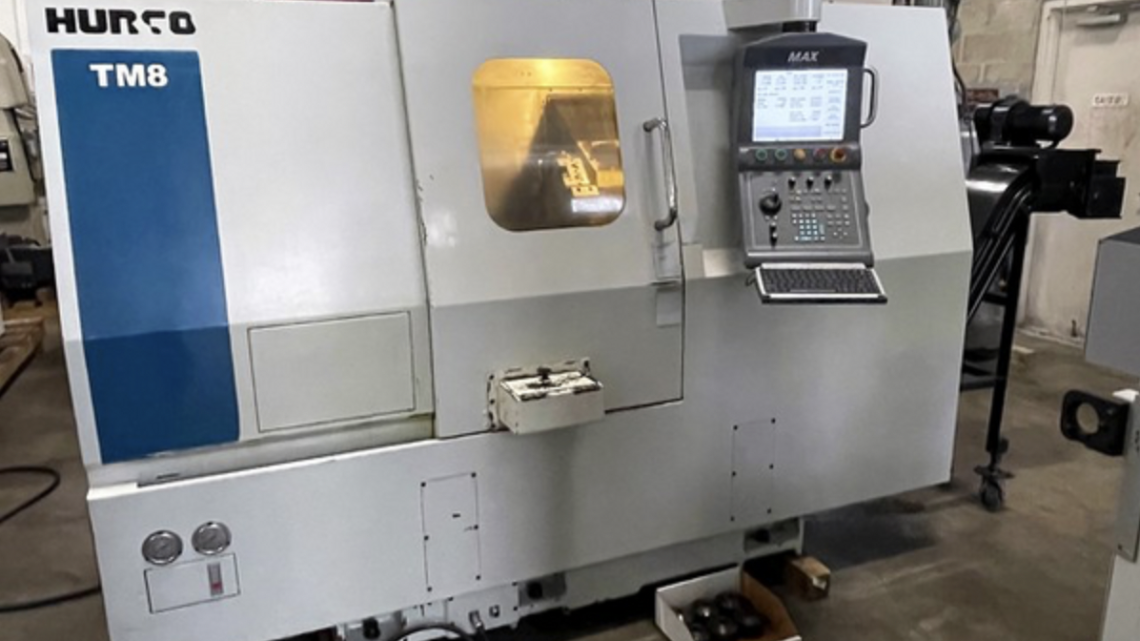
What Do Buyers Look for Before Investing in a Pre-Owned, Used, Secondhand, Surplus CNC Equipment Before Purchase HURCO TM8 CNC Turning Center made in Germany
When evaluating a pre-owned / used / surplus Hurco TM8 (or TM8i / TM8 variant) CNC turning center, a buyer should approach with a comprehensive due-diligence checklist. Many of the same kinds of checks apply as with other CNC machines, but each model / configuration has its own quirks, weak points, and risk zones. Below is a detailed guide — from general CNC inspection principles to items specific to the Hurco TM8 family — covering what to look for, what to test, and red flags to watch out for.
Reference Specs & Typical Capabilities (Hurco TM8 Family)
Before you inspect, you must know what the machine should be capable of, so you can spot exaggerations, omissions, or deficiencies. Here are several reference specifications for the TM8 / TM8i / TM-8 models from used listings and manufacturer datasheets:
| Spec | Typical / Known Value* |
|---|---|
| Swing over bed | ~ 21.6 in (≈ 550 mm) |
| Swing over cross slide | ~ 12.6 in (≈ 320 mm) |
| Max turning diameter | ~ 12 in (≈ 305 mm) |
| Max turning length / between centers | ~ 18.8 in (≈ 478 mm) |
| X / Z travel | X ~ 8 in (≈ 203 mm), Z ~ 20 in (≈ 508 mm) |
| Spindle speed | ~ 4,800 rpm (for many TM8 variants) |
| Spindle motor / power | ~ 15 HP continuous in many listings |
| Bar capacity / spindle bore | ~ 2 in (≈ 51–52 mm) bar / spindle bore ~ 2.4 in (≈ 61 mm) |
| Turret stations / tool capacity | Many listings show 10-station turrets (block or V-type) |
| Control / software | Many machines use Hurco’s WinMax / MAX control (or “Hurco MAX Control”) |
*These are reference values from used machine listings and Hurco’s published “TM8 / TM8i” specs. The actual machine you inspect may deviate due to modifications, rebuilds, or variant options.
Knowing these expected values gives you a baseline — if any claimed spec is far from this without clear justification, that’s a warning sign.
Due Diligence / Inspection Checklist for a Used Hurco TM8
Below is a structured approach you can take on site or via virtual inspection. Divide your evaluation across mechanical, electrical / control, operational, and contractual aspects.
1. Documentation & History
- Request all original manuals, electrical schematics, parts lists, and service/maintenance records (repair logs, rebuilds, replacement parts).
- Ask for the machine’s usage history: hours of operation, types of jobs run, cycle counts, periods of downtime, crash history or collisions.
- Ask whether any major overhauls, rebuilding of spindle or replacement of ball screws or guides has been done, and whether documentation is available.
- Ask whether any retrofits or upgrades were performed (e.g. control upgrade, spindle change, tool changer modification).
- Obtain photos / videos of the machine running under power, ideally showing motion, axis movement, etc.
A machine with transparent history and documentation is far lower risk than one where you must take the seller’s word.
2. Structural & Mechanical Condition
- Examine the machine base, bed, column, headstock, saddle for cracks, weld repairs, distortion, or signs of over-stress.
- Inspect all way surfaces (on bed, saddle, cross slide) for wear, grooves, scoring, rust or pitting. Use a straightedge / gauge / surface plate if possible.
- Check way wipers, seals, guide covers, and ensure no missing or damaged covers.
- Inspect structural castings for fatigue cracks around high-stress zones (e.g. around turret mounting, spindle housing).
- Look for misalignment of panels, bent covers, or signs that the machine has been bumped or handled roughly.
- Observe how rigid the assembly appears, and whether any parts seem to have shifted or loosened over time.
Structural integrity underlies precision and long-term stability.
3. Spindle / Bearings / Running Condition
- Run the spindle through its speed range (including full speed) and listen carefully for unusual noises (rumbling, squeal, knocking).
- Use a test bar or known precision tool to measure radial and axial runout. (Use a dial indicator or known tooling).
- Check for axial play (push / pull gently) or lateral looseness in the spindle.
- Inspect the spindle lubrication / lubrication lines, seals, cooling (if any). Are seals intact, any oil leakage?
- Ask whether spindle bearings have been replaced or serviced; check for documentation of such work.
- Examine the spindle nose taper and contact surfaces for wear, gouging, or damage.
- Consider temperature behavior — does spindle heat excessively during runs?
Spindle condition is one of the most expensive failure modes in used CNC lathes.
4. Axis Motion / Ball Screws / Guides
- Jog the X and Z axes across full travel in both directions, at varying speeds. Note any “sticky” zones, stiction, slow segments, or irregular motion.
- Use a dial indicator to test backlash, positional repeatability, and whether the axes can reliably return to a reference point.
- Inspect ball screws, nuts, support bearings, linear guides for wear, damage, scoring, or play.
- Check lubrication to the ball screws and linear guides. Confirm that any automatic lubrication is functional and that oil / grease is clean.
- Check end stops, limit switches, homing routines, and encoder feedback — confirm consistent referencing.
- Measure straightness / alignment (if you have a precision gauge) to see if there is drift or deviation over travel.
Worn axes or backlash degrade precision and make it harder to meet tight tolerances.
5. Turret / Tooling / Tool Changer (if applicable)
- Cycle the turret through its full set of stations; examine indexing speed, accuracy, and whether any mis-indexing, hesitation or misalignment occurs.
- Inspect tool pockets, tool holders, the interface surfaces, sensors, and clamping elements for wear or damage.
- Test tool change operations (unloaded and under light load) to see if the machine reliably changes tools and holds correct alignment.
- Confirm whether the turret is a “block type,” “V-type,” or other design, and whether tooling is standard (or needs custom holders).
- Check whether any live tooling or driven tools / C-axis (if the model has such) are functional (if applicable).
- Inspect turret locking mechanism, drive, mechanical coupling, turret wedge or indexing clamping.
A faulty or worn turret or tool changer severely impacts cycle time, reliability, and can cause tool crashes.
6. Control System, Electronics & Wiring
- Power up the control console, inspect the user interface: screens, program memory, parameter access, overrides, axis commands.
- Review alarm logs, fault history, and any error codes to understand past operational issues.
- Check the control / electrical cabinet: wiring harnesses, connectors, cables, insulation, signs of overheating, discoloration, or poor splices.
- Inspect servo drives, motor controllers, encoder cables, limit switches, interface connections.
- Confirm software / firmware versions, whether updates are available, and whether backups are present.
- Check backups / data retention, i.e. whether part programs or parameters are stored securely (battery backup, memory retention).
- Run dry axis motion and tool change sequences in the control to validate command execution.
- Look for any non-OEM wiring, modifications, or “hacks” by previous owners that may complicate servicing.
The control electronics are often a weak point in used machines; missing modules or obsolete parts can be expensive or impossible to replace.
7. Coolant / Chip Management / Auxiliary Systems
- Inspect the coolant tank, pump(s), piping, nozzles, filters; check for sludge, corrosion, rust, or contamination.
- Turn on the coolant flow (if possible) and observe distribution, pressure, leaks, or blockages.
- If there is a chip conveyor, chip chute, or chip disposal / catch system, test its operation.
- Check auxiliary systems such as chip blast / air purge, coolant filtration, mist systems, and whether they function.
- Inspect compressed air / pneumatic lines (if used), including air quality, leaks, or contamination.
- Confirm that all pump drives, valves, sensors, and indicators function properly.
Poor coolant / chip handling can damage tool life, degrade machine performance, and accelerate wear.
8. Operational / Machining Trials
- Run the machine through axis movements, tool changes, speed changes (dry) before applying any load. Watch for irregularities in motion.
- Perform test machining using representative workpieces and materials you intend to use (turning, facing, threading, etc.).
- Measure parts for dimensional accuracy, repeatability, surface finish, and consistency over multiple cycles.
- Test longer runs to see if accuracy drifts with thermal effects or fatigue.
- Observe responsiveness, chatter, tool deflection under realistic cutting force loads.
- Re-run test parts after warm-up (meaning let the machine run idle or under light cycles to stabilize temperature) to see if geometry shifts.
Operational tests reveal practical problems that static or idle checks may not.
9. Safety & Compliance
- Check that all safety guards, interlocks, door doors, emergency stop (E-stop) functions, and chip shields are present and functional.
- Confirm whether any safety circuits or interlocks have been bypassed, disabled, or tampered with.
- Inspect electrical grounding, shielding, panels, and ensure the machine is electrically safe (no exposed live wiring).
- Ensure the machine can be certified / is compliant with local regulatory / safety standards (e.g. CE, ISO, OSHA) in your country.
- Check operator access and ensure chip / coolant splash protection is adequate.
Machine safety is a nonnegotiable aspect — missing or compromised safety features are serious liabilities.
10. Parts Support, Obsolescence & Maintainability
- Research whether Hurco (or its service network) still supports the TM8 series — whether spare parts (spindle bearings, drives, modules, tool changer parts) are available.
- Ask whether the seller can (or does) include spare modules, boards, or replacement parts.
- Evaluate whether any custom or nonstandard parts or modifications were made that may complicate future servicing.
- Check whether aftermarket or third-party parts suppliers exist for TM8 components.
- Evaluate whether upgrades or retrofits (e.g. new spindle, upgraded control) are feasible in your region.
Even a technically sound machine can become a burden if you can’t maintain or repair it.
11. Shipping, Installation & Setup Costs
- Determine the machine’s physical dimensions, weight, and required rigging / disassembly for transport.
- Check whether your shop has the capacity (crane, forklift, overhead hoist) to handle the machine.
- Assess whether the installed foundation / floor is adequate (does it require leveling, anchoring, special foundations?).
- Plan for disassembly / reassembly, alignment, leveling, and calibration after installation at your site.
- Ensure your facility’s utilities (power, coolant, compressed air, chip disposal) match the machine’s needs.
- Estimate the costs for refurbishing (fresh lubrication, seal replacement, alignment, tuning) before production use.
Often the logistics and “getting it up & running” costs overshadow the machine’s purchase price.
12. Contractual Terms & Acceptance Conditions
- Negotiate a conditional acceptance clause that allows you a period to test and reject the machine if it fails to meet promised specs.
- Ask for a limited warranty (if seller will provide) on critical systems such as spindle, control, drives.
- Require the seller to disclose all known defects, repairs, or damage in writing.
- Clearly define responsibilities (transport damage, installation, spare parts, calibration) in the contract.
- Consider withholding final payment until the machine passes your acceptance tests.
- Insist on a rights-to-inspect clause upon arrival in your facility, under full load conditions.
Strong contractual protections can shield you from “hidden defect” risk.
Specific Risk Areas / Weak Spots for a Hurco TM8
While many of the above apply generically, here are some particular risk zones or issues to watch for with TM8 family machines:
- The spindle is relatively high speed (4,800 rpm in many models) — bearing wear or spindle damage is a likely failure point.
- Turret/tool changer mechanics (indexing, clamping) often degrade over time, especially in shops with heavy tool changes.
- Control / CNC modules or electronics for older Hurco models (WinMax / MAX, older hardware) may be obsolete or hard to source.
- Wiring or electrical components may have been modified, repaired, or replaced in the field in imperfect ways.
- Thermal stability: repeated cycles may lead to thermal drift, especially with long Z-travel or under heavy cuts.
- Wear in ball screws or guide rails (especially in the Z axis) can manifest as positional error or chatter.
- Coolant contamination or neglect may cause corrosion, deposits, or damage to internal parts.
- Hidden collisions / mishandling: look for signs of past crashes or tool collisions (bent parts, gouges, weld repairs).
- Misrepresentation of specs: sellers may exaggerate travel, spindle speed, tool capacity, or accuracy. Always verify.
- Incomplete parts support: if spare boards, modules, or drives are scarce, a component failure could render the machine unusable for long time.
“Red Flags” That Should Trigger Caution or Walk-Away
During inspection, if you discover any of the following, you should either demand a major discount / repairs, or consider rejecting the purchase:
- Spindle having noticeable play, noise, or signs of bearing failure
- Significant runout, wobble, or inconsistency in spindle performance
- Axis motion that’s erratic, sticky, with dead zones or abrupt changes
- Excessive backlash in axes, inability to hold repeatability
- Turret mis-indexing, tool change failures, or worn turret mechanics
- Control or CNC electronics missing, damaged, obsolete, or irreplaceable
- Wiring harnesses or electronics with cut/spliced wires, insulation damage, evidence of heat damage
- Safety interlocks bypassed or missing, or guard doors not functional
- Poor condition or contamination of coolant system, rusted tanks, clogged lines
- Structural damage, welds, cracks that suggest past collisions
- The seller refuses to allow real machining trials or limits your inspection
- Parts or modules claimed as included but missing or nonfunctional
- Transport / rigging risk is very high or unplanned
- Performance far below expected specs (e.g. tool change time, spindle speed, travel)
Be especially wary of machines where many items in the checklist fail — after all, you inherit not just the machine but its maintenance burden.
Summary & Strategy
- Start with benchmark specs (from credible listings or manufacturer data) so you can spot overclaims.
- Inspect systematically: documentation, mechanical, spindle, axes, turret, control, coolant, safety, support.
- Run real machining tests with your materials if possible — accuracy, consistency, repeatability matter more than static specs.
- Demand clear contractual terms: conditional acceptance, limited warranty, disclosure, right to reject.
- Evaluate spare parts & support: ensure you can maintain, repair or replace modules, bearings, electronics in your location.
- Budget for refurbishment & installation: transport, alignment, calibration, fresh lubrication, possibly repairs after arrival.