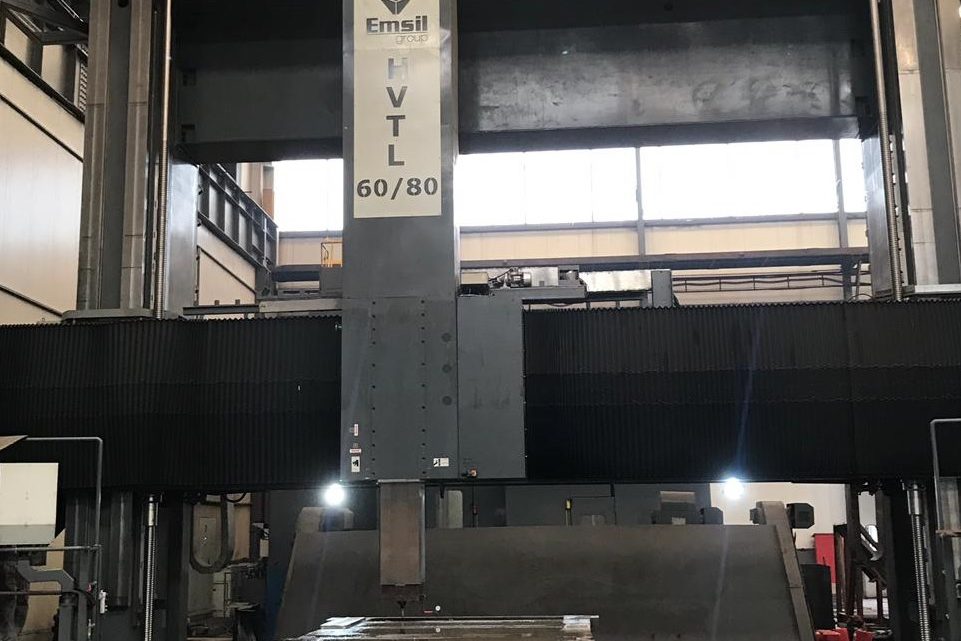
What Do Buyers Look for Before Investing in a Pre-Owned, Used, Secondhand, Surplus CNC Equipment Before Purchase Emsil HVTL 60/80 CNC Vertical Lathe made in Romania
Here’s a tailored checklist and set of considerations for evaluating a pre-owned / surplus Emsil HVTL 60/80 CNC vertical lathe (or similar large VTL machines) before purchasing. Many items are general for CNC lathes, but some are especially critical for large vertical machines.
Understand the machine & its specifications
Before you inspect in person, get as much information as possible about the machine. For the Emsil HVTL 60/80, for example:
- The machine is listed with specs including table (faceplate) diameter 6,000 mm, workpiece max weight ~100,000 kg, continuous table speed 0–50 rpm, FANUC 31i control, Y, Z, W axes travels, torque of ~470,000 Nm at table.
- Confirm exactly which variant the seller owns (year, control revisions, accessory package, ram / cross-rail arrangement, milling capability, etc.).
- Clarify capacity limits (max diameter, max height, max weight) and ensure these meet your requirements.
- Ask about any optional features (e.g. live tooling, milling spindle, C-axis, auxiliary axes, tool changer, tailstock, Y-axis, cross-rail, etc.).
- Request documentation: user manuals, maintenance logs, electrical and hydraulic schematics, control manuals, spare parts lists, and previous repair invoices.
With those in hand, you can plan what to test and what to accept or reject.
Key areas to inspect / test
Below is a structured guide for what to check. Bring along a trusted machinist or service engineer if possible, and bring measurement and diagnostic tools (dial gauges, test bars, vibration sensors, thermal gun, etc.).
1. Visual / external condition
- Examine the structure and frame, including columns, cross-rail supports, bed, base, and welded assemblies. Look for cracks, repairs, distortion, misalignment, or signs of stress.
- Inspect way covers, bellows, guards, enclosures — torn or missing covers allow chips, coolant, and dust to damage internals.
- Check for rust, corrosion, pitting especially on exposed surfaces, guideways, ways, the faceplate, and any sliding surfaces.
- Look for oil, hydraulic, coolant leaks — inspect tanks, piping, seals, hoses, joints.
- Inspect all wiring, connectors, junctions, cable trays — look for frayed wires, loose connectors, signs of overheating or corrosion.
- Examine access panels, doors, hinges, condition of fasteners, whether panels are original or replaced, etc.
These items are your first indicators of how well the machine was maintained.
2. Table / faceplate / bearing / drive
- Evaluate the faceplate / table: check flatness, surface wear, damage, cracks, pits, or dents.
- Check the table bearings or support system (roller bearings, hydrodynamic support, tapered roller bearings, etc.). See if there is play, noise, vibration while rotating.
- Run the table at slow, medium, and max speeds (if possible). Listen for unusual noise, feel for uneven rotation, vibration, “grinding” sensations.
- With the table rotating, check for runout / eccentricity using a dial gauge on a test bar or reference surface.
- If the machine has a C-axis indexing or rotary drive, test the indexing accuracy, backlash, repeatability.
- Inspect the drive system (motors, torque drives, gearboxes, couplings). Check lubrication, noise, heat, alignment, and any unusual noises or vibration.
Given the heavy loads vertical lathes handle, the condition of the table drive and bearings is critical.
3. Ram / cross-rail / axes (X, Z, Y, W) / slides / guideways
- Jog each axis through full traverse: the ram / cross-rail (elevation, W axis, etc.) should move smoothly, without stiction, binding, or jumps.
- Use a dial gauge or test indicator to check straightness, alignment, and any deviation or bending across moves.
- Check for backlash / lost motion / hysteresis on every axis (especially the ram axes).
- Inspect guideways (box ways, linear guides, roller ways) for wear, scoring, pitting, and repair marks.
- Inspect ball screws, nuts, leadscrews (if applicable) for wear, noise, binding, and presence of metal debris.
- Examine lubrication / recirculating oil systems (if present) — test whether lubrication is functioning (flow, pressure, check oil lines, filters).
- Check adjustability: whether shims, alignment features, or wear compensation remain.
Given the heavy moving mass in vertical lathes, even small wear or misalignment can lead to large errors in machining.
4. Spindle / milling attachments (if applicable)
If the machine includes a milling spindle (ram head, vertical spindle) or live tooling:
- Test the spindle (or milling head) at multiple speeds. Listen for noise, vibration, heat generation.
- Check for runout / wobble on the spindle nose / toolholder interface.
- Inspect the taper or tool interface (HSK, BT, etc.) for wear, scoring, or damage.
- If there is tool change (ATC), test the tool change cycles, grippers, magazine, indexing, alignment, and consistency.
- Inspect the motor, drive, cooling / lubrication of the spindle head.
If the milling spindle is compromised, it may render many additional machining capabilities unusable or expensive to repair.
5. Control, electronics, drives, and software
- Power up the control, observe startup behavior, any errors, alarms, warnings.
- Test all control panels, buttons, displays, switches, emergency stop (E-stop) circuits, interlocks, limit switches, etc.
- Access the control menus; examine parameter settings, axis configuration, offsets, error logs, backup memory, program storage.
- Test motion commands: jog, incremental move, homing, reference moves for each axis.
- Upload/download a test program or block of G-code; test DNC / file transfer, USB/Ethernet/serial connectivity (depending on control).
- Run a simple test program (e.g. a rectangle, pocket, or contour) and monitor actual movement versus expected.
- Under that test, watch for dropouts, stalling, axis lag, and how smoothly the axes coordinate under load.
- Monitor temperature / thermal drift if the machine runs for a period.
- Inspect servo amplifiers / motor drives, power supply units, cooling ventilation, fans, capacitors, wiring.
- Confirm you have control software versions, manuals, backups, and replacement media (floppy, CD, USB) if needed.
- Get the electrical and wiring diagrams, control schematics, ladder diagrams. Missing documentation is a serious negative in used machine purchases (forums emphasize this heavily).
6. Test under load / production trial
- Perform a live cut with material (steel, aluminum, or material you would normally use). Produce a test part.
- Measure geometric tolerances: roundness, diameters, flatness, parallelism, concentricity, surface finish.
- Evaluate whether the part is within acceptable tolerances over several cycles (i.e. check repeatability).
- Monitor for vibration, chatter, drift, deformation or thermal expansion during the cut, especially over extended run (e.g. 30–60 minutes).
- Test the machine under heavier cuts or feed / depth-of-cut conditions.
- Verify cycle times, feeds, and whether the machine responds correctly to commanded feed / rpm changes.
This is your real proof of performance.
7. Documentation, service history, and parts / spares
- Ask for the maintenance records / logs: when lubrications, repairs, overhauls, or part replacements occurred.
- Request repair invoices and component replacement history (spindle rebuilds, ram regrinding, motor replacements, etc.).
- Confirm hours of operation, distinguishing between “power-on hours” and cutting hours (the latter are more indicative of wear).
- Ensure that original documentation (manuals, schematics, spare parts catalogues) is included.
- Ensure that you have or can get spare parts, especially for critical components (bearings, spindles, control boards, servo amps, tool changers).
- Check whether the manufacturer or third parties still support the model (especially the control system, spares, upgrades).
- Investigate whether any modifications or retrofits have been made (and whether they were done well).
- Confirm machine identification info: serial number, year of manufacture, version, and whether the machine was relocated (which may affect alignment).
A machine well documented and with accessible spare parts is vastly safer to invest in.
8. Contract, warranty, acceptance, transport & installation
- Negotiate an acceptance / trial period after delivery during which the machine must meet agreed performance criteria, else you can refuse or adjust payment.
- If possible, get a limited warranty or guarantee from the seller (especially for key components) for a short period.
- Ensure the sales contract or invoice includes a full description of condition, known defects, included accessories, and as-is terms.
- Plan and budget for transportation, rigging, disassembly / reassembly, leveling, foundation, power hookups, coolant, chip handling, etc.
- Inspect logistics: can your shop accommodate the machine size, weight, crane capacity, power supply, and foundation requirements?
- Ensure that the machine will be aligned and leveled properly during installation, and that you have skilled technicians for commissioning.
- Account for import duties, taxes, insurance, handling costs, and budget a margin for unexpected repairs or adjustments after installation.
Specific red flags / deal-breakers (especially for big VTLs)
When evaluating a large vertical lathe like the HVTL 60/80, some issues are near fatal:
- Table bearing / drive damage or excessive play — replacing or rebuilding these is extremely expensive.
- Severe wear or non-repairable damage in guideways, large structural elements, or frame cracks.
- Missing or dead control, or obsolete / unsupported control hardware or software.
- Absence of electrical/ wiring / hydraulic schematics — as many experienced buyers say, without those, repairs become much riskier.
- Spindle or milling head damage — especially if the machining attachments are damaged or unusable.
- Major component replacements or overhauls done poorly and undocumented.
- Obsolete parts or no source for replacement drives, amplifiers, bearings, boards — in large machines, replacement parts may be custom, expensive, or no longer made.
- No opportunity to do a live test under realistic load — if the seller refuses a full test, that’s a serious red flag.
- Evidence of heavy abuse, collisions, or neglect — e.g. chips inside covers, poor lubrication, signs of stress or deformation.
- Inability to transport, install, or commission properly — even a machine in good condition is useless if you can’t install it.
Tailoring the checklist to Emsil HVTL 60/80 & large machines
Because the HVTL 60/80 is enormous and heavy, in addition to all of the above:
- Pay special attention to the table and bearing system given the extreme loads (100,000 kg). If its bearing or drive is compromised, repair will be prohibitively expensive.
- Because travel axes (Y, Z, W) are very large, even small misalignment or mechanical issues can magnify into big errors.
- Structural integrity is paramount — long spans, heavy cross-rails, high loads — any warping, cracks, or repairs should be closely inspected.
- Thermal behavior under extended operation matters more in large machines: check for thermal drift, expansion, and stability over long jobs.
- The control (FANUC 31i or equivalent) must be fully functional, with all modules, I/O systems, and spares.
- Cable runs, hydraulics, lubrication systems are large scale — leaks or failures in these systems are more expensive to fix.