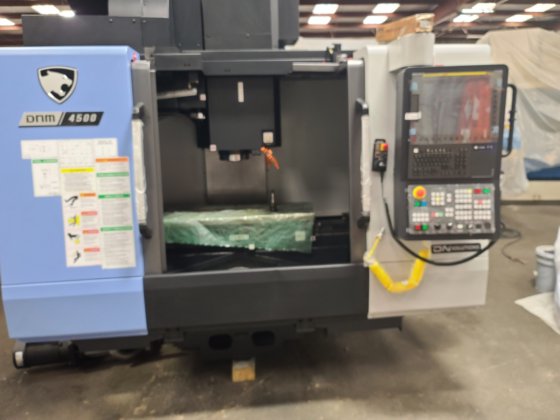
What Do Buyers Look for Before Investing in a Pre-Owned, Used, Secondhand, Surplus CNC Equipment Before Purchase DN SOLUTIONS (DOOSAN) DNM 4500 CNC Vertical Machining Center made in South Korea
When considering buying a pre-owned / surplus CNC vertical machining center like the DN SOLUTIONS / DOOSAN DNM 4500 (made in South Korea), you want a systematic inspection and evaluation approach. Below is a detailed checklist, plus special notes for this particular model, to help you avoid hidden problems and make a sound investment.
Why extra care is needed
- Modern CNCs have many precise and costly components (spindles, linear guides, drives, controls).
- Wear and poor maintenance often manifest internally, not visibly.
- A failure of a critical component (spindle, drive, control board) can cost as much as a significant fraction of the purchase.
- For a model like DNM 4500, which is relatively “modern,” control obsolescence is less of a risk — but component life, support, and condition still matter.
Typical specifications & “fit check” for DNM 4500
Before you even inspect the machine physically, match its specs against your production requirements. Based on multiple used machine listings and the manufacturer’s literature:
| Parameter | Typical Value / Range | What to Verify |
|---|---|---|
| Travels (X / Y / Z) | ~ 800 mm × 450 mm × 510 mm | Confirm actual travel limits (usable travel), any blockages or reduced strokes |
| Table size & load | ~ 1,000 × 450 mm, load ~ 600 kg | Ensure your parts fit, and that the table’s rigidity is acceptable |
| Spindle & speed | Typical spindle speed options: 8,000 rpm (some units)some listings show up to 12,000 rpm versions. | Confirm which variant the seller has (8,000 vs. 12,000 rpm, torque, taper, live spindle or not) |
| Tool changer / magazine | 30-station ATC is common | Verify tool magazine condition, cycle speeds, gripper wear |
| Control system | Many units use FANUC or Doosan / Fanuc i series control | Confirm control version, modules, I/O, and whether backups / software are available |
| Rapid traverse & feed | Rapid moves: ~36 m/min (X & Y), ~30 m/min (Z) (for “4th generation” model) | Confirm actual rapid rates and that drives are capable of those speeds |
| Machine footprint & weight | The machine is heavy (≈ 5,000 kg) | Make sure your shop floor, rigging, crane, foundation, and access suffice |
If any of these “fit checks” fail — e.g. your parts are larger than the table envelope, or your cycle times demand a faster spindle — then this machine may not be suitable or require significant upgrades.
Detailed inspection checklist
Here is a structured on-site / power-on checklist you (or your technician) should follow. Bring measurement tools (e.g. dial gauges, test bars, vibration sensors, IR thermometer).
1. General / Visual inspection
- Frame, castings, welds: look for cracks, repairs, distortions, stress marks.
- Way covers, guards, bellows: check integrity — torn or missing covers are red flags.
- Chip accumulation, cleanliness: heavy chip buildup in covers or under the machine suggests neglect.
- Rust / corrosion: especially on exposed ways, rails, table edges, coolant tray.
- Leaks: coolant, hydraulic, oil — inspect joints, hoses, pumps, seals.
- Access panels, wiring, connectors: look for burn marks, loose wires, missing covers, cable strain.
- Leveling, mounting, base condition: check whether the machine has shifted or been moved roughly.
These are your preliminary “health” indicators.
2. Spindle & tool interface
- Run the spindle at multiple speeds (low, medium, high). Listen for unusual noises: grinding, whine, rumble.
- After running for a while, check for overheating or thermal drift.
- Check for radial and axial play (wobble). Use a test bar or dial gauge.
- Check the spindle taper interface: any scoring, damage, or wear. Use a known good toolholder and check for tightness.
- If the machine supports through-spindle coolant or spindle chiller, test those systems. Some listings show DNM 4500 units with these features.
- If a “Big Plus” or other dual-contact taper version is present, verify proper alignment and condition. (In newer DNM machines, Big Plus is often standard)
Spindle / bearing issues are among the costliest problems in used CNCs.
3. Linear axes, guides, ballscrews, backlash
- Jog each axis (X, Y, Z) across full travel. Feel for stiction, binding, “dead spots,” rough segments.
- Use a dial gauge to measure deviations, straightness, and tramming.
- Measure backlash (lost motion) on each axis in both directions.
- Inspect guideways (linear or roller guides, box ways). Look for wear, scratches, pitting, or repair marks.
- Examine ball screws / leadscrews, nuts, support bearings, and check for metal debris in nuts.
- Check lubrication system: are lines, oil pumps, reservoirs, filters present and functioning?
- Look for adjustability / remaining wear compensation margin.
These determine how precisely the machine can perform.
4. Tool changer / magazine
- Cycle through all tool positions. Check for smooth indexing, correct alignment, no binding.
- Change tools under load, if possible, to see if any misfeeds or jams occur.
- Inspect grippers, retention arms, magazine rails, pocket alignment, sensors.
- Check if the system is well maintained and whether spare grippers or magazines are available.
A failing ATC can dramatically impair productivity.
5. Control, electronics, drives, and software
- Power up the control. Watch boot messages, alarms, error logs.
- Test all operator panel keys, switches, indication lights, screens, and interlocks.
- Enter and review parameter settings, offsets, program storage, memory.
- Test jogging, incremental moves, homing, limit switches, reference moves, axis coupling.
- Run a sample program (simple geometric contour) and monitor axis behavior under real motion.
- Test DNC/file transfer, USB / Ethernet / serial interfaces.
- Under load, watch for dropout, stalling, or lag in axis motion.
- Check electrical cabinets: drives, servo amps, power supplies, capacitor health, wiring neatness, cooling fans.
- Verify that the machine comes with full documentation: electrical schematics, wiring diagrams, ladder logic, control manuals, parameter backups. Missing documentation is a big negative.
Many used CNC buyers warn that lack of control schematics or lost software = serious risk.
6. Performance / test cut
- Perform a real test cut using material representative of what you will machine.
- Inspect the part carefully: dimensional accuracy, repeatability, surface finish, geometry (flatness, circularity, etc.).
- Run the machine continuously for a period (e.g. 30–60 minutes) to see if thermal drift or deviation occurs.
- Try higher load cuts / deeper feeds to see how the machine behaves near its limits.
- Monitor for chatter, vibration, tool wear deviations.
- Check whether feeds, speeds, and path interpolation are followed correctly.
This is your “proof in operation” and is essential.
7. History, documentation, parts availability
- Ask for maintenance logs, repair history, particularly for spindle rebuilds, ball screw replacements, major overhauls.
- Ask for running hours / cutting hours. Cutting hours matter more than power-on hours.
- Request spare parts records: what parts remain, which have been replaced, which are damaged.
- Confirm the availability of replacement parts, especially for drives, control modules, motors, tool changer components.
- Check whether control or drive modules are still supported by Doosan / DN Solutions or third-party suppliers.
- Confirm the presence of and access to operation manuals, service manuals, parts catalogues, wiring diagrams, software backups.
- Ask if any retrofits or modifications were done (e.g. upgraded spindle, changed control, replaced axes), and whether they were professionally performed.
Good documentation and spare parts access often tip a deal from risky to viable.
8. Contract, warranty, acceptance & logistics
- Negotiate an acceptance period / trial run clause after installation, to validate performance under your operations.
- Try to include a limited warranty (for example, on major components) if possible.
- Ensure the contract clearly states the condition, included accessories, known defects, and that the machine is accepted only after test performance.
- Plan for transport, rigging, disassembly, reassembly, leveling, alignment, foundations, power, coolant, chip handling in your facility.
- Verify that your shop has sufficient capacity: floor strength, crane / hoist, clearance, power supply.
- Account for insurance, customs / import, local installation costs, and cushion your budget for unforeseen repairs post-installation.
- Upon delivery, ensure you or a technician perform full alignment, calibration, and acceptance testing.
Specific risks / red flags for DNM 4500
When inspecting a used DNM 4500, watch carefully for:
- Spindle / bearing wear — because many units may run high-volume jobs, spindle wear may already be significant.
- Control / electronics issues — drives, servo modules, or control boards might have been repaired or swapped; missing or incompatible modules are expensive.
- Obsolete parts or control compatibility — although DNM 4500 is relatively modern, older units might use less common modules.
- Axis wear or inability to adjust / re-lap — if the machine has exhausted its compensation margins, accuracy cannot be restored.
- Poor tool changer alignment or damaged grippers — ATC failures reduce uptime significantly.
- Missing documentation or software backups — without these, servicing or reprogramming can be much harder.
- Inadequate cooling, lubrication, or chip removal systems — overheating or chip damage can accelerate wear.
- Structural damage or poor maintenance history — signs of neglect, collisions, burrs, or modifications done badly.
- No opportunity for full load test — if the seller refuses you to run under normal cutting conditions, that’s a serious red flag.
- Transportation or installation constraints — if the machine cannot be installed properly, that risk erodes any cost advantage.