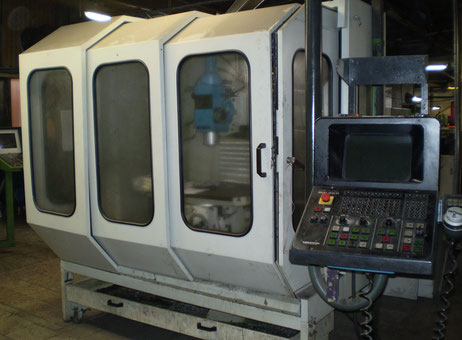
What Do Buyers Look for Before Investing in a Pre-Owned, Used, Secondhand, Surplus CNC Equipment Before Purchase Deckel FP5A CNC Milling Machine made in Germany
When evaluating a pre-owned / surplus DECKEL FP5A CNC milling machine (or any high-precision, older German vertical CNC mill) before purchase, buyers typically carry out a multi-layered due diligence. Below is a detailed, practical checklist and guidance (mechanical, control, accuracy, risk) tailored to the the FP5 / FP5A family (and similar Deckel vertical milling machines) that you can use in field inspections.
I also include known specs (for FP5A / FP5 variants) so you have benchmarks to compare against.
1. Know the Baseline / OEM Specification
Before visiting the machine site, obtain the original or target spec sheet for that particular FP5 / FP5A variant. Use that as your “ideal” for comparison.
From a refurbished FP5A listing, typical published spec values:
| Parameter | Value |
|---|---|
| Spindle speed (range) | 0 – 6,300 rpm |
| Feed rate (continuous) | up to ≈ 3,600 mm/min |
| Rapid feed | ≈ 6,000 mm/min |
| Axis travels (X / Y / Z) | ~ 710 / 600 / 445 mm |
| Table size | 1,000 × 550 mm |
| Max table load | ~ 600 kg (in the refurbished spec) |
| Spindle taper / tool interface | SK 40 (DIN / DIN 2080 or DIN 69872) |
| Folding / swiveling head (optional) | ± 90° head swivel capability in some FP5A models |
You should try to get the exact subtype (FP5A, control version, any retrofit) to know which features / options should exist.
When you inspect, your measured or observed performance (speeds, feeds, load capacity) should be reasonably close to these values (within expected degradation tolerances). Large gaps suggest serious wear, past overuse, or mismatched variant.
2. Visual & Structural Inspection
Before powering the machine, do a thorough external inspection. Many serious problems are visible.
What to look for:
- Frame, base, castings
- Cracks, weld repairs, patched sections, evidence of previous damage or misalignment
- Twist or warp in the base or column (use straight edges or feel warpage by sight)
- Corrosion, pitting, especially in coolant / splash zones
- Signs of repeated impact or handling abuse
- Way covers, bellows, protective covers, guards
- Tears, holes, patching, misalignment
- Do covers open/close freely without binding or interference?
- Inside of covers: presence of chips, embedded debris (could scratch ways)
- Table / fixture area, T-slots, clamping surfaces
- Flatness, distortion, wear or gouging on table surface
- T-slots: wear, rounding, damage, burrs
- Clamping surfaces, welds, modification or “fixes”
- Coolant / lubrication lines, tanks, pumps
- Leaks, stains, corrosion around pipes, hoses, fittings
- Integrity of reservoirs, filters, piping
- Cleanliness of coolant tank, presence of sludge, chips, contamination
- Head / spindle housing area
- Signs of oil leakage, seal failure, worn surfaces
- Condition of the spindle nose region, protective shrouds
- Foundation, leveling, anchoring
- Are leveling screws intact, undamaged, properly shimmed?
- Evidence of machine drift, shifting, poor reinstallation
- If the unit has been relocated, did they re-level it accurately or is there residual stress?
- Control / electrical cabinet external state
- Rust, moisture ingress, dust, dirt on cabinet doors
- Locking / panel integrity, hinges, cable entries
If you see structural damage, poor care, or aggressive modifications, it raises the risk significantly.
3. Mechanical Motion, Kinematics & Wear
With the machine powered and accessible, examine how it moves, how smoothly it behaves, and look for internal degradation.
Key mechanical checks:
- Jog motion & smoothness
- Jog X, Y, Z axes slowly across full travel. Feel for binding, sticky zones, changes in friction
- Reverse direction and see if there is hysteresis (i.e. path differs forward vs reverse)
- Listen for scraping, clicking, or subtle change in tone during motion
- Backlash / lost motion measurement
- Use a dial indicator (or a more precise metrology tool) to check for backlash in each axis
- Move ± direction and see how much play (dead zone) is present
- Compare measured backlash with what a “good” FP5 should have (or acceptable tolerance for your use)
- Straightness, pitch / yaw, cumulative error
- Use a test bar or in-situ measurement to check straightness over full axis travel
- Check squareness between axes (e.g. X vs Y), and right-angle integrity
- In repeated zig-zag passes, check for error accumulation or drift
- Ballscrews, nuts, linear guideways or box ways
- Inspect ballscrew surfaces for pitting, scarring, “fretting,” or wear marks
- Check if ball nuts have play, looseness, or lack of preload
- Inspect linear guides or slides for chipping, wear, spalling, or dents
- Move slides manually (if safe) to feel for irregular or gritty patches
- Spindle health
- Run the spindle (unloaded) at multiple speeds; listen for hum, vibration, bearing noise
- Use a test bar / dial indicator to measure radial and axial runout
- Run for a few minutes and monitor if vibration or noise changes over time
- Check spindle lubrication paths, seals, cooling, and cleanliness
- Swivel / folding head (if present)
- If the machine has a head that tilts or swivels (e.g. ± 90° head), test its motion, locking, backlash, and smoothness
- Check for play in the swivel mechanism
- Tool changer, tool arm, magazine (if equipped)
- Operate the ATC cycle: tool pick, tool change, placement — any misalignment, hesitation, or collision?
- Inspect grippers, rails, arms, rails for wear, binding, looseness
- Check tool seat retention, clamping, and repeatability of tool seating
Mechanical defects like excessive backlash, rough slides, worn nuts or guideways, spindle wear, or head-swivel play are among the costliest to fix and often degrade the machine beyond acceptable tolerances.
4. Control, Electronics, Software & I/O Systems
Even a mechanically perfect used FP5 is useless if the control or electronics are failing or obsolete.
What to inspect / test:
- Control system boot, interface, error logs
- Power on the CNC control, watch boot sequence, inspect for alarms, error messages
- Review fault / alarm history, memory contents, parameter backups
- Test soft limits, homing routines, offset tables, referencing
- Servo drives, amplifiers, motor cables
- Inspect cabling (power, signal, encoder) for wear, fraying, discoloration, damage
- Jog axes while observing amplifier behavior (current draw, temperature, anomalies)
- Monitor for drive faults or alarms during motion
- Sensors, limit switches, interlocks, I/O
- Trigger limit switches, emergency stops, safety doors — verify correct response
- Test tool / probe inputs, coolant sensor signals, door interlocks
- Inspect I/O boards, connectors, wiring harnesses for damage or corrosion
- Power supply, grounding, filtering
- Confirm supply voltage, phase stability, cleanliness
- Check cabinet grounding, shielding, surge protection
- Validate fan cooling, air filters, cabinet ventilation
- Software version / control obsolescence / retrofit history
- Identify what control is installed (e.g. DECKEL Dialog, Heidenhain, Siemens, retrofit)
- Ask whether spare modules, upgrade paths, or support are still available
- Check whether control firmware or licenses are intact and not locked or damaged
- Coolant, lubrication, and auxiliary system controls
- Verify that the coolant system (pumps, flow, pressure) works under command
- Check the automatic lubrication system (axis, ways, spindle) if present
- Inspect sensors and controls for those subsystems
If the control electronics are failing or no longer serviceable, the rest of the machine may be unreachable or require expensive retrofit.
5. Accuracy, Repeatability & Test Cuts
This is where the machine must prove itself under load or in a production-like cycle.
What to do:
- Run a calibration / test part
- Provide or ask for a test workpiece (geometric shape) with features: flatness, hole pattern, positional tolerance
- Measure results (CMM / micrometers / gauge) and compare with acceptable tolerances
- Repeatability / multiple cycle tests
- Run the same part or feature repeatedly to detect drift, variation, or cumulative error
- Vary tool, direction, position — check consistency
- Thermal / warm-up behavior
- Let the machine run (spindle / axes) for 20–30 minutes or more; watch dimensional drift or behavior shifts
- Monitor temperatures of axes, spindle housing, head, base
- Realistic machining cut test
- If safe and permissible, perform a representative cut (milling, pocketing, etc.)
- Monitor for chatter, variation, deviations, vibration, stability under load
If the machine can’t reliably deliver your required tolerances even in test runs, then further use will require expensive repairs or compensation.
6. Documentation, Maintenance History & Modifications
A used FP5A with solid documentation is much less risky.
- Maintenance logs (lubrication, repairs, replacements)
- Repair / overhaul records (bearing changes, mechanical rebuilds)
- Hours or duty cycles (if available)
- Original manuals: mechanical, electrical, control, I/O
- Wiring diagrams, schematics, ladder logic / control schematics
- Software / parameter backups, module IDs, revision history
- Records of retrofits, upgrades, modifications
- Evidence of part replacement (spindle rebuild, guide refurb)
Missing or fragmentary documentation increases risk — unknown modifications or hidden faults may exist.
7. Spare Parts, Support & Obsolescence Risk
Even a well-inspected machine is only as useful as your ability to maintain it going forward.
What to evaluate:
- Parts availability
- Are key components still manufactured or remanufactured (spindle bearings, drive modules, encoders, control boards)?
- Are there third-party / aftermarket suppliers for Deckel FP5 components?
- OEM or third-party service / support
- Does Deckel (or the brand’s successor / authorized dealers) support this model or control version?
- Are there regional service partners familiar with FP5 / Deckel mills?
- Can refurb / retrofit services be engaged if needed?
- Control module / electronics obsolescence
- Ensure that control modules, boards, memory units, power supplies are not end-of-life or extremely rare
- If a control board fails, can it be replaced or is it proprietary
- Upgrade / retrofit potential
- Can the machine be retrofitted (modern CNC, more axes, higher spindle speed, etc.) if needed?
- Are upgrades feasible within your cost constraints?
If parts or support are scarce, the machine may become non-viable despite good mechanical condition.
8. Commercial, Risk & Negotiation Strategy
Once you’ve collected objective data, you must translate it into a business decision.
- Estimate the cost of likely repairs / refurbishment (bearings, guideways, control modules)
- Add a contingency margin (e.g. 10–20 %) for hidden issues
- Negotiate conditional acceptance (final payment contingent on meeting performance criteria)
- If possible, arrange a “shakedown / trial run” period before full commitment
- Add transport, installation, leveling, alignment, commissioning, calibration costs into your total project cost
- Account for downtime, training, ramp-up time
- Consider resale or salvage value of the machine
Also, negotiate with the seller around giving you access to live tests, providing control backups, or warranty on key subsystems.
9. Known or Likely Weak Points / FP5A-Specific Cautions
When evaluating an FP5 / FP5A, here are particular areas you should pay extra attention to:
- Wear in guideways and slides — because FP5 machines are built for precision, any wear in linear ways or slides (especially vertical axes) can degrade performance noticeably.
- Spindle / spindle bearings / runout — given the relatively high spindle speeds (0–6,300 rpm in some refurbished spec) , bearing health is critical.
- Swivel / folding head mechanism — on FP5A’s that have a swiveling / folding head (± 90°), the pivot bearings, locking mechanism, backlash, and repeatability of that axis often degrade over time.
- Tool changer / ATC wear — if the machine has ATC or tool magazine, its mechanical parts are subject to fatigue, misalignment, and wear.
- Control / electronics obsolescence — older controls (Deckel Dialog, Contour, or early Heidenhain / Siemens retrofits) may be difficult to support or have parts that are scarce.
- Cooling, lubrication, chips / contamination — many FP5’s have had decades of use; poor coolant cleanliness, chip ingress into moving parts, or neglected lubrication accelerate wear.
- Past modifications or non-OEM parts — look for signs of nonstandard retrofits or modifications that compromise original geometry or maintenance.
- Alignment drift / frame fatigue — over many years, slight misalignments or fatigue may creep in, especially if the machine has been moved or overworked.