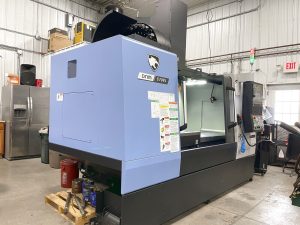
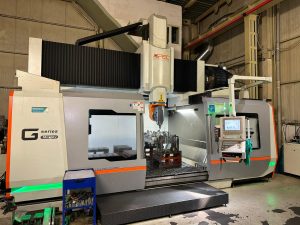
What are MITSUBISHI Brand CNC Control Unit Cards, Drivers ,Parts?
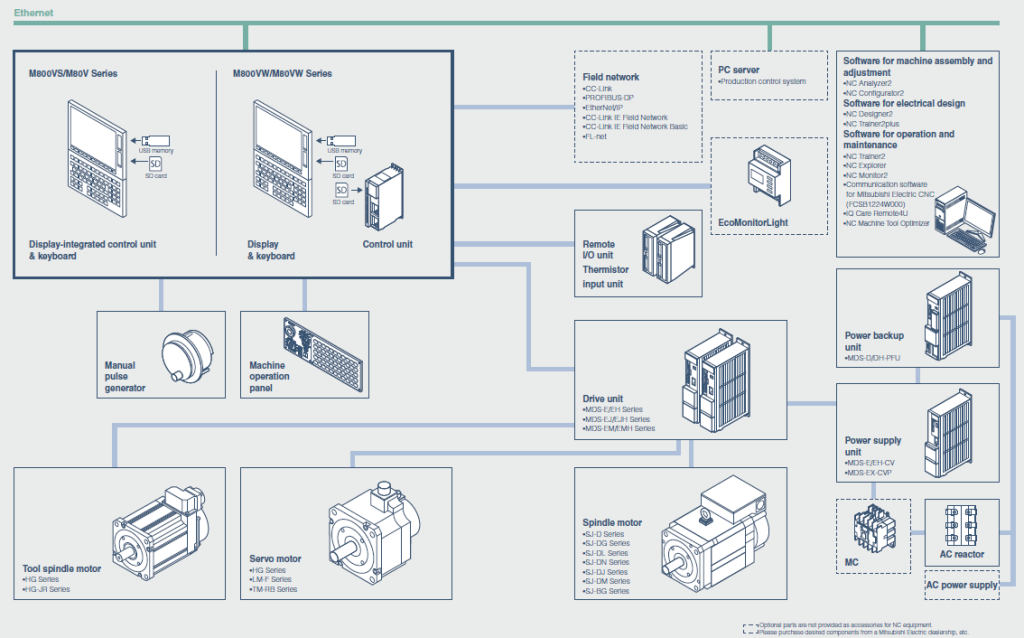
Mitsubishi Electric, a pioneer in factory automation, delivers advanced Computer Numerical Control (CNC) systems tailored for machine tools including lathes, machining centers, grinders, and multi-axis mills. These systems emphasize high-speed processing, energy efficiency, and seamless integration via protocols like SSCNET III/H (high-speed optical fiber bus at 150 Mbps) for noise-immune communication. Key series include the premium M800/M80 (with CNC-dedicated CPU for up to 4x faster interpolation), mid-range C70/E70 for compact applications, and modular C80 for iQ-R platform integration. The control unit (e.g., M800S integrated type) processes G-code/M-code programs, achieving nanometer-level precision through SSS (Super Smooth Surface) 4th-generation control, which optimizes acceleration/deceleration per axis to reduce vibration and improve surface finish (Ra <0.4 μm). The architecture features a modular backplane (e.g., 4-8 slots in M80) for cards (PCBs interfacing via PCIe-like buses), drivers (servo/spindle amplifiers with vector control), and parts (sub-modules for maintenance). Closed-loop operation uses encoder feedback (up to 22-bit resolution) with adaptive PID tuning for following errors <0.5 μm. This enables high-productivity features like AI-based tool path optimization and multi-part system control (up to 96 axes). In the CNC sector, Mitsubishi’s design supports Industry 4.0 via CC-Link IE TSN for real-time Ethernet synchronization, achieving >99.5% uptime in demanding environments like aerospace and automotive.Below, I explain these components technically, highlighting roles, interfaces, and applications.CNC Control Unit CardsControl unit cards are pluggable PCBs in the CNC’s expansion slots (e.g., option card slots in M800/M80, supporting up to 4 cards per unit) for processing, I/O, and connectivity. They run on 24V DC logic with galvanic isolation for EMC compliance (IEC 61000-6-2). The CNC-dedicated CPU (multi-core RISC at 200-400 MHz) orchestrates via internal buses (100-500 Mbps), enabling look-ahead up to 2000 blocks for jerk-limited motion. Key aspects:
- CPU/Processor Cards (e.g., in M800/M80 Series):
Core module with dedicated CNC CPU, featuring 1-2 GB DRAM for NC programs and SSD/SD card interfaces for data logging (up to 32 GB). Executes spline/helical interpolation at 1-2 ms cycles, with SSS-4G for vibration suppression (reduces cycle time by 20-30%). Interfaces: Dual-port RAM for PLC ladder (IEC 61131-3 compliant), Ethernet (Gigabit) for MTConnect, and USB 3.0 for diagnostics. In 5-axis mills, supports Tool Center Point (TCP) control with singularity avoidance, achieving ±0.001 mm accuracy. - I/O Interface Cards (e.g., DI/DO Modules in C70 Series):
Manage up to 2048 points of discrete I/O (24V DC, 5-10 ms response) and analog signals (0-10V, 14-bit resolution) for peripherals like coolant or ATC. Uses CC-Link protocol (10 Mbps serial) for distributed I/O, reducing wiring by 70% with daisy-chain topology. High-speed mode (<1 ms latency) for safety chains (e.g., E-stop). In lathes, integrates with Y-axis turrets; in grinders, handles probe feedback for in-process gauging. - Axis Control Cards (e.g., FSSB/SSCNET Interface in M80):
Handle 4-8 axes per card, outputting position commands via optical fiber (SSCNET III/H, 150 Mbps, <100 μs latency). Integrates absolute encoders (17-22 bit) for backlash compensation. Supports multi-axis sync with electronic gearing (ratio up to 1:1000). For multi-tasking machines, enables 3D contouring with NURBS interpolation at 500 blocks/s. - Display/Operator Panel Cards (e.g., MDI Panels in M800):
Drive 10.4-19″ capacitive touch LCDs (up to 1920×1080 resolution) with GPU for 3D simulation (60 FPS). Customizable UI via “Selective Display” for operator-specific menus. Interfaces: LVDS for video, with gesture support for parameter tuning.
Cards support hot-plug in select models, with LED diagnostics and alarms (e.g., SV0101 for servo mismatch).DriversDrivers (servo amplifiers and spindle units, e.g., MDS-EH Series) amplify control signals to power motors (0.1-110 kW), using PWM at 8-16 kHz for low ripple (<0.5%). DC bus (200-800V) enables regenerative sharing (>90% efficiency). IP20-rated with forced-air cooling, they feature STO (Safe Torque Off) per ISO 13849-1 (SIL3). Technical highlights:
- Servo Drivers (e.g., MDS-E/EH Series):
For linear/rotary axes, with high-gain control (current loop 62.5 μs). Vector mode decouples torque/speed (Iq/Id, <0.3% error), supporting 300% overload for 3s. Input: Pulse train (4 MHz) or analog from axis cards via SSCNET. Output: Adaptive tuning for inertia variation (settling <5 ms). In machining centers, enables high-speed rapids (120 m/min) with dual-feedback (encoder + auxiliary sensor). - Spindle Drivers (e.g., MDS-E-SP Series):
For 5,000-15,000 RPM spindles, with orientation control (<0.05° accuracy via encoder). Supports V/f or sensorless vector modes, with dynamic braking (<30 ms stop). Integrates C-axis for milling on lathes (torque up to 400 Nm). Regenerative units recycle energy, cutting power use by 15-20%.
Drivers include auto-tuning software and fault logging (e.g., overheat via thermistors), with MR-JE configurator for parameter upload.Parts”Parts” include replaceable sub-components for cards/drivers, supporting predictive maintenance via GOT2000 HMI diagnostics. Mitsubishi’s global service network stocks legacy items (e.g., for E-series) with MTBF >50,000 hours. Common examples:
| Category | Examples (Part Numbers) | Technical Role | Application in CNC/Machine Tools |
|---|---|---|---|
| Power Supply Modules | A8B-3200-xxx (PSU) | Stabilizes 24V/5V DC (20-60A); <100 mV ripple, PFC for harmonics (EN61800-3). | Powers M80 units; redundant for unmanned cells in automotive lines. |
| Feedback Interfaces | FCU-xxx Encoder Cards | Handles A/B/Z signals (up to 4 MHz); Hi-resolution absolute (20-bit). | Sub-micron grinding; RS-485 differential for noise immunity. |
| Communication Adapters | SSCNET III/H Modules | Optical transceivers (multi-mode fiber, 150 Mbps); daisy-chain up to 16 drives. | Syncs axes in transfer machines, latency <50 μs. |
| Repairable Sub-Boards | MDS-DM-xx Power PCBs | IGBT drivers (600V/150A); overcurrent protection via current sensors. | Fixes in EH amps; OEM-tested post-reflow. |
| Auxiliary Components | Capacitors/Fuses (e.g., 10A fast-blow) | DC link filtering; surge protection (up to 2 kV). | Prevents faults in high-vibration setups like die/mold machining. |
Parts are refurbished in-house, with testing to original specs.Integration in CNC Control Units and Machine ToolsIn a typical M800 setup (for 5-axis portals), the control unit (panel-mount, IP54, -10-55°C) slots 4-6 cards, linking to drivers via SSCNET (fiber reduces EMI >2 kV/m). CPU processes paths, I/O cards handle signals, and drivers actuate motors with feedback loops for real-time correction. This yields 25% faster machining via SSS-4G, with CC-Link for PLC-CNC sync. Diagnostics (e.g., alarm 700 for I/O fault) enable rapid swaps. For C70 compact lathes, scaled-down versions support 2-4 axes with embedded drivers. Overall, these deliver precision to 0.0001 mm, energy savings (20% via eco-modes), and scalability for sectors like precision optics and EV production. For specifics, refer to Mitsubishi’s manuals or authorized service.