What are HEIDENHAIN Brand CNC Control Unit Cards, Drivers ,Parts?
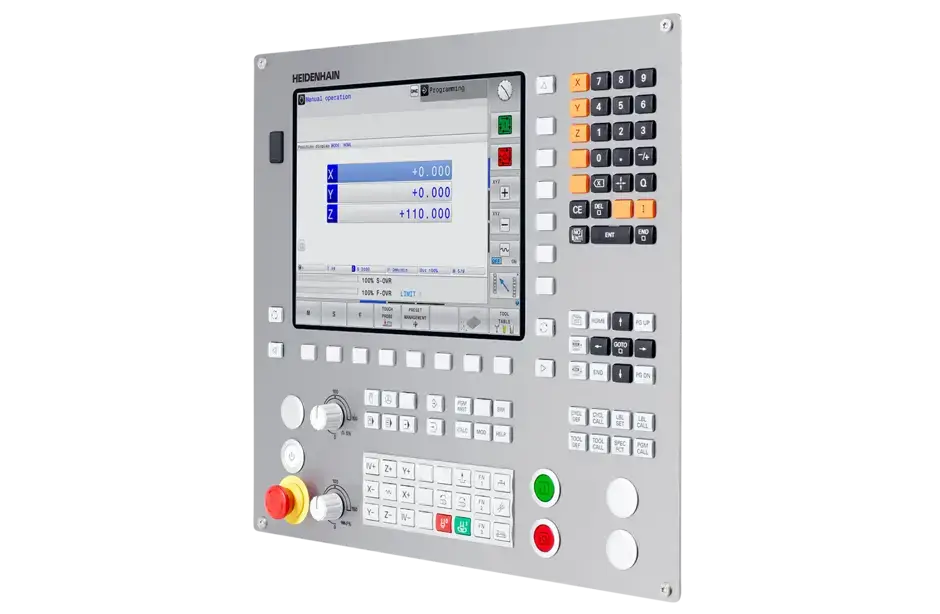
HEIDENHAIN, a DR. JOHANNES HEIDENHAIN GmbH brand renowned for precision metrology, develops advanced Computer Numerical Control (CNC) systems optimized for high-accuracy machine tools such as milling centers, lathes, grinders, and hybrid turning-milling machines. Their controls, including the flagship TNC series (e.g., TNC 640, TNC 7), iTNC, and CLR lathe controls, support up to 23 axes with conversational programming, enabling complex 5/6-axis simultaneous operations. Emphasis is on ultra-precision (down to 0.001 μm via LC encoders), dynamic accuracy through features like Dynamic Precision® (compensating thermal errors and vibrations for <1 μm contour fidelity), and integration with proprietary encoders (EnDat 2.2/3 protocols at 100 Mbps). The architecture is modular yet integrated, with the control unit (e.g., panel-mounted TNC 640, IP54-rated, -10 to +50°C operation) housing expansion cards via proprietary backplanes, interfacing to drivers (Gen 3 modular power units) over high-speed serial buses like HSC (High-Speed Connection) or fiber-optic links for EMI immunity (>1 kV/m). Parts include field-replaceable modules for encoders and interfaces, supporting closed-loop control with absolute/incremental feedback (up to 28-bit resolution) and adaptive algorithms (e.g., jerk-limited jerk for settling times <2 ms). In the CNC sector, HEIDENHAIN excels in medical (implant machining, Ra <0.2 μm), aerospace (turbine blades), and optics, achieving >99.8% uptime via predictive diagnostics and Digital Shop Floor software for real-time monitoring.Below, I explain these components technically, focusing on roles, interfaces, and applications.CNC Control Unit CardsHEIDENHAIN CNC control units feature semi-modular cards (PCBs slotted into the mainframe via DIN connectors or proprietary slots, up to 6-8 slots in TNC 640) for scalability. Powered by 24V DC with isolated I/O (galvanic, 1 kV), they leverage a multi-core processor (e.g., Intel/ARM hybrid at 1-2 GHz) for NC processing at 0.25-1 ms cycles, supporting look-ahead >1000 blocks and NURBS/spline interpolation. Communication uses EnDat Master (serial, 18 Mbps) for feedback and internal EtherCAT-like buses (100 Mbps) for synchronization. Key aspects:
- CPU/Processor Cards (e.g., in TNC 7 Main Computer Module):
Core processing unit with 4-8 GB SSD for NC programs and real-time OS (RTOS) for deterministic execution. Handles 5-axis TCPM (Tool Center Point Management) with singularity avoidance, executing cycles for milling/turning/grinding (e.g., Advanced Dynamic Collision Detection). Interfaces: USB 3.0/Ethernet for DNC/MTConnect, HR (Human Resources) ports for handwheels, and dual-port RAM for PLC (IEC 61131-3). In 5-axis mills, enables PLC-integrated simulation at 120 FPS, reducing setup by 30%. - I/O Interface Cards (e.g., HR I/O Modules or Expansion Cards in TNC 640):
Support up to 1024 DI/DO (24V, <5 ms response) and analog (0-10V, 16-bit) for ATC, coolant, and probes. Uses safe PLC for SIL3 safety (e.g., E-stop chaining <10 ms). High-speed I/O via HSC bus (serial, 10 Mbps) minimizes wiring. In grinding machines, integrates touch probes (e.g., TS 460) for in-cycle measurement with <1 μm repeatability. - Axis Control Cards (e.g., FDM Digital Drive Interface Modules):
Manage 4-8 axes per card, processing position/velocity commands with feedforward compensation (up to 2000 Hz update). Integrates LC/LIF encoders (1 Vpp or EnDat) for absolute positioning (±0.5 arcsec). Supports synchronized axes via virtual master-slave gearing (1:10000 ratio). For hybrid machines, enables turning/grinding cycles with C-axis orientation (<0.01° error). - Display/Operator Panel Cards (e.g., 19″ TFT Modules in iTNC):
Drive multi-touch panels (up to 4K resolution) with GPU for 3D CAD/CAM import and collision simulation. Features gesture-based programming (e.g., drag-and-drop cycles) and AR overlays for setup. Interfaces: LVDS video with haptic feedback for parameter editing.
Cards include self-diagnostics (e.g., LED codes, error 4001 for axis fault) and are field-upgradable via firmware.DriversDrivers (modular Gen 3 digital motor controls, e.g., CLM Axis Modules) are compact power amplifiers for synchronous/linear motors (0.5-125 kW), using vector control with PWM at 10-20 kHz for torque ripple <0.2%. DC bus (300-800V) supports regenerative sharing (95% efficiency) and STO/SBC per EN ISO 13849-1 (PL e). Cooled via forced air (IP20/40), they interface via fiber-optic EnDat for noise-free transmission. Technical highlights:
- Axis/Servo Drivers (e.g., CLM/CLP Series):
For feed axes, with current loops at 62.5 μs and adaptive gain scheduling for inertia changes (settling <3 ms). Input: Digital commands via HSC (100 Mbps fiber), output: 300% overload for 10s. Integrates dual encoders for high-precision (e.g., LIP 588, 5 nm resolution). In milling centers, supports HSC (>40 m/min) with vibration damping, reducing chatter by 40%. - Spindle Drivers (e.g., CLM Spindle Modules):
For 3,000-24,000 RPM spindles (up to 40 kW), with sensorless vector or closed-loop modes (EnDat feedback, <0.05° orientation). Dynamic braking (<20 ms) and torque control (up to 300 Nm). In turning centers, enables live tooling with B/C-axis sync for off-center milling.
Drivers feature auto-commissioning (via TNC oscilloscope) and fault logging (e.g., overtemp via NTC sensors).Parts”Parts” refer to interchangeable sub-components and accessories for cards/drivers, emphasizing encoder integration and repairability (MTBF >80,000 hours). HEIDENHAIN’s service includes OEM replacements and calibration. Common examples:
| Category | Examples (Part Numbers) | Technical Role | Application in CNC/Machine Tools |
|---|---|---|---|
| Power Supply Modules | PSU 22-125 kW Units | Converts 3x400V AC to DC bus (ripple <50 mV); PFC for EN 61000-3-2 compliance. | Powers multi-axis setups in aerospace mills; redundant for 24/7 operation. |
| Feedback/Encoder Interfaces | EnDat 2.2/3 Cards (e.g., ID 1094xxx) | Serial converters for absolute encoders (up to 28-bit, 2 MHz); diagnostic telemetry. | Sub-nm positioning in optics grinders; cable diagnostics for predictive maintenance. |
| Communication Adapters | HSC Fiber Modules | Optical transceivers (multi-mode, 100 Mbps); daisy-chain up to 16 axes. | Syncs drivers in 9-axis borers, latency <50 μs with EMI rejection. |
| Repairable Sub-Boards | CLM Power PCBs | IGBT drivers (1200V/300A); short-circuit protection via shunt sensors. | Refurbishes amps in medical lathes; tested to ±0.1% torque accuracy. |
| Auxiliary Components | Fuses/Capacitors (e.g., 20A DC-rated) | Surge protection (2.5 kV); DC link stabilization for high dynamics. | Guards against spikes in EDM-integrated machines. |
Parts are cataloged globally, with repairs restoring to metrology-grade specs.Integration in CNC Control Units and Machine ToolsIn a TNC 640 setup (for 5-axis medical machining), the control unit integrates 4-6 cards in a compact enclosure, linking to Gen 3 drivers via HSC fiber (reducing cabling 60%). The CPU card orchestrates interpolation, I/O handles peripherals, and drivers close the loop with encoder feedback for real-time corrections (e.g., KinematicsOpt for thermal compensation, <2 min recalibration). This yields 30% faster cycles via Dynamic Efficiency, with StateMonitor for IoT connectivity. For CLR lathe controls (2-4 axes), embedded designs suit compact turning. Overall, components ensure 0.0001 mm precision, thermal stability (±0.5 μm/K), and scalability for sectors like semiconductors and robotics. For model-specific details, consult HEIDENHAIN manuals or service.