What are FANUC Brand CNC Control Unit Cards, Drivers ,Parts?
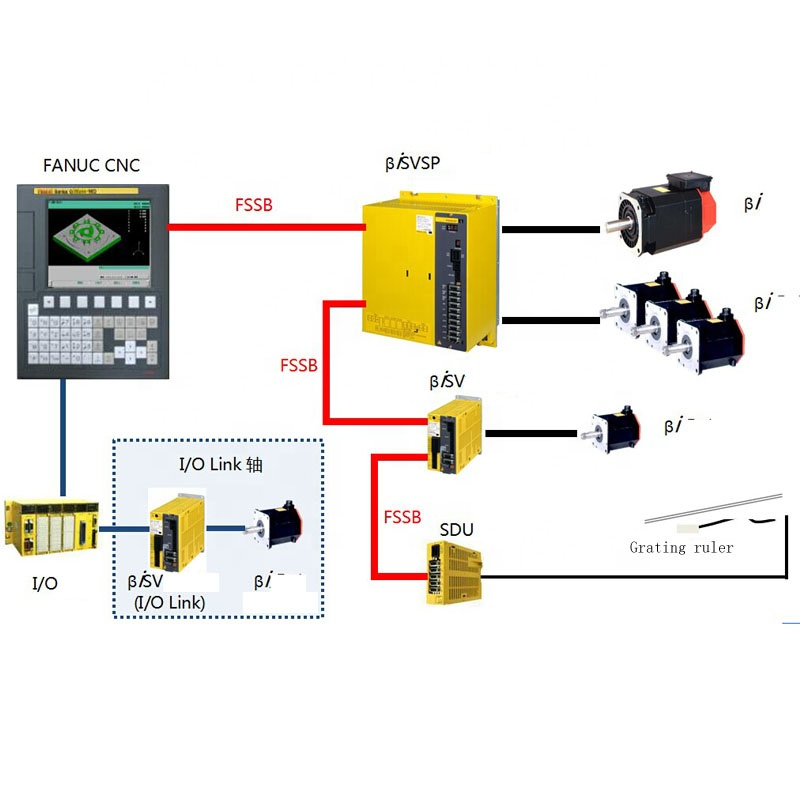
FANUC Corporation, a global leader in factory automation, produces highly reliable Computer Numerical Control (CNC) systems for machine tools such as lathes, milling machines, grinders, and multi-axis machining centers. These systems integrate hardware components like control unit cards, drivers, and modular parts to enable precise, programmable control of machine motion, spindle speed, tool changes, and auxiliary functions. In the CNC control unit and machine tools sector, FANUC’s architecture emphasizes modularity, high-speed processing, and noise-resistant communication protocols (e.g., I/O Link i, FSSB—FANUC Serial Servo Bus). This allows for scalable configurations from compact 2-axis lathes to complex 32-axis systems with nanometer-level interpolation accuracy.The core of a FANUC CNC is the control unit (e.g., Series 0i, 30i, or 31i models), which processes NC (Numerical Control) programs written in G-code and M-code. It comprises a modular backplane where cards (printed circuit boards or PCBs) slot in for specific functions. Drivers (servo amplifiers and power modules) interface between the control unit and machine actuators (motors, spindles). Parts refer to replaceable sub-components like fuses, capacitors, or interface modules that ensure system uptime and maintainability. These elements collectively achieve closed-loop control: position feedback from encoders is compared to commanded paths, with real-time corrections via PID (Proportional-Integral-Derivative) algorithms to minimize following errors (typically <1 μm in high-precision setups).Below, I explain these components technically, focusing on their roles, interfaces, and applications in CNC control units and machine tools.CNC Control Unit CardsControl unit cards are modular PCBs that plug into the CNC’s backplane (e.g., via Eurocard DIN 41494 connectors) to handle processing, interfacing, and expansion. They operate on a 5V/3.3V logic supply with isolated I/O for EMI (Electromagnetic Interference) protection. FANUC’s design uses a master-slave hierarchy, where the CPU card acts as the master, polling slave cards via high-speed buses (e.g., 10-100 Mbps). Key technical aspects:
- CPU/Processor Cards (e.g., A20B-1000 Series):
These are the computational core, featuring multi-core RISC processors (e.g., 32/64-bit ARM-based at 1-2 GHz in modern i-series). They execute NC interpolation algorithms (linear, circular, helical, or spline) at scan rates of 0.5-4 ms, supporting look-ahead up to 1000 blocks for high-speed contouring. Memory includes DRAM (512 MB-8 GB) for part programs and flash for OS/firmware. Interfaces: Dual-port RAM for PMC (Programmable Machine Controller) ladder logic, Ethernet for DNC (Direct Numerical Control), and USB/PCMCIA for data transfer. In machine tools, they enable features like AI Contour Control, compensating for servo delays via adaptive feedforward. - I/O Interface Cards (e.g., A20B-2000 Series or I/O Unit-Model A):
Handle discrete and analog signals for machine peripherals. Digital I/O (up to 1024 points) uses opto-isolated 24V DC inputs/outputs with 1-10 ms response time. Analog channels (e.g., 0-10V for tool wear compensation) support 12-16 bit resolution. Communication via I/O Link i protocol (serial bus at 2 Mbps, cycle time ~2 ms), which reduces wiring (up to 256 signals over twisted-pair cable) and supports high-speed mode for real-time DI/DO (e.g., emergency stop chaining with <1 ms latency). In CNC lathes, these cards integrate with tool turrets or coolant pumps; in milling centers, they manage ATC (Automatic Tool Changer) sequencing. - Axis Control Cards (e.g., A03B-0807-Cxxx Servo Interface):
Manage multi-axis synchronization (up to 8 axes per card). They process position commands from the CPU, outputting pulse trains (up to 4 MHz) to drivers via FSSB (fiber-optic serial bus, 20-100 Mbps, immune to electrical noise >1 kV/m). Feedback integration from resolvers/encoders (incremental or absolute, 1-1024 CPR—Counts Per Revolution) enables velocity/position loops with ±0.001° accuracy. For 5-axis machines, they support RTCP (Real-Time Cutter Path Compensation) to avoid singularities. - Display/Operator Panel Cards (e.g., A20B-2100 Series):
Drive LCD/MDI (Manual Data Input) panels with touch interfaces. Graphics processing for 3D simulation uses dedicated VRAM (up to 128 MB), rendering tool paths at 60 FPS. Touch resolution: 1024×768 pixels, with capacitive sensing for parameter editing.
These cards are hot-swappable in some models, with diagnostics via built-in LEDs and error codes (e.g., PS0080 for servo overtravel).DriversDrivers (servo amplifiers and spindle modules, e.g., A06B-60xx Series) are power electronics that amplify low-level signals from the control unit to drive motors (AC servo, linear, or spindle). They convert DC bus voltage (typically 200-600V from regenerative power supplies) into three-phase PWM (Pulse Width Modulation) outputs at 2-16 kHz carrier frequency, achieving torque ripple <1%. Cooling via forced air or liquid, with IP20/IP65 ratings for harsh shop floors. Technical highlights:
- Servo Drivers (e.g., αi/βi Series):
For axis motors (e.g., 0.5-100 kW). Closed-loop control uses vector modulation for precise current regulation (Iq/Id decoupling, <0.5% torque error). Input: Analog velocity commands (±10V) or digital pulses from axis cards. Output: Up to 300% overload for 5s (e.g., rapid traverses at 100 m/min). Regenerative braking dumps energy back to the DC bus (efficiency >95%), reducing heat. In CNC mills, they enable rigid tapping with phase-locked spindle sync (±0.01 rev error). - Spindle Drivers (e.g., A06B-6114 Series):
Oriented for high-speed spindles (up to 20,000 RPM). Support vector control for constant torque (0-100% speed range) or V/f control for induction motors. Orientation function uses encoder feedback for rigid positioning (<0.1°). Interfaces: Analog speed reference from CNC, with dynamic braking resistors for quick stops (<50 ms). In turning centers, they integrate with C-axis for live tooling, modulating torque up to 500 Nm.
Drivers include self-diagnostics (e.g., overcurrent via Hall-effect sensors) and parameter tuning via CNC software (e.g., auto-tuning for inertia matching, reducing settling time to <10 ms).Parts”Parts” encompass consumable or repairable sub-components within cards and drivers, ensuring long-term reliability (MTBF >100,000 hours). FANUC’s ecosystem supports predictive maintenance via MTConnect or embedded sensors. Common examples:
| Category | Examples (Part Numbers) | Technical Role | Application in CNC/Machine Tools |
|---|---|---|---|
| Power Supply Modules | A16B-1210-xxx (PSM) | Converts AC to stabilized DC (5V/24V, 10-50A); ripple <50 mV. Includes EMI filters (EN55011 Class A). | Powers control unit; fault-tolerant with redundancy for 24/7 operation in automotive machining. |
| Feedback/Encoder Interfaces | A20B-1300-xxx | Processes A/B/Z quadrature signals (up to 2 MHz); absolute Hi-resolution (26-bit). | Ensures sub-micron positioning in grinders; noise rejection via differential RS-422. |
| Communication Adapters | A03B-0808-Cxxx (HSSB/FSSB) | Fiber-optic transceivers (multi-mode, 100 Mbps); protocol for daisy-chaining up to 8 drives. | Links drivers to CNC in multi-spindle transfer lines, minimizing latency (<100 μs). |
| Repairable PCBs/Sub-Boards | A20B-8100-0851 (Motor Driver PCB) | Gate driver circuits for IGBTs (1200V/200A rating); overheat protection via NTC thermistors. | Replaces faulty sections in servo amps; tested for 100% functionality post-repair. |
| Auxiliary Components | Fuses (A06B-6070-xxx), Capacitors | Fast-blow protection (10-50A); electrolytic filtering for DC link stability. | Prevents cascading failures in high-vibration environments like aerospace part production. |
These parts are inventoried globally, with repair services restoring PCBs to OEM specs (e.g., reflow soldering, component-level fixes).Integration in CNC Control Units and Machine ToolsIn a typical FANUC setup (e.g., Series 31i for 5-axis mills), the control unit houses 4-12 cards in a rack-mounted enclosure (IP54, 0-45°C operation). The CPU card broadcasts commands via internal bus to I/O and axis cards, which relay to drivers over FSSB (reducing cable count by 80% vs. parallel wiring). Drivers energize motors, with feedback looped back for error correction. This architecture supports Industry 4.0 features like real-time monitoring (via Ethernet/IP) and energy optimization (e.g., 20% power savings via idle motor shutdown).For troubleshooting, FANUC diagnostics (e.g., alarm 401—servo mismatch) pinpoint issues to specific cards/drivers, enabling quick swaps. Overall, these components deliver >99.9% uptime, precision to 0.001 mm, and scalability for sectors like automotive (high-volume) and medical (ultra-precision). For model-specific details, consult FANUC’s parameter manuals or contact authorized service.