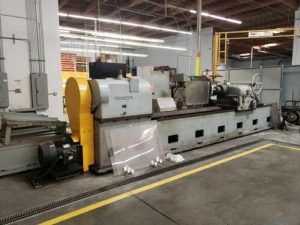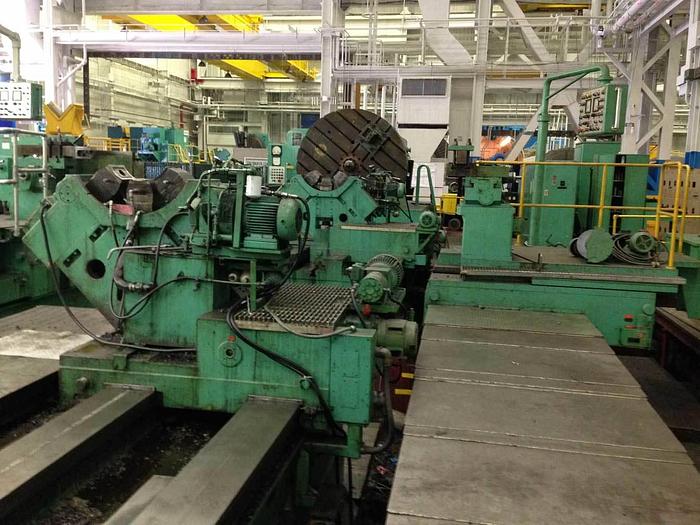
Technical Evaluation Guide: How to Identify a Quality Used, Secondhand, Pre-Owned, Surplus Waldrich Siegen Turbine Heavy-Duty Lathe 13 Meters made in Germany
1) Machine Context & Benchmark Specifications
Before your inspection, secure the original factory documentation, drawings, or spec sheets for that particular lathe. Because “13 m” is a long-bed machine, it likely served in turbine, rotor, generator, or large shaft industries. The spec sheet should include:
- Bed length (≈ 13,000 mm) and usable turn length
- Swing over bed, swing over carriage
- Cross slide travel / vertical slide / tailstock travel
- Spindle bore / bar capacity
- Spindle speed and power (often low-rpm, high torque)
- Torque curves, spindle bearings type
- Chuck / collet / drive arrangement
- Tailstock / heavy steady rest or follower rest provisions
- Drive / cross feed mechanisms — massive ball screws, linear rails, or ways
- Cooling, lubrication, hydraulic / pneumatic systems
- CNC control (if retrofitted) or manual / hybrid operation
Typical tolerances for these machines tend to be microns over long spans, and angular alignment is critical.
2) Pre-Visit Document Request
Ask the seller for:
- Factory drawings / build sheets / original tolerances
- Alignment / calibration / leveling reports
- Service / maintenance logs (spindle rebuilds, bed grinding, way overlays)
- Spindle bearings replacement records, lubrication records
- CNC retrofit documentation (if upgraded)
- Electrical / hydraulic / pneumatic schematics
- Parts lists for bearings, saddles, carriage, spindle
- Alarm / error history if CNC equipped
- Reference measurement reports (post-installation alignment)
These documents guide your “expected limits” and help detect deviations or unknown modifications.
3) Structural & Visual Inspection (Machine Unpowered)
For a machine of such size, structural integrity is paramount.
- Bed & bed fillet / ways: inspect for bends, cracks, repairs, reinforced patches, corrosion, worn sections
- Carriage / cross slide / saddle surfaces: check for heavy wear, gouges, uneven contact, dips or humps
- Spindle housing & nose: inspect for cracks, distortion, welds, signs of collision or overload
- Tailstock or follower rest systems: alignment surfaces should be clean, no damage
- Guideways, linear rails, or rails: check for scoring, rust pits, uneven wear that accumulates over long travel
- Drive trains / ball screws / coupling systems: inspect visible coupling parts, backlash zones, support bearings
- Large cable carriers, coolant / hydraulic plumbing, lines: inspect for wear, fatigue, leaks
- Electrical / control cabinets: examine for heat damage, dust, rodent damage, component replacement
- Cooling & lubrication tanks / pumps: check for corrosion, leaks, mounts, condition
- Walking the machine span: look for sagging, a twisted bed, or misalignment along length
- Foundation & anchorage: check how the machine was mounted — whether anchor locations show previous rework or shifting
Photographic or video documentation of bed, ways, carriage, and visible machines is very helpful in negotiations.
4) Installation, Alignment & Bed Checks
Given the size (13 m), proper bed alignment is crucial:
- Use a precision straightedge, granite reference, or laser / optical leveling system to check straightness along bed length (rail straightness).
- Check bed twist or warp by placing dial indicators across multiple cross-sections along the bed (e.g. every few meters).
- Confirm that the foundation / mounting is stable, flush, and has not shifted or cracked.
- Mount a test bar or stable reference in the spindle and measure linear radial runout across different carriage positions.
- Move the carriage to multiple positions along bed and verify cross-slide / saddle alignment using dial indicators.
- If tailstock or follower rest systems are installed, check their alignment with spindle axis at different positions.
For very long machines, you may need to use laser alignment or long baseline metrology tools (e.g. laser trackers).
5) Power-On & Motion / Functional Tests
Once power is available:
- Warm up machine by jogging carriage and cross-axes for a prolonged period (30+ minutes) to stabilize conditions.
- Perform home / reference returns (if CNC) or reference moves — ensure repeatability and no limit errors.
- Jog longitudinal carriage (X travel) at various speeds (slow, mid, full); listen and feel for jerk, uneven motion, binding.
- Cross-motion / vertical / cross slide motion test: move cross slide, saddle, check for consistent motion everywhere.
- Spindle ramp-up: though heavy-duty lathes often operate at low rpm, test ramping behavior, torque loading, bearing smoothness.
- Test clamping systems (if hydraulic or mechanical) to verify tails or chucks clamp reliably.
- Operate lubrication, coolant, hydraulic, pneumatic systems to confirm they function under power (flow rates, pressure).
- In CNC-equipped units, review alarm logs, simulate limit trips, check interlock correctness.
- During motion, monitor feedback encoders or sensors for dropouts or fault signals.
6) Accuracy, Repeatability & Metrology Tests
Given the machine’s size, these are critical for acceptability:
- Use a laser interferometer, long-range straightness system, or laser tracker to measure linear deviation in the transverse and longitudinal directions along the bed.
- Perform carriage reversal tests over long travel (e.g. ±1 m movement) to assess backlash / reversal error in drive train.
- Command repeated moves to a fixed point along bed (10× or more) and measure repeatability variation.
- Cross-slide / vertical travel repeatability tests at multiple positions.
- Check parallelism / squareness between bed axes (X → Z, X → cross slide) using reference surfaces or precision squares.
- Run a long-length test cut (e.g. turning a shaft) and use precision gauges / CMM to measure straightness, taper, roundness along the length.
- After extended operation (≥ 1 hour), re-measure reference distances to detect thermal drift.
- Hysteresis test: move to a point, dwell, return, measure offset.
Because 13 m is long, even small per-meter drift becomes large in absolute error—so tolerances must scale accordingly.
7) Spindle, Bearing & Drive System Checks
- Mount a test bar into the spindle and measure radial runout at different points along length of travel
- Use vibration analysis or acoustic listening to detect bearing noise as rpm changes
- Operate spindle under moderate load (if safe) for extended duration and monitor temperature, current, noise
- Inspect drive couplings, torque arms, bearing supports for looseness or wear
- If the machine uses a turret, follower rest, or indexing head, test its repeatability and torque performance
- If the machine has multiple spindle heads or milling attachments, test each spindle similarly
8) Lubrication, Cooling, Hydraulic & Auxiliary Systems
- Check lubrication systems (oil / grease / coolant) for each axis: verify delivery, inspect lines, ensure no blockages or leaks
- Activate coolant system; verify flow, pressure, cleanliness, check for leaks
- Examine coolant tanks, filters, piping for corrosion or contamination
- Test hydraulic or pneumatic systems (if involved in clamping or movement) for stable pressure and smooth operation
- Operation of any chip conveyors or heavy-sludge removal systems—verify robustness
- Cooling / ventilation fan systems for cabinets and drive enclosures must be operational and adequate
9) Common Failure Patterns & Red Flags
- Bed sagging or misalignment over time
- Guideway wear or irregularities over long span
- Drive train backlash or torque loss in long-length axis
- Spindle bearing failure manifested as vibration or unstable operation
- Clamping or chucking system wear or slippage
- Loss of lubrication or lube contamination causing accelerated wear
- Hydraulic / coolant leaks causing undermined structural or drive components
- Control or electronics aging (overheating, failed components)
- Encoder or feedback instability especially on long axes
- Cable chain fatigue or wiring harness damage over long runs
If you see multiple of these, the machine will require major reconditioning.
10) Acceptance Criteria & Benchmark Tolerances (Sample)
For a machine of this scale, acceptable tolerances are tighter per unit distance. You might use:
| Parameter | Target / Acceptable Tolerance |
|---|---|
| Linear deviation over full bed | e.g. ≤ ±25–50 µm over 13 m (or tighter per specification) |
| Reversal / backlash error (carriage) | ≤ 0.01 mm for moderate travel segments |
| Repeatability over travel | ± 10 µm or better (for given segments) |
| Cross-slide / vertical repeatability | ± 5 µm or tighter depending on design |
| Spindle radial runout | ≤ 5 µm (or in the low-micron range) |
| Thermal drift over extended operation | ≤ 10–20 µm per meter (or better) |
| Torque performance / spindle stability | No significant drop under load mid-cycle |
| Drive current / servo stability | Smooth current, no spikes or oscillation |
| Clamping / chuck repeatability | Within few microns under heavy load cycles |
These tolerances should be validated against the original factory documentation.
11) Buyer’s On-Site Quick Checklist
- Serial number, drawing or build sheet confirmed
- Visual inspection: bed integrity, ways, carriage, spindle housing
- Check machine leveling and anchoring
- Jog axes (carriage and cross) to sense motion quality
- Run long-axis motion test and listen for anomalies
- Ramp spindle, measure runout and vibration
- Accuracy / repeatability / thermal drift tests
- Lubrication, coolant, chip systems operational
- Review electrical cabinet status, wiring, alarm logs
- Walk away or major price adjustment if multiple serious defects