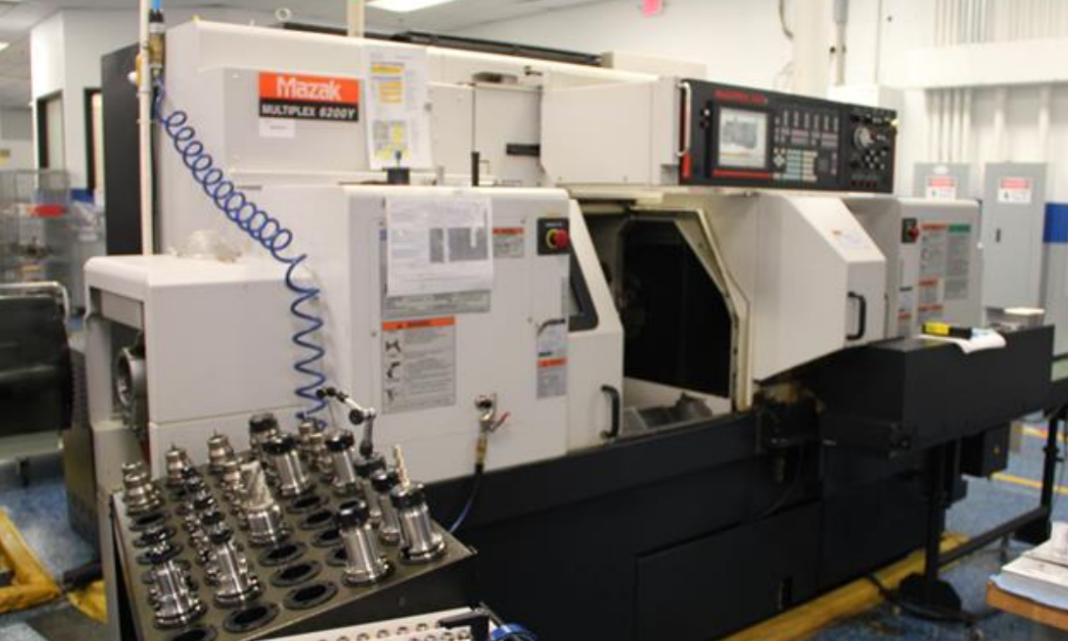
Technical Evaluation Guide: How to Identify a Quality Used, Secondhand, Pre-Owned, Surplus Mazak Multiplex 6200Y CNC Turning Center made in Japan
1) Machine Overview & Baseline Specifications
Before your inspection, obtain the official specifications or brochures for the exact Multiplex 6200Y model. Here are representative specs often associated with the Mazak Multiplex 6000/6200 series with Y-axis:
| Feature | Representative Value / Specification |
|---|---|
| Main spindle speed | ~ 4,000 rpm (or optional higher) |
| Spindle bore / bar capacity | ~ Ø 65 mm (approx) |
| X-axis travel | ~ 300 mm (may vary) |
| Z-axis travel | ~ 1,000 mm (or close) |
| Y-axis travel | ± 50 mm (or variant) |
| Live tooling / mill spindle | optional in many models |
| Turret / tool changer | multi-position turret or combination tool post |
| Control | Mazatrol / FANUC variant often |
| Rapid feed rates | subject to model — e.g. 30–40 m/min |
| Chuck size | e.g. 8″ / 10″ (model variant) |
Use these as reference points. The actual machine should lie reasonably close to spec unless heavily modified.
2) Documentation & Pre-Visit Request
Have the seller provide:
- Serial number, build year, and exact model configuration
- Original spec sheet / build sheet listing options (Y-axis, live tooling, sub spindle, etc.)
- Maintenance logs (spindle rebuilds, axis overhauls, lubrication service)
- Accuracy / calibration / test reports (e.g. ballbar, laser)
- CNC parameter backups, axis compensation tables
- Electrical schematics, wiring, hydraulic / pneumatic drawings
- Tooling list (live tools, holders, turrets)
- Alarm / fault history logs
- Records of crashes, collisions, or major repairs
These documents help you understand possible deviations and wear.
3) Static & Visual Inspection (Powered Off)
Perform a detailed visual inspection before powering:
- Frame / base / casting: check for cracks, weld repairs, distortion, evidence of impact
- Way covers / guards / bellows: look for tears, missing covers, chip damage, hardened residue
- Turret / tool changer / tool post: inspect turrets for indexing wear, play in grippers, tool pocket damage
- Spindle nose / taper: check for corrosion, surface wear, scratches, dents
- Guideways / slides / rails: search for scoring, pitting, polishing, uneven lubrication patterns
- Y-axis mechanism / saddle: visually confirm smoothness of cross slide or Y saddle, check for misalignment
- Cable carriers / hoses / wiring harnesses: inspect insulation condition, chafed surfaces, prior repairs
- Electrical cabinets / wiring: open and check for discoloration, burnt components, messy wiring, dust
- Coolant / hydraulic / pneumatic lines: check hoses, connections, leaks, stiff lines
- Safety doors / interlocks: verify that guards fit properly, switches exist and align correctly
Document all findings with photos, especially any suspicious wear or damage.
4) Alignment & Installation Checks
If the machine is semi-mounted or ready:
- Check the machine base is level and bolts are secure
- Mount a test bar in the spindle (with Y = 0) and measure radial runout to assess spindle alignment
- Jog X / Z / Y small distances to test for binding, inconsistent torque or “dead spots”
- If turret indexing or Y-axis cross slide positioning can be measured with a dial indicator, check consistency across positions
- Verify saddle / Y-axis travel is linear and that movement is uniform across the stroke
5) Power-On & Dynamic Function Testing
After power is enabled and safety procedures are in place:
- Warm-up jogging: move axes continuously (X, Z, Y) for ~20–30 min to stabilize temperatures
- Home / reference cycles: repeat homing several times and check consistency
- Axis motion tests: move X, Z, Y axes at different speeds (slow, medium, fast) and listen/feel for anomalies
- Turret / tool change cycles: if equipped, run turret indexing or tool changes repeatedly; check for mis-indexing or delay
- Spindle ramp-up test: accelerate spindle through its rpm range while monitoring vibration, noise, temperature, and current
- Live tooling / mill spindle (if applicable): run under light load and monitor stability
- Coolant / lubrication systems: enable fluid systems, check flow, pressure, leaks
- Fault / alarm review: check existing alarm history; test limit or error triggers intentionally if safe
- Encoder / feedback integrity: during motion, observe that position feedback is consistent and no dropouts occur
6) Accuracy, Repeatability & Metrology Tests
These tests will reveal how well the machine still meets precision standards:
- Use a laser interferometer or precision gauge to measure linear accuracy / straightness on X, Z, and Y (if applicable)
- Perform backlash / reversal error test by moving ±0.01 mm and measuring the change on reversal
- Do several repetitions (e.g. 10×) to test repeatability of returning to the same position
- Index turret repeatedly and measure tool location repeatability
- For live tooling / milling operations, run a test cut in combination with turning to check alignment and positioning
- After extended operation (1 hour+) re-measure reference points to check thermal drift
- Conduct a hysteresis test: move to a point, dwell, return, and measure offset
7) Spindle, Tooling & Wear Evaluation
- Install a precision test bar and measure radial runout of spindle
- Use vibration analysis or careful listening to detect bearing noise at intermediate rpm
- Run spindle at moderate speed for ~30 min, measure temperature rise
- Test tool retention mechanism or holding grip strength (pull test if feasible)
- Use dye / blue to check taper seating uniformity
- Cycle tool changes (if available) to confirm tool offset repeatability
- For live tooling spindles, evaluate runout, vibration, and stability under light load
8) Lubrication, Cooling & Auxiliary Systems
- Ensure all axes and motion elements are receiving lubrication / oil / grease; check for blocked lines, leaks, or dry spots
- Run coolant system, verify flow, pressure, clarity, leaks, condition of filters
- Inspect filters, tanks, screens for sludge, rust, or contamination
- Operate chip conveyor (if present) and confirm smooth motion and clearance
- Test hydraulic / pneumatic systems (if turbo feed, clamping, etc.) for stable pressure and responsiveness
- Ensure cabinet and electrical compartments are cooled properly (fans working, no overheating)
9) Common Wear Modes & Red Flags
- Guideway wear, especially in high-load or mid-travel zones
- Turret play or mis-indexing
- Spindle bearing failure or vibration at speed
- Tool changer gripper wear or slop
- Live tooling spindle wear or instability
- Lubrication failure or contamination entering bearings
- Coolant leaks, causing corrosion of components
- Controller, drive or power electronics aging or failure
- Encoder dropout or signal errors
- Cable harness aging, damaged insulation, connector corrosion
If multiple red flags appear, the machine may require significant refurbishment.
10) Acceptance Criteria & Benchmark Tolerances
Here is a sample tolerance table you can use as a reference (adjust per actual specs):
| Parameter | Target / Acceptable Tolerance |
|---|---|
| Linear positioning accuracy (X, Z) | ± 0.005 mm over moderate strokes |
| Backlash / reversal error | ≤ 0.01 mm |
| Repeatability | ± 0.005 mm or better |
| Turret / indexing repeatability | ≤ 0.01 mm |
| Spindle radial runout | ≤ 0.005 mm |
| Thermal drift over 1 hour | ≤ 5 µm |
| Tool change / offset repeatability | ≤ 0.01 mm |
| Coolant / lube stability | No large pressure/flow drop |
| Servo / current stability | Smooth, no current spikes |
| Noise / vibration at rpm | Low — no abrupt vibration peaks |
If the machine fails several of these, it is likely less reliable without refurbishment.
11) Buyer’s On-Site Quick Checklist
- Confirm serial number, model variant, and build spec
- Verify spec sheet vs actual travel, tool capacity, spindle type
- Perform visual inspection: frame, covers, rails, spindle
- Jog axes (X, Z, Y) to sense motion smoothness
- Cycle turret indexing / tool changes
- Ramp spindle, measure runout / vibration
- Accuracy / repeatability / drift tests
- Test coolant, lubrication, chip systems
- Boot control, review alarms, verify parameter backups
- Walk away if too many serious defects found