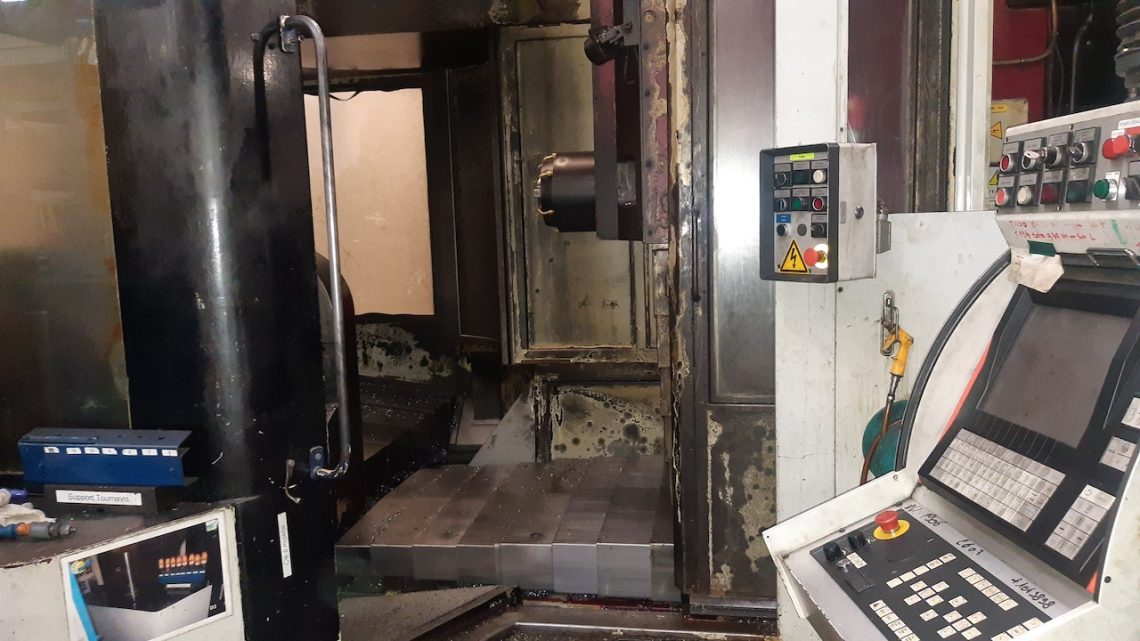
Technical Evaluation Guide: How to Identify a Quality Used, Secondhand, Pre-Owned, Surplus MANDELLI M7H CNC Horizontal Machining Center made in Italy
1) Machine Context & Reference Specifications
Before inspection, obtain the original datasheet or build sheet for the specific M7H unit. In the absence of that, here are some reference data drawn from Mandelli’s M7 / M7S machines which you can use as benchmarks:
- Mandelli M7 horizontal machine listing: X = 1,000 mm, Y = 800 mm, Z = 1,050 mm; 6 pallets, table 630×630 mm, pallet load ~1,500 kg
- Mandelli “Type 7” (related model) has spindle speed up to 4,000 rpm, pallet 630×630 mm, X = 1,000 mm, Y = 80 mm (possible misprint)
- Mandelli company is well established in Italy for horizontal machining centers and multitasking machines
Thus, you can expect a well-made Mandelli M7H to have:
- Large travels in X / Y / Z
- Multi-pallet / pallet changer system
- Robust spindle power (several tens of kW)
- High structural rigidity
- Precision in indexing / pallet repeatability, axis straightness, spindle alignment
Use these as your target ranges; deviations must be explained by documented modifications or wear.
2) Pre-Inspection Document Checklist
Ask the seller to provide:
- Original specification / build / configuration sheet for that M7H
- Serial number, year of manufacture, model variant, options
- Geometry / calibration / accuracy / spindle / pallet repeatability reports
- Maintenance / repair logs (spindle replacement, ways overhaul, pallet system servicing)
- CNC / control version and backups of all parameter tables
- Electrical, hydraulic, pneumatic schematics
- Parts list (spindle, pallets, drives, servo motors)
- Records of crashes or collisions, retrofits or modifications
These documents will let you set “expected tolerances” properly and evaluate “wear vs. deviation.”
3) Visual & Static Inspection (Machine Powered Down)
Before powering, do a close visual inspection:
- Frame & Bed / Casting Integrity
Look for cracks, weld repairs, distortion, sagging across long spans. - Way Covers / Guards / Bellows
Check for tears, missing covers, chip ingress, hardened deposits. - Pallet / Table System
Inspect pallet faces, alignment pins, rails, and wear marks. - Rotary / Indexing Components
Check for play, misalignment, spline wear, cracked faces. - Spindle Nose / Taper Surface
Inspect for corrosion, nicks, wear on the taper surfaces. - Guideways / Linear Ways / Rails
Look for scoring, pitting, uneven wear, discoloration. - Cable Chains / Flexible Conduits / Hoses
Inspect insulation for brittleness, frays, repairs. - Electrical Cabinets / Wiring
Open panels, inspect for burnt wiring, discolored insulation, dust buildup. - Coolant / Hydraulic / Pneumatic Lines
Check fittings, hoses, seals for leakage, hardened lines, corrosion. - Safety Enclosures / Interlocks / Doors
Ensure safety guards are intact, interlock switches exist and working.
Take photos of any signs of repair, welding, or excessive wear.
4) Installation & Alignment Checks
If the machine is semi-installed:
- Check whether the machine base is level and properly anchored — misleveling can hide twist or distortion.
- Mount a test bar or dial indicator in the spindle (with B / rotary neutral) and check radial runout at different positions.
- Jog X/Y/Z small increments to feel for binding or irregular motion.
- For pallet / index system: place a dial indicator at multiple pallet positions and check positional deviation when indexing.
- Verify that the pallet / table surfaces are flat and orthogonal to the spindle centerline using straightedges / indicators.
5) Power-On & Motion / Functional Tests
With power and safety measures in place:
- Warm up axis motion (X, Y, Z, pallet indexing) by consecutive jogging for 15–30 min to stabilize lubrication.
- Perform homing / reference cycles and check repeatability.
- Move each axis (X, Y, Z) at different speeds (slow → mid → rapid) and listen for irregular sounds, catches, or jerkiness.
- Cycle through pallet indexing (if multi-pallet) repeatedly, checking for mis-index, hesitation, or positioning drift.
- Ramp spindle up from low to nominal rpm and monitor vibration, noise, temperature, current draw.
- Run a mock toolpath (no heavy load) combining X, Y, Z moves to test motion synchronicity.
- Engage coolant / lubrication systems; verify flow, leaks, pressure.
- Review CNC fault logs and test interlocks (emergencies, safety door opens).
- During movement, monitor encoder feedback or position readouts for dropouts or errors.
6) Accuracy, Repeatability & Metrology Tests
These are critical to determine how good the machine is truly:
- Use a laser interferometer or precision gauge to test linear accuracy / straightness on each axis.
- Execute back-and-forth small moves (±0.01 mm) and measure reversal error / backlash.
- Return to a point repeatedly (10–20 times) and measure repeatability spread.
- Check pallet / indexing repeatability: index to same pallet position multiple times and measure offset.
- Run a contour interpolation / combined axis motion (e.g. diagonal moves) and measure deviation from intended path.
- Operate under warm-up or load for 1 hour and then re-check reference positions to assess thermal drift.
- Do a hysteresis test: move to position, dwell, return, measure offset from original.
7) Spindle, Tooling & Wear Tests
- Mount a precision test bar in spindle, measure radial runout.
- Use vibration analysis or listen for bearing whine at moderate rpm.
- Monitor spindle temperature over extended run (e.g. 30 min) to ensure stable heating.
- Test tool retention / torque / drawbar force (if applicable) to verify holding strength.
- Perform a dye / blue contact test to check taper seating uniformity.
- Cycle tool changes (if automated) and verify tool offset repeatability.
- For horizontal machines with milling heads or rotary heads, test those spindles similarly.
8) Lubrication, Cooling & Auxiliary Systems
- Confirm lubrication / grease / oil supply lines to all axes and check for blockages, leaks, or dry areas.
- Run coolant pumps; verify flow, pressure, temperature, and absence of leaks.
- Check filters, screens, tanks for sludge, corrosion or contamination.
- Operate any chip conveyors / swarf removal systems and verify smooth function.
- Test any hydraulic / pneumatic clamping or actuation systems for pressure stability and leak-free operation.
- Verify electrical cabinet fans and ventilation – no overheating during operation.
9) Common Failure Patterns & Red Flags
- Excessive wear or scoring on linear ways
- Pallet indexing with drift or lost repeatability
- Spindle bearing degradation: vibration, noise, runaway temperatures
- Tool changer or clamping system wear or slop
- Loss / contamination of lubrication or coolant causing internal wear
- Encoder / position feedback failures or dropout
- Control or servo drive board failures, overheating, or prior repairs
- Cable harness aging or insulation failure
- Evidence of crash damage or undocumented modifications
If you encounter multiple of these, the machine may require expensive refurbishment.
10) Acceptance Criteria & Benchmark Targets (Example)
Here is a sample tolerance table you can use (adjust based on the actual M7H spec):
| Parameter | Target / Acceptable Tolerance |
|---|---|
| Linear axis accuracy | ± 0.005 mm over moderate travel |
| Reversal / backlash error | ≤ 0.01 mm |
| Repeatability | ± 0.005 mm or better |
| Pallet / indexing repeatability | ≤ 0.01 mm |
| Spindle radial runout | ≤ 0.005 mm |
| Thermal drift (after 1 hour) | ≤ 5–10 µm |
| Tool change / offset repeatability | ≤ 0.01 mm |
| Coolant / lubrication stability | No major drop under load |
| Servo current stability | Smooth with no sudden spikes |
If the machine fails multiple parameters, its effective accuracy is compromised.
11) Buyer’s On-Site Quick Checklist
- Serial number, model variant, build sheet confirmed
- Visual inspection: frame, ways, guards, cables
- Jog axes (X, Y, Z) to sense motion quality
- Cycle pallet indexing multiple times
- Ramp spindle, measure runout / vibration
- Accuracy / repeatability / drift tests
- Coolant, lubrication, chip systems operational
- Control boot-up, alarms, backups checked
- Walk away if too many serious defects or missing documentation