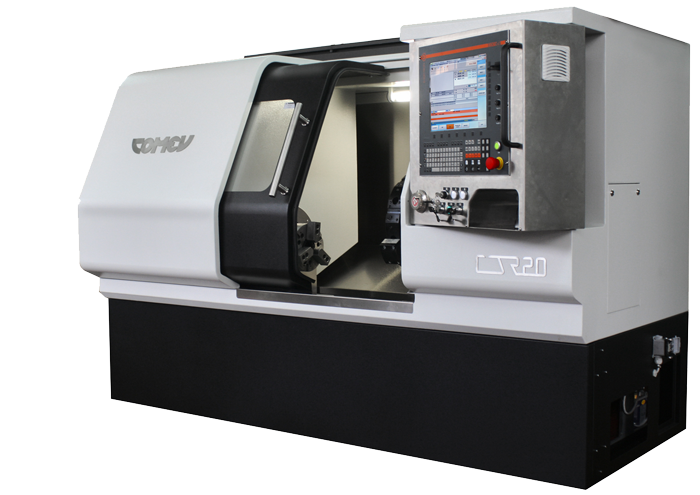
Technical Evaluation Guide: How to Identify a Quality Used, Secondhand, Pre-Owned, Surplus COMEV CDR 20 CNC Lathe made in Italy
1) Machine Overview & Benchmark Specifications
Before your inspection, request the original spec sheet or brochure for the exact CDR 20 unit under consideration. Below are typical or representative specs based on listings and COMEV product lines for a CDR-20 series lathe:
| Feature | Typical Value / Published Spec |
|---|---|
| Maximum turning diameter (over bed) | ~ Ø 400 mm (varies by version) |
| Maximum turning length (Z-axis) | ~ 500 mm or more (depending on model) |
| X-axis travel (cross slide) | ~ 200 mm |
| Z-axis travel | ~ 500 mm (or model variant) |
| Spindle bore / bar capacity | ~ Ø 60 mm or specified value |
| Spindle speed | Up to several thousand rpm (e.g. 4,000–5,000 rpm) |
| Spindle motor power | ~ 11 – 22 kW (depending on variant) |
| Tool turret / tool post | Some versions may have turret with driven tools or B-axis |
| Rapid feed rates | As per control / drive limits |
| Control type | Fanuc / Siemens / Fagor / COMEV’s own integration |
These reference values help calibrate your expectations and guide acceptance thresholds. If the used machine deviates significantly without documented modifications, treat that as a red flag.
2) Document Request Before Visit
Ask the seller to supply:
- Serial number, manufacture year, and full configuration / build sheet
- Maintenance / service logs (major repairs, spindle rebuilds, axis servicing)
- Calibration or test / geometry reports (ballbar, straightness, runout tests)
- CNC control and software version, parameter file backups
- Electrical, hydraulic, pneumatic, and wiring schematics
- Tooling list (turret, driven tools, holders)
- Modification or retrofit records
- Alarm / fault history logs
These help you judge how far the machine may have drifted from original specs or whether modifications have introduced unknown risks.
3) Static & Visual Inspection (Machine Off)
Conduct a thorough visual inspection before powering up:
- Frame & base / casting: inspect for cracks, weld repairs, distortion, or impact damage
- Way covers / bellows / guards: examine for tears, signs of chip damage, missing sections, hardened residue
- Turret / tool post area: check for wear, play, misalignment, gripper damage
- Spindle nose / taper / barrel: look for corrosion, scratches, pitting, surface wear
- Guideways / slides / cross slide: inspect for scoring, pits, uneven lubricant traces
- Tailstock or steady rest (if equipped): assess alignment surfaces, mounting, wear
- Coolant / hydraulic / pneumatic lines: check for leaks, brittle hoses, repaired sections
- Cable carriers / wiring harnesses: inspect for insulation damage, signs of chafing, repair patches
- Electrical cabinet / wiring: open panels and inspect for burnt marks, discolored wires, modifications, dust/dirt buildup
- Safety covers / interlocks / doors: test fit, check switch mechanisms, hinges
Photograph all concerning areas for documentation and later negotiation.
4) Installation & Alignment Checks
If the machine is already partially installed:
- Check machine leveling and tightness of foundation bolts
- Use a dial indicator or test bar to measure spindle radial runout in neutral configuration
- Jog X and Z axes through small motions and check for smooth movement without binding
- Index turret (if applicable) and measure deviation in tool position relative to spindle axis
- If tailstock or steady rest are present, align them and check them relative to spindle axis
5) Power-Up & Functional Motion Tests
Once powering and safety checks are done:
- Warm-up jogging: move axes continuously for ~20–30 minutes to stabilize system
- Home / zero return cycles: ensure consistent referencing and no limit / reference errors
- Axis travel test: move X, Z at various speeds (25 %, 50 %, 100 %) and listen / feel for binding or irregularities
- Turret / tool change cycles: if the lathe is equipped with turret, exercise indexing, tool changes, check for mis-index or alarm
- Spindle ramp-up test: gradually accelerate the spindle through its rpm range while monitoring vibration, current draw, noise, and temperature behavior
- Coolant / lubrication systems: activate coolant pump, verify flow, test for leaks, confirm lube to axes
- Controls & alarms: review alarm history, provoke mild fault scenarios to test error detection capability
- Encoder / feedback test: move axes and verify no encoder dropouts or fault messages during motion
6) Accuracy, Repeatability & Metrology Tests
These tests separate a high-quality used machine from one with excessive wear:
- Use a laser interferometer or precision gauge to measure linear positioning error on X and Z axes
- Perform backlash / reversal error test: ±0.01 mm commanded moves, measure the direction reversal error
- Execute repeatability test: return to a point 10× (or more) and measure deviation
- For turret-equipped units, index repeated times and measure tool location repeatability
- Perform a combined turning + milling test (if machine supports live tools or driven tools) and compare actual part dimensions to intended program
- After prolonged operation (1 hour), remeasure reference features to detect thermal drift
- Move to a point, dwell, return, and measure offset for hysteresis / drift
7) Spindle, Tooling & Wear Evaluation
- Mount a test bar in spindle and measure radial runout
- Use vibration analyzer or listen for bearing noise at intermediate — high rpms
- Run spindle under continuous operation for 30 minutes and watch temperature rise
- Test tool retention or tool holding mechanism (pull-out or torque test)
- Use blue / dye test to check taper contact uniformity
- Cycle tool changes and verify tool offset repeatability
- If live tool features exist, test for runout, vibration, and repeatability
8) Lubrication, Cooling & Auxiliary Systems Inspection
- Ensure lubrication lines deliver oil / grease to all axes; check for blockages, leaks, or dry spots
- Run coolant pump; verify flow, pressure, cleanliness, and leak points
- Check filters, tubing, tanks for corrosion, clogs, or debris
- Operate chip conveyor if present; check for smooth motion, alignment, and no jamming
- Test hydraulic / pneumatic systems (if used) to confirm stable pressures and responsiveness
- Inspect electrical cabinet cooling fans, vents, and cooling performance during prolonged operation
9) Common Wear / Failure Modes & Red Flags
- Guideway wear or scoring, especially in mid-travel zones
- Turret indexing play or mis-index
- Spindle bearing fatigue or vibration
- Tool changer or gripper wear or slop
- Coolant leaks into structural or mechanical areas
- Loss of lubrication, clogged lube circuits
- Encoder or feedback errors / dropouts
- Electrical / servo drive aging, heat stress, component failure
- Cable harness fatigue or damage, connector corrosion
If multiple such signs appear, the machine carries higher risk.
10) Acceptance Criteria & Benchmark Tolerances
Here is a sample table of tolerances to compare against (modify per spec sheet):
| Parameter | Target / Acceptable Tolerance |
|---|---|
| Linear positioning accuracy (X, Z) | ± 0.005 mm |
| Backlash / reversal error | ≤ 0.01 mm |
| Repeatability (X, Z) | ± 0.005 mm or better |
| Turret / tool offset repeatability | ≤ 0.01 mm |
| Spindle radial runout | ≤ 0.005 mm |
| Thermal drift over 1 hour | ≤ 5 µm |
| Tool change / offset repeatability | ≤ 0.01 mm |
| Coolant / lubrication stability | No significant pressure drop |
| Servo / current stability | Smooth traces, no spikes |
| Vibration / noise at rpms | Minimal — no bearing noise spikes |
If the machine fails multiple of these benchmarks, especially in critical dimensions, its effective accuracy is compromised.
11) Buyer’s On-Site Quick Checklist
- Serial number, build year, and configuration confirmed
- Spec sheet compared with actual travel & features
- Visual inspection: frame, way covers, turret, spindle
- Jog axes (X, Z) and sense smooth motion
- Cycle turret (if present) multiple times
- Ramp spindle, measure runout, listen for noise
- Accuracy / repeatability / drift tests
- Coolant, lubrication, chip systems operational
- Control boot-up, alarm logs, parameter backups checked
- Walk away if too many serious defects or unknown repairs