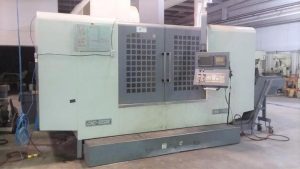
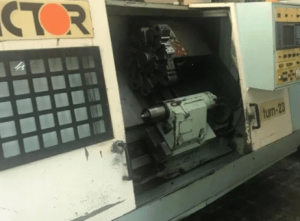
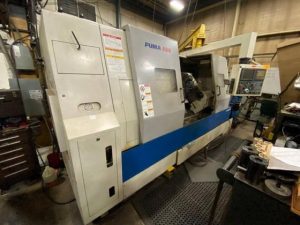
Technical Evaluation Guide: How to Identify a Quality Used, Secondhand, Pre-Owned, Surplus Mazak SQT 10MS CNC Lathe made in Japan
1) Machine Overview & Baseline Specifications
First, obtain the factory specification sheet or previously documented specs for the exact SQT 10MS unit. Below are representative specs from listings of the model:
- Max turning diameter: ~ 9.06 in (~230 mm)
- Max machining length (Z travel): ~ 12.05 in (~306 mm)
- X-axis stroke: ~ 6.31 in (~160 mm)
- Z-axis stroke: ~ 17.93 in (~455 mm)
- Spindle speed: 35 – 6,000 rpm (stepless)
- Spindle bore (bar capacity): ~ 2.40 in (≈ 61 mm) bore; bar work diameter ~1.65 in (~42 mm)
- Turret: 12-station drum turret, live tool capability
- Secondary spindle (sub spindle) specification: speed 180–6000 rpm, some units include second spindle / B-axis stroke ~18 in
- Controller: Mazatrol T-32-3 (common for SQT10MS)
These values serve as your target benchmarks. Any used machine should be reasonably close to these (aside from allowable wear or optional variants).
2) Documentation & Pre-Visit Checklist
Before visiting, request from the seller:
- Serial number, manufacturing year, and full build/configuration sheet (options, live tools, sub spindle)
- Maintenance and service logs (spindle rebuilds, axis overhauls, lubrication, repairs)
- Geometry / calibration / test reports (ballbar, laser, runout, straightness)
- CNC parameter backups, offset / compensation tables
- Electrical, pneumatic, hydraulic, and wiring diagrams
- List of tooling, live tool holders, turret options
- Alarm history or fault logs
- Records of any collisions, crashes, or major repairs
These documents help you understand how far the machine may have drifted or been modified.
3) Static & Visual Inspection (Machine Off / Unpowered)
Walk around the machine carefully and inspect:
- Frame & Castings
Check for cracks, weld repairs, distortion, evidence of collisions, surface fatigue. - Way Covers / Bellows / Guards
Look for tears, missing sections, chip damage, hardened deposits. - Turret & Tool Magazine
Inspect turret face, tool pockets, gripper fingers, indexing surfaces. Check for play or misalignment. - Spindle Nose & Taper
Check for corrosion, scratches, dents, or pitting. - Guideways / Slides / Carriage
Inspect for scoring, uneven wear, discoloration, lubrication residue. - Sub Spindle / Secondary Spindle (if present)
Inspect for damage, alignment, carriage movement. - Cable Carriers / Hoses / Wiring
Look for brittle insulation, worn drag chain links, repairs, missing coverings. - Electrical Cabinet / Wiring
Open panel; observe wiring quality, burnt traces, component discoloration, modifications. - Coolant / Fluid Lines / Fittings
Check for leaks, brittle hoses, corrosion, past repairs. - Safety Devices / Doors / Interlocks
Ensure guards are in place, doors close flush, interlocked switches exist.
Take high-resolution photos of areas of concern.
4) Installation & Alignment Checks
If the machine is partially installed or mounted:
- Ensure the machine is leveled and properly anchored (no excess shims or flex).
- Mount a test bar / indicator in the spindle at neutral position, measure radial runout to confirm spindle alignment.
- Jog the X and Z axes through small moves; feel for binding, stiff spots, or uneven motion.
- Rotate the turret face / index the turret and measure lateral positional consistency relative to spindle.
- If parting devices or tailstock are present, align those to spindle axis and check for offset.
5) Power-On & Motion / Functional Tests
Once powered and with safety protocols:
- Warm up the axes via jogging for ~20–30 minutes to stabilize lubrication and thermal conditions.
- Execute home / zero-return cycles and check for repeatability and no limit / reference errors.
- Command full-axis strokes (X, Z) at variable speeds (25 %, 50 %, 100 %) — listen for chatter, binding, or irregular movement.
- Cycle the turret through all indexing stations repeatedly; look for mis-index, hesitation, or alarms.
- Ramp the main spindle from low to max rpm, monitoring vibration, sound, current, and temperature.
- Run a few live tool / milling operations (if equipped) at light loads to check the live tooling spindle behavior and stability.
- Engage coolant and lubrication systems; monitor flow, pressure, and leaks.
- Exercise sub spindle (if present) and test its synchronization, motion, and locking.
- Review CNC alarm/fault logs and attempt to provoke minor errors to test error handling.
- While moving axes, monitor encoder feedback, servo currents, check for dropouts or anomalies.
6) Accuracy, Repeatability & Metrology Tests
These evaluate true performance under load:
- Use laser interferometer or precision gauge(s) to test linear positioning / straightness on X & Z axes.
- Perform small ±0.01 mm reversal moves and measure backlash / direction reversal error.
- Conduct repeated moves to a target position (e.g. 10×) and measure repeatability error.
- Index the turret repeatedly to same station and measure tool location repeatability.
- For live tool operations, command a small milling or drilling move and verify that tool positioning matches expected.
- For subspindle units, perform part transfer operations and check concentricity / alignment.
- Run a test cut (turn + mill) on a sample workpiece and measure critical dimensions (diameter, length, hole placement).
- After continuous operation (1 hour or more), recheck reference dimensions to capture thermal drift.
- Perform a hysteresis test: move to a point, dwell, return, then measure offset from original.
7) Spindle, Tooling & Wear Checks
- Mount a high-precision test bar in the spindle and measure radial runout.
- Use a vibration analyzer or listen for noise anomalies at intermediate rpm to detect bearing issues.
- Monitor spindle temperature over a 30-minute run — it should remain stable without excessive rise.
- Test tool retention force (if applicable) or check gripper hold in live tool holders.
- Use dye / blue contact test to confirm that the taper seating is uniform and contact area is good.
- Cycle tool changes multiple times, inspect tool change repeatability and offset consistency.
- If equipped with live tooling, test for runout, vibration, and repeatability of milling spindle.
8) Lubrication, Cooling & Auxiliary Systems
- Check that the lubrication / grease / oil supply to axes, turret, slides is active and no blocked lines or leaks.
- Run coolant system; check pump flow, pressure, clarity, and leak paths.
- Inspect filters, screens, coolant tanks for cleanliness, sludge, rust.
- Operate chip conveyor / removal path; check for jamming, alignment, smooth motion.
- Test any hydraulic / pneumatic systems (e.g. turret clamping, tailstock) for smooth operation and pressure stability.
- Ensure electrical cabinet cooling and ventilation fans are working; no overheating in drive compartments.
9) Common Wear Patterns & Risk Indicators
- X / Z guideway wear or scoring (especially mid-travel)
- Turret indexing wear or backlash
- Spindle bearing fatigue / vibration
- Tool changer / gripper wear or looseness
- Live tooling spindle wear or instability
- Loss of lubrication (blocked lube circuits)
- Coolant leaks, corrosion, or contamination in bed or way surfaces
- Servo drive or control board aging, heat stress, failed components
- Encoder or feedback dropout errors
- Cable harness aging, insulation degradation
10) Acceptance Criteria & Benchmark Tolerances
Use these as your “go / no-go” thresholds (adjust based on spec sheet and acceptable application tolerances):
| Parameter | Target / Acceptable Tolerance |
|---|---|
| Linear positioning accuracy (X, Z) | ± 0.005 mm over moderate stroke |
| Backlash / reversal error | ≤ 0.01 mm |
| Repeatability (X, Z) | ± 0.005 mm or better |
| Turret index repeatability | ≤ 0.01 mm |
| Spindle radial runout | ≤ 0.005 mm |
| Thermal drift over 1 hour | ≤ 5–10 µm |
| Tool change offset repeatability | ≤ 0.01 mm |
| Coolant / lubrication stability | No large pressure or flow drop under load |
| Servo / current stability | Smooth traces, no sudden spikes |
| Noise / vibration at rpm | Low — no abnormal bearing whine or vibration peaks |
If a candidate fails multiple of these, its reliability is questionable without refurbishment.
11) Red Flags / Walk-Away Conditions
- Turret fails to index reliably or shows play
- Spindle vibration or bearing noise at any rpm
- Repeated servo or axis error alarms
- Tool change cycles failing or mis-alignment issues
- Coolant leaks into bearings or slides
- Severe guideway wear / scoring
- Missing CNC parameter backups or corrupted memory
- Control / servo drives with visible damage, overheating marks
- Live tool spindle anomalies (runout, chatter)
- Stiff or binding motion on axes
12) On-Site Quick Buyer’s Checklist
- Verify serial number, build year, and variant
- Compare spec sheet vs travel, spindle, tools
- Visual inspection of frame, way covers, guards
- Jog axes (X/Z) for smoothness
- Cycle turret indexing multiple times
- Ramp spindle, measure runout / vibration
- Test live tooling and subspindle (if applicable)
- Accuracy / repeatability / thermal drift tests
- Check coolant, lubrication, chip systems
- Boot CNC, check fault logs, backup parameters
- Walk away if many significant defects found