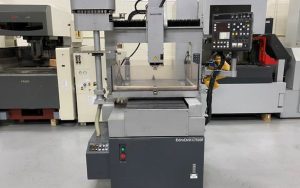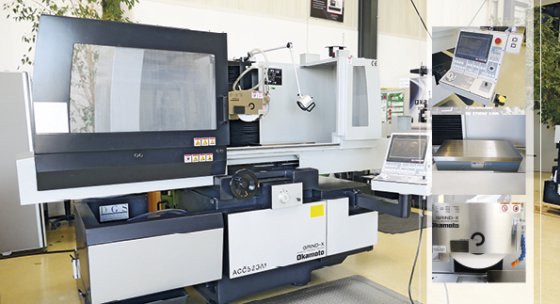
Technical Evaluation Guide: How to Identify a Quality Used, Secondhand, Pre-Owned, Surplus Okamoto ACC52 SA1 Surface & Profile Grinding Machine made in Japan
1) Machine Overview & Benchmark Specifications
Before arriving, request the original spec sheet or user manual so you have the manufacturer’s tolerances and capacities. For an Okamoto ACC52 SA1, typical specs may include:
- Grinding wheel size: e.g. Ø 520 mm (or similar)
- Spindle speed: e.g. 3,000 – 4,000 rpm (depending on wheel & motor)
- Table travel (X / Y): approximate working surface travel
- Max workpiece dimension / height clearance
- Profile grinding capability (contour, cam, segments)
- Motor / power ratings for main spindle and feed axes
- Table / work support system and clamping mechanism
- Control type: CNC or manual / semi-automatic
- Dressing mechanism: rotary dresser, diamond dresser, etc.
These values let you judge how far off worn machines might drift.
2) Pre-Inspection Document Request
Request the following ahead of time:
- Serial number, model designation, and year of manufacture
- Original spec sheet / machine layout drawings
- Maintenance & service logs (electrical, spindle, axes, dressing)
- Calibration / accuracy certificates, geometry / flatness / straightness test records
- Control / CNC parameter backups, axis compensation files
- Wiring / electrical schematic diagrams
- List of accessories (dressers, workholding, fixtures)
- Records of past rebuilds, major parts replacement, crash history
These let you interpret what deviations are acceptable.
3) Visual & Static Inspection (Machine Off)
Conduct a methodical visual assessment before powering:
- Machine base & casting: check for cracks, repairs, distortion, welded patches
- Table / work surface / slides: inspect for pitting, wear, damage, irregularities
- Lion’s share of bed / support structure: confirm stiffness, no sagging or visible bow
- Wheel spindle housing / wheel mount: look for signs of impact, wear, taper damage
- Wheel flanges / mounting faces: inspect for run-out damage, corrosion, wear
- Guideways / cross-slide & feed rails: check for scoring, rust, lubrication residue
- Dressing mechanism: inspect diamond dresser, rotation bearings, motor, slides
- Electrical & control cabinet: open and inspect wiring, heat damage, component condition
- Cabling, hoses, cables: inspect for brittle insulation, damage, cracking
- Workholding / fixture mounts: check surface finish, mounting integrity
- Coolant / lubrication plumbing: inspect hoses, fittings, leaks or corrosion
Take photos of any questionable wear or repair zones.
4) Installation & Alignment Checks
If the machine is mounted or partially installed:
- Check machine base leveling and foundation stability
- Mount a precision flat reference (e.g., granite block) on table and measure twist or deviations across the span
- Mount indicators on the wheel spindle (without wheel) and check radial runout at various positions over table travel
- Jog table (X/Y) in small increments and verify smooth, consistent motion
- Command cross-slide motion (if profile grinding) and check consistency across profile axes
5) Power-Up & Functional / Motion Tests
After powering (with safety):
- Warm-up jogging: move axes (table, cross-slide) continuously to stabilize temperature
- Homing / reference return: verify repeatability and no reference errors
- Axis traverse test: move X / Y / cross axes at varying speeds (slow to full feed) — listen / feel for binding, chatter
- Wheel spindle ramp-up: accelerate spindle and monitor vibration, current, noise, smoothness
- Dressing cycle: engage the dresser, perform a test dressing motion, verify smoothness, repeatability, no skipping
- Test grind run (light cut): without heavy load, move wheel over table travel slowly — observe smoothness, engagement, wheel behavior
- Coolant / lubrication systems: turn on coolant pump, confirm flow, check for leaks, delivery to zones
- Control / alarm monitoring: review historical alarms, test limit errors / soft limits, sensor feedback
- Cable / sensor feedback: observe signals during motion; no dropout or errors
6) Accuracy, Repeatability & Metrology Tests
Critical tests to gauge machine precision:
- Use a precision flat test surface on the table and sweep the wheel across it; measure flatness error across table travel
- Perform backlash / reversal error tests: command small ±0.01 mm feed in cross or Y and measure difference on reversal
- Execute repeated positioning moves (e.g. 10×) to test repeatability of table / feed axes
- If profile motion is present, run a contour test (arc or cam trace) and compare actual path vs intended geometry
- After extended run (1 hour), re-measure key surfaces for thermal drift
- Move axes to a position, dwell, return, and measure offset (hysteresis test)
7) Spindle, Wheel & Wear Checks
- Mount a test ring or arbor and check radial runout of the wheel spindle
- Run spindle at mid rpm and listen / monitor for bearing noise or vibration
- Run the spindle for extended time and measure temperature rise
- Inspect wheel mounting flanges, wheel balance (if available), wheel locking mechanism
- If the machine has tool/chuck components on table, verify workholding alignment
- Test wheel run through motion zones and check for deflection under feed
8) Lubrication, Cooling & Auxiliary Systems
- Check that lubrication / grease / oil delivery to all slideways / axes is functional (no dry lines, leaks)
- Run coolant pump; confirm correct coolant flow, pressure, check for leaks
- Inspect filters, tanks, plumbing for contamination, rust, leaks
- Operate chip removal or grinding swarf handling systems if present
- Test cabinet cooling / ventilation; ensure drive / electronics do not overheat
- Check hydraulic / pneumatic actuators, pressure stability, valves (if used for carriage control)
9) Wear Patterns & Red Flags
- Table / surface wear or local dips (due to long travel)
- Spindle taper wear or runout, damage
- Cross-slide or profile axes wear, scoring
- Dresser mechanism wear, stuck or inconsistent motion
- Loss of lubrication or clogging, leading to increased friction or uneven movement
- Coolant leakage or system failure
- Electrical or control board failures, inconsistent signals
- Cable chain fatigue or insulation breakdown
- Inconsistent movement, jerk, or binding at extremes of travel
If multiple signs appear, it suggests the machine may require repair or reconditioning.
10) Acceptance Criteria & Tolerance Benchmarks
You can adopt the following as sample acceptable tolerances (then compare with spec sheet):
| Parameter | Sample Target / Tolerance |
|---|---|
| Table flatness across travel | ± 0.01 mm or better |
| Backlash / reversal error (cross / Y) | ≤ 0.01 mm |
| Repeatability of axes | ± 0.005 mm or better |
| Wheel spindle radial runout | ≤ 0.005 mm |
| Thermal drift over 1 hour | ≤ 5–10 µm |
| Dressing repeatability | ± 0.01 mm or better |
| Coolant / lubrication stability | No major pressure / flow drop |
| Servo / axis current stability | Smooth traces, no spikes |
| Noise / vibration levels at rpm | Minimal, no bearing whine peaks |
If the candidate fails multiple key benchmarks, proceed with caution or demand refurbishment.
11) Buyer’s On-Site Quick Checklist
- Serial number, build model, configuration verified
- Spec sheet / datasheet in hand for comparison
- Visual inspection: frame, table, guides, spindle
- Jog axes (table / cross / profile) to test smoothness
- Ramp spindle, measure runout / vibration
- Execute dressing cycles, light grinding motion
- Accuracy / repeatability / drift measurements
- Cooling / lubrication / chip systems operational
- Control boot-up, alarm logs, control backups
- Walk away if too many serious defects or unknown repairs
Given the precision demands of surface / profile grinders, always demand a live grinding test (on a calibration flat or known test piece) and measurement of surface flatness / profile accuracy under full travel—no purchase should be finalized without it.