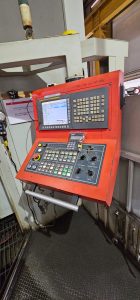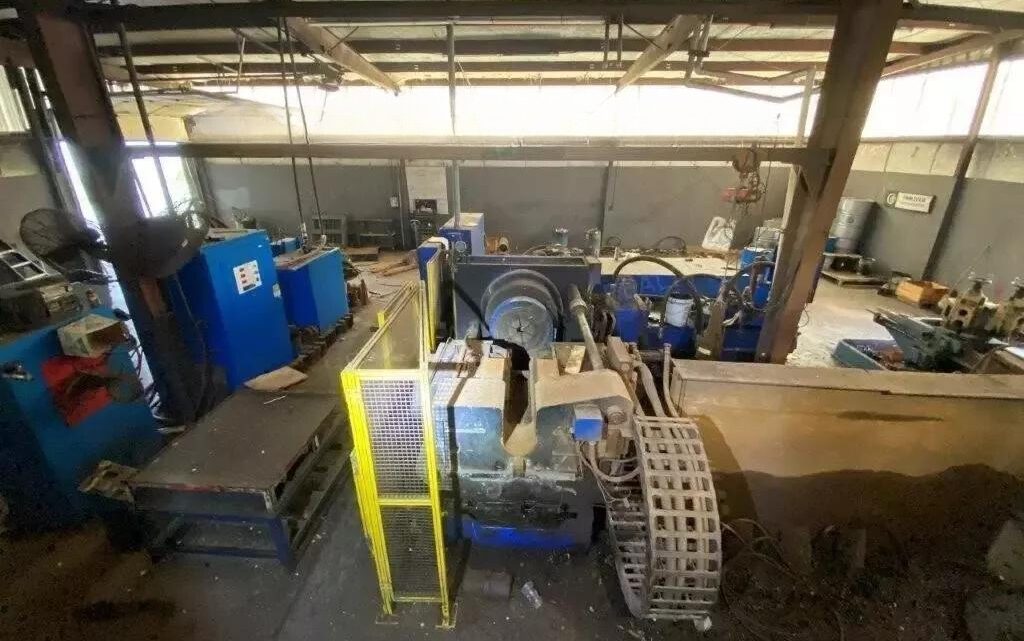
Technical Evaluation Guide: How to Identify a Quality Used, Secondhand, Pre-Owned, Surplus MTI Manufacturing Technology INC 250BX 150HP INERTIA Friction Welder made in USA
1) Machine Overview & Key Specs / Reference Data
First, gather the published / seller-provided specs so that you can measure deviations. These reference specs are based on current listings and MTI’s product line:
- The MTI 250B / BX is a rotary inertia friction welder model.
- A listing shows: 100 ton (force), 150 HP, max thrust 200,000 lb, max spindle speed 2,000 rpm, tailstock travel 25″, slide table to spindle centerline 19″.
- Another spec sheet lists the 250B / BX machine line in MTI’s inertia friction welder portfolio.
- Typical application in joining parts like valve bodies, piston rods.
From those, some “target values” you can expect (or demand) are:
| Parameter | Reference / Typical Value |
|---|---|
| Force / capacity | ~100 ton (≈ 200,000 lb thrust) |
| Motor / drive power | 150 HP |
| Max spindle / rotational speed | ~2,000 rpm |
| Spindle drawbar / clamping force | ~15,000 lb (as per listing) |
| Tailstock travel | ~25 in |
| Slide table to spindle centerline | ~19 in |
Use these as your bench marks; deviations should be explained by modifications or wear.
2) Pre-Inspection Document Request
Before going to the site, ask the seller for:
- Serial number, build year, configuration (250BX or variant)
- Original spec / capacity sheet
- Maintenance logs (bearing changes, drive repairs, lubrication)
- Past weld trials / quality test reports
- Drawings / schematics (electrical, hydraulic, pneumatic)
- Control / programming manuals (Cyrq / CNC control)
- Any known damage, repair, or crash history
- Parts list (bearings, drive components, friction discs)
- Calibration / alignment / positioning verification reports
These documents help you define acceptable deviation thresholds.
3) Visual & Static Inspection (Power Off)
With the machine de-energized:
- Frame, base & structure: inspect for cracks, weld repairs, deformations, sagging or misalignment over the long span
- Rotary spindle hub / turret / drive shaft: check for damage, dents, wear on bore or coupling surfaces
- Inertia flywheel / energy storage elements: if visible, inspect for cracks, welds, balance weights missing
- Bearing housings & supports: check for oil leaks, seal failure, wear marks
- Slide table / tailstock carriage: inspect for play, wear, alignment slop
- Tailstock or support spindle components: examine quill, slides, and supports for wear
- Drive motors, gearboxes, couplings: examine physical condition, broken teeth, misalignment, loose fasteners
- Control / CNC / operator cabinet: open panels, inspect wiring, burned insulation, loose components
- Cabling, power cables, coolant / lubrication lines: inspect insulation, connectors, signs of aging or chafing
- Hydraulic / pneumatic systems: inspect cylinders, hoses, seals for leaks or damage
- Mounting surfaces: check spindle bore, mating faces, surfaces for wear or burrs
Take detailed photographs of all suspicious areas.
4) Installation & Alignment Checks
If machine is installed or partially mounted:
- Check that the foundation / base is stable, level, and properly anchored
- Mount a reference test bar or alignment bar to the spindle axis and check for radial runout at various radial positions
- Move the slide table / carriage along full travel and verify smoothness and consistency
- Check alignment of tailstock / support axis relative to spindle centerline using dial indicators
- Inspect coupling alignment and angular / radial alignment between motor, gearbox, and spindle
5) Power-Up & Functional / Motion Tests
With safety procedures active:
- Warm-up motion: jog the table / carriage and drive axes for ~20–30 minutes to stabilize bearings, lubrication, temperature
- Homing / reference return (if control allows): perform repeated home cycles and check consistency
- Drive motion tests: command table movement (forward / reverse) at various speeds. Listen for binding, jerk, stuck spots
- Spindle ramp-up: gradually increase spindle speed up to maximum (e.g. 2,000 rpm), observing for vibration, noise, smooth acceleration
- Clamping / drawbar activation: test engagement and disengagement of drawbar / clamping for the rotating spindle
- Tailstock / support travel: move tailstock quill under power and manually, check for smoothness
- Hydraulic / pneumatic actuation: cycle any support or pressure systems (if used) to confirm responsiveness
- Control / alarm log review: inspect control’s error logs, test limit triggers, interlocks
- Encoder / feedback during motion: monitor for encoder or sensor fault during motion
6) Welding / Load Test & Quality Checks
This is critical, because the machine must produce acceptable welds:
- Use a known standard test piece (matching typical application) and perform a weld under controlled parameters
- Inspect the weld joint: look for uniform flash, absence of voids, cracks, or discontinuities
- Perform destructive / tensile tests (if feasible) to check weld strength vs specification
- Across repeated welds, check consistency (repeatability) of weld geometry
- Under varying loads, verify the rotational speed control remains stable
- Monitor spindle torque, vibration, and backlash under loading conditions
- Assess tailstock / support alignment when under pressure during weld
7) Bearing, Spindle, Couplings & Drive System Inspection
- Monitor bearing noise / vibration when spindle is rotating
- Measure spindle runout / wobble with test bar or precision tool
- Inspect couplings / torque arms for play, misalignment, wear
- Test the drawbar / clamping force to ensure it meets required retention load
- Examine gearboxes, belts, or drive trains for wear, backlash, looseness
- Under load, check for stable torque delivery and no dropouts
8) Lubrication, Cooling & Auxiliary Systems
- Confirm lubrication / oil lines are functional, no blockages, leaks, or dry zones
- Activate any coolant or lubrication delivery systems, verify flow, pressure, absence of leaks
- Inspect filters, reservoirs, tanks for cleanliness, contamination, rust
- Cycle any hydraulic / pneumatic auxiliaries for smooth operation
- Check cooling / ventilation of drive cabinets and motor assemblies
9) Common Wear & Failure Patterns / Red Flags
- Wear or play in spindle bearings or drawbar mechanism
- Excessive vibration or noise at lower or higher rpm
- Coupling misalignment or breakdown
- Drive system backlash or uneven motion at carriage
- Inconsistent weld quality, voids or non-uniform flash
- Lubrication failure or oil contamination
- Heat damage, control circuit degradation, solder joint failures
- Encoder faults, signal dropouts, sensor failures
- Cracked flywheel or imbalance of inertia mass
If several of these appear, the machine is high risk.
10) Acceptance Criteria & Benchmark Tolerances (Sample)
You can use these as a “go / no-go” benchmark (adjust per the actual machine’s spec sheet):
| Parameter | Target / Acceptable Tolerance |
|---|---|
| Spindle radial runout | ≤ 0.005 in (or better, depending on spec) |
| Reversal / backlash in carriage | Minimal, e.g. ≤ 0.001 in over direction changes |
| Repeatability of positioning (table / carriage) | ± 0.001 in or better |
| Weld quality consistency | Minimal variation over multiple cycles |
| Bearing noise / vibration | Smooth, no harsh whine |
| Drive motor smoothness / torque stability | No dips or surges under load |
| Lubrication / oil pressure stability | Consistent flow, no pressure drops |
| Temperature rise under load (spindle & bearings) | Acceptable rise after 30 min |
| Coupling / alignment error | Minimal, within spec |
| Clamping / drawbar retention force | Meets spec for safe retention |
If you find the machine fails multiple key benchmarks (especially weld quality or spindle integrity), then any purchase should include major refurbishment or price adjustment.