07/10/2025
Technical Evaluation Guide: How to Identify a Quality Used, Secondhand, Pre-Owned, Surplus Pema VRWP 12200/2 Robot Welding Gantry System made in Finland
1) Machine Overview
- Manufacturer: Pemamek Oy, Loimaa, Finland
- Model: VRWP 12200/2
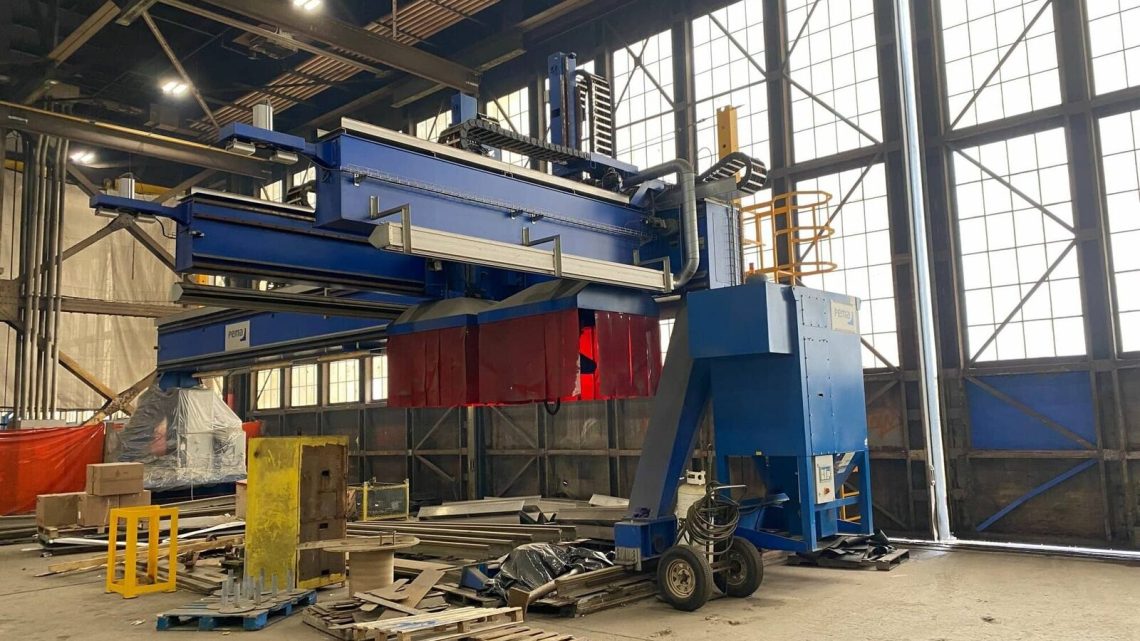
- Type: Robotic Welding Gantry / Portal Welding System
- Core Application: Heavy fabrication, shipbuilding, offshore structures, pressure vessel, wind tower, and large steel component welding.
- System Concept: Dual-axis or multi-axis overhead gantry carrying robotic welding heads (typically Yaskawa Motoman or ABB robots) for automated fillet, butt, and corner welds across large panels or structures.
- Key Strength: Extremely rigid portal structure, synchronized motion control, and full offline programming integration (PEMA WeldControl 500 / PEMA Cell Controller).
2) Documentation & Pre-Purchase Requirements
Before inspection, request the following from the seller:
- Original technical specification sheet (confirm rail length, gantry travel, robot type, welding process, and controller version).
- Robot controller manuals and backup (e.g., Yaskawa DX200 / DX100 or ABB IRC5).
- Electrical & pneumatic schematics (PEMA system diagrams).
- Commissioning reports and CE compliance certificates.
- Calibration data (robot TCP verification, vision sensor calibration if applicable).
- Maintenance logs (linear rail lubrication, gear-rack inspections, welding torch service).
- Power-on hours and robot running hours.
Red flags: Missing controller backups, incomplete wiring schematics, or no service history — especially if system was disassembled or relocated.
3) Structural & Mechanical Integrity
Portal Frame & Rails
- Inspect the gantry beams and columns for cracks, deformation, or alignment shifts.
- Check rail straightness and parallelism (≤ 0.5 mm deviation over 10 m is acceptable).
- Verify end-stop limit switches and travel sensors.
- Inspect rack-and-pinion or ballscrew drives (depending on configuration) for backlash or wear.
Carriage & Linear Bearings
- Run gantry through full X/Y/Z travel at low and high speed. Listen for gear chatter or bearing rumble.
- Check lubrication system — confirm automatic lube pump cycles properly and oil distribution reaches each rail.
- Examine cable carriers for cracked links or twisted bundles.
Workpiece Handling Tables (if equipped)
- Verify synchronized table alignment and clamping operation.
- Ensure hydraulic or pneumatic clamping pressures meet specification.
4) Robot Arm & Manipulator Inspection
- Robot Brand: Commonly Yaskawa Motoman EA1900N / HP20 or ABB IRB 2600/4400 series.
- Motion Test: Execute joint jogs through full range at low and high speed.
- Observe for vibration, squeal, or encoder drift.
- Backlash Test: Manually deflect each joint at servo-lock to verify stiffness.
- Calibration: Check TCP (tool center point) accuracy — ≤ ± 0.5 mm error is excellent; ≤ 1 mm acceptable for heavy welding.
- Harnesses: Inspect robot umbilical, torch cables, and coolant lines for wear or burnt shielding.
5) Welding Equipment & Power Source
- Typical brand: Abicor Binzel / ESAB / Fronius / Kemppi / Lincoln Electric source integrated by Pemamek.
- Check:
- Power source duty cycle (e.g., 1000 A @ 100%).
- Feeder operation and wire feed consistency.
- Cooling unit performance and coolant purity.
- Torch condition: contact tip wear, nozzle erosion, gas lens alignment.
- Gas flow check: Stable shielding gas delivery at rated L/min.
- Arc start reliability: Verify ≥ 99 % success in automated start/stop cycle test.
6) Control, Sensors & Automation
PEMA Control Interface
- Confirm PEMA WeldControl 500 / 600 software operational with all features licensed.
- Test program load/save, path editing, adaptive tracking, and data logging.
- Inspect HMI touch panel and industrial PC for display integrity.
Vision / Seam Tracking
- If equipped, verify camera calibration and proper seam detection under welding light.
- Check laser sensor cleanliness and functionality.
Safety & I/O
- Validate emergency stops, safety curtains, door interlocks, and light barriers.
- Confirm all axis limit switches and torque limit sensors respond correctly.
7) Electrical & Pneumatic Systems
- Open electrical cabinets — ensure wiring is clean, labeled, and free of corrosion.
- Inspect servo drives, inverters, and braking resistors for dust and discoloration.
- Verify cooling fans and filter elements are functioning.
- Pneumatics: pressure regulators, FRL units, and solenoid valves should operate quietly and without leakage.
8) Precision & Performance Validation
Robot Repeatability Test
- Run calibration routine using pointer tip and reference block.
- Acceptable: repeatability ≤ ± 0.1 mm @ 500 mm reach.
Path Accuracy Test
- Execute pre-programmed weld path on test coupon; measure deviation vs. CAD path (≤ 1.0 mm preferred).
System Synchronization
- Verify coordinated motion between gantry axes and robot arm — no lag or over-travel.
Test Weld
Perform a live weld test using standard material (S355 steel plate):
- Inspect bead uniformity, penetration, spatter level, and arc stability.
- Measure bead height and width vs. program targets (variation ≤ ± 10 %).
9) Auxiliary Components
- Torch Cleaning Station: Verify function (wire cut, ream, air blast).
- Fume Extraction System: Check filter condition and airflow rate.
- Cooling System: Ensure coolant flow > 3 L/min; monitor temperature rise.
- Cabling & Hoses: Securely routed with strain relief; no exposed copper.
10) Wear Components & Expected Lifetimes
| Component | Typical Rebuild Interval | Inspection Focus |
|---|---|---|
| Spindle / Rotary Drives | 20,000 h | Bearing play, vibration |
| Robot Harness | 10,000 h | Cable wear, leaks |
| Linear Guide Bearings | 15,000 h | Noise, lube flow |
| Wire Feeder | 8,000 h | Motor wear, rollers |
| Cooling Pump | 10,000 h | Flow rate |
| Fume Filter | 2,000 h | Airflow drop |
11) Acceptance & Run-Off Test Checklist
| Test | Target | Result |
|---|---|---|
| Rail alignment | ≤ 0.5 mm / 10 m | |
| Gantry motion smoothness | No chatter | |
| Robot repeatability | ≤ ± 0.1 mm | |
| Weld bead accuracy | ≤ ± 1 mm | |
| Arc start success rate | ≥ 99 % | |
| Safety E-stop | Verified | |
| HMI & software | Full control |
12) Common Issues in Used VRWP 12200/2 Systems
- Misalignment of long-travel rails after relocation.
- Cable-carrier chain cracking due to age.
- Servo amplifier fan failure or encoder drift.
- Gas hose leaks near torch rotation unit.
- Software license mismatch after control PC replacement.
13) Evaluation Summary
| Evaluation Category | Ideal Condition | Acceptable Limit |
|---|---|---|
| Gantry Geometry | ±0.5 mm / 10 m | ±1.0 mm / 10 m |
| Robot Calibration | ≤ 0.1 mm repeat | ≤ 0.2 mm repeat |
| Welding Quality | Consistent bead geometry | Minor spatter |
| Electrical Cabinet | Clean & labeled | Moderate dust |
| Safety & Sensors | 100 % active | Minor delay tolerated |
| Software / HMI | All functions operational | Minor screen aging |
14) Final Verdict
A PEMA VRWP 12200/2 in verified operational condition remains among the world’s most precise heavy-duty robotic welding gantries. Finnish engineering ensures:
- Exceptional structural rigidity,
- Stable long-stroke motion,
- Superior arc automation,
- Lifetime parts support from Pemamek Oy.
When equipped with a healthy Yaskawa or ABB robot and verified system calibration, it is capable of continuous high-accuracy multi-meter welds for decades — a flagship example of Nordic automated welding quality.