07/10/2025
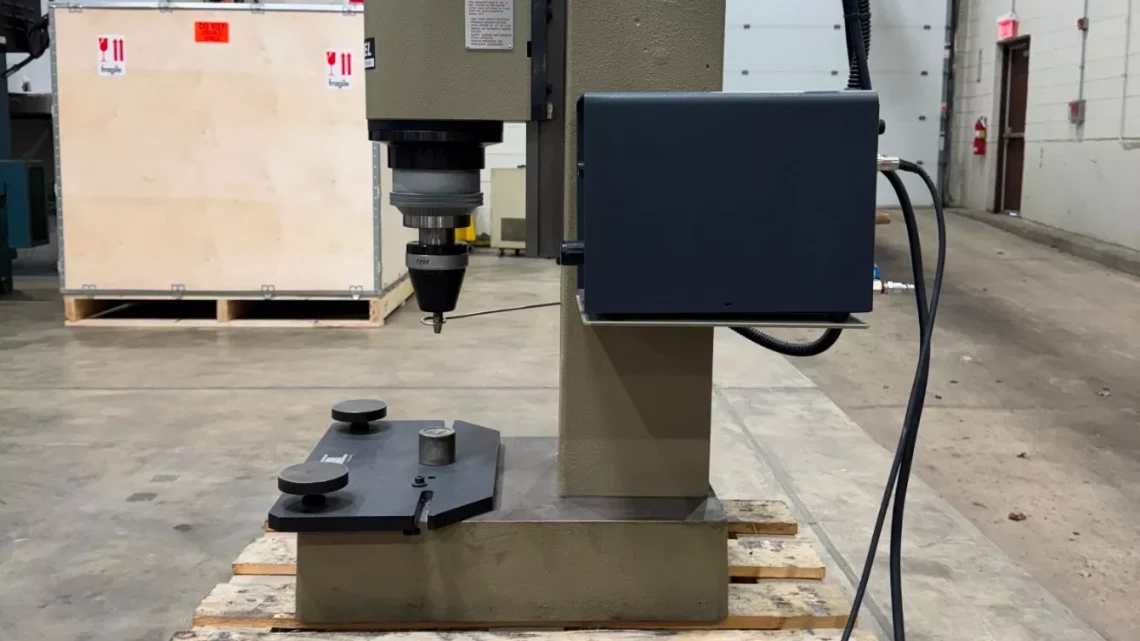
Technical Evaluation Guide: How to Identify a Quality Used, Secondhand, Pre-Owned, Surplus Taumel T-321 Bench-Top Orbital Head Forming Machine made in USA
1) Overview
- Manufacturer: Taumel Assembly Systems Inc., New York (USA)
- Model: T-321
- Machine Type: Bench-top orbital head / orbital riveting & forming machine
- Typical Use: Precision forming, swaging, riveting, crimping, or heading of small metal components (electronics, automotive, aerospace, and precision hardware).
- Construction: Compact cast-iron frame, adjustable orbital head spindle, pneumatic or hydraulic drive module, low-vibration forming cycle.
- Core Advantage: Taumel’s US-engineered orbital forming head provides controlled deformation, zero-crack forming, and superior surface finish on rivet heads compared with impact riveting.
2) Documentation & Pre-Purchase Checklist
Request from seller:
- Machine ID plate photo (confirm model T-321 and serial number).
- Original manuals – setup, lubrication, adjustment, pneumatic or hydraulic schematics.
- Forming head tooling list (cone angle, radius, diameter).
- Cycle count or hour meter reading.
- Maintenance records (spindle bearing, motor, seal replacements).
- CE / UL certificates (if exported to Europe).
- Air pressure and power specifications.
Avoid units missing head tooling, with unmarked control valves, or with home-made electrical retrofits.
3) Mechanical Condition Evaluation
Frame and Base
- Check the cast-iron housing for cracks, welds, or surface repairs.
- Verify machine level stability on bench mounts.
- Confirm that the drive column is square to the worktable (±0.05 mm).
Spindle and Orbit Head
- Rotate manually: movement should feel smooth, no grinding or axial play > 0.02 mm.
- Check orbital tilt mechanism (typically 3–6° angle) for free movement and lock clamp function.
- Verify head bearing play with dial indicator.
- Inspect forming spindle bushing for polish marks or wear.
- If available, run a test cycle with dummy part to observe head concentricity and wobble.
Drive Mechanism
- Identify drive type (pneumatic, hydraulic, or electro-mechanical retrofit).
- Cycle stroke smoothness: No hesitation or impact noise.
- Verify ram return spring or air cushion recovery.
4) Pneumatic / Hydraulic System
- Air pressure: Usually 5–6 bar (70–90 psi) — confirm gauge reading and stability.
- Listen for air leaks at valves and fittings.
- Check filter / regulator / lubricator (FRL) assembly for moisture or oil carry-over.
- For hydraulic versions: inspect hoses for cracking, pump noise, and temperature rise (< 10 °C after 15 min).
5) Electrical & Control Components
- Verify start cycle and safety interlock switches.
- Inspect motor and gear drive (if equipped) for unusual noise.
- Check emergency stop and foot pedal function.
- Open the control box: ensure clean wiring, properly grounded components, and no burnt contacts.
- Confirm limit switches and proximity sensors operate during a test cycle.
6) Tooling and Accessories
- Inspect forming tools (rivet head, cone, flat formers) for chipping or rounding.
- Measure forming tool diameter against part spec to confirm proper geometry.
- Check tool holder fit — no wobble > 0.01 mm.
- Verify availability of replacement tools and spares from Taumel or authorized dealers in the U.S.
7) Functional Testing
- Cycle test — run at rated pressure for 10–20 cycles.
- Observe ram motion (smooth, consistent speed).
- Listen for air leak on return stroke.
- Form test — use a 0.125 in steel rivet or aluminum sample.
- Check formed head symmetry and surface finish.
- Measure rivet diameter increase (should match tool geometry ± 5 %).
- Repeatability test — run 20 cycles and measure head height variation (< 0.03 mm preferred).
8) Wear Indicators and Maintenance Points
| Component | Typical Life | Inspection Method |
|---|---|---|
| Orbit head bearings | 10 000 – 15 000 h | Noise, axial play |
| Forming tools | 5 000 – 10 000 cycles (depends on material) | Visual wear on radius |
| Drive seals (O-rings) | 2 years | Air leak test |
| FRL filter elements | 6 months | Pressure drop monitor |
| Motor brushes (if AC motor) | 10 000 h | Visual inspection |
9) Dimensional and Performance Verification
| Test | Target Value | Result |
|---|---|---|
| Spindle runout | ≤ 0.02 mm | |
| Orbital angle accuracy | 3 – 6° ± 0.2° | |
| Formed head concentricity | ≤ 0.05 mm | |
| Cycle time consistency | ± 3 % | |
| Air leak rate @ 6 bar | ≤ 0.2 L/min |
10) Typical Failure Modes to Watch For
- Excessive noise from worn spindle bearings.
- Head tilt mechanism sticking due to dry lubrication.
- Air valve lag causing incomplete form.
- Over-polished forming tools causing slip marks.
- Cracked mounting base if machine was bolted too tight on rigid bench.
11) Acceptance & Verification Checklist
| Inspection Item | Acceptable Condition | Verified (✓/✗) |
|---|---|---|
| Frame integrity | No cracks or welds | |
| Spindle smoothness | Uniform rotation | |
| Air/Hydraulic leaks | None visible | |
| Control functionality | All switches respond | |
| Test forming accuracy | ± 0.03 mm | |
| Tool alignment | Within 0.05 mm center offset |
12) Summary of Evaluation Criteria
| Category | Excellent Condition | Acceptable Condition |
|---|---|---|
| Frame & Base | Original finish, no damage | Minor cosmetic wear |
| Spindle & Bearings | Silent, no play | Light bearing noise |
| Pneumatics | No leaks, steady pressure | Minor leak < 0.2 L/min |
| Tooling | Full set, sharp tips | Moderate wear |
| Electrical Control | Clean, responsive | Minor switch oxidation |
| Functional Accuracy | ± 0.02 mm repeatability | ± 0.05 mm repeatability |
13) Final Verdict
A well-maintained Taumel T-321 Bench-Top Orbital Head Forming Machine represents one of the most durable and repeatable precision forming tools in its class.
Made in the USA, it is known for:
- Exceptional mechanical stability
- Consistent, non-impact forming results
- Low maintenance requirements
- Widely available spare parts and tooling support
With verified forming accuracy and stable pneumatic or hydraulic drive performance, a used T-321 can deliver production-grade repeatability for years — making it a top-tier choice for high-precision rivet and head-forming operations.