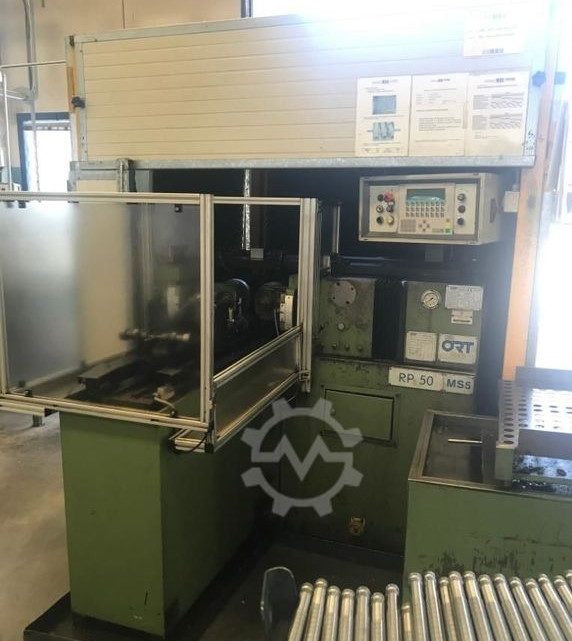
Technical Evaluation Guide: How to Identify a Quality Used, Secondhand, Pre-Owned, Surplus ORT RP50 MS5 CNC Thread & Gear Rolling Machine made in Italy
1. Machine Overview & Key Specs (Reference)
To properly inspect, first gather any spec data available — here’s what you should look for or ask:
- Make & origin: ORT (Italy) — their RP series of rolling machines are built in Italy.
- Model: RP50 MS5 (variant)
- Key parameters: rolling force capacity, die size range, feed/infeed modes (in-feed / thru-feed), CNC control axes, servo motors, spindle RPM, die inclination mechanism (if applicable)
- Note: ORT’s RP series (including “EVO” or “CN” variants) are servo-driven, with PLC and touch screen interfaces.
- Ask for original machine drawings, build sheets, user manuals, and spare parts lists.
Having good documentation is critical before physical inspection.
2. Documentation & Records to Request
Before visiting the machine, secure or review:
| Document | Purpose / What to Verify |
|---|---|
| Build / specification sheet | Confirms original configuration, capacity, options |
| CNC / PLC backups | Ensures you can restore control parameters if needed |
| Maintenance & service logs | History of repairs (dieholders, gearbox, bearings) |
| Calibration / alignment certificates | Ensures machine was within tolerance during life |
| Spare parts list, tooling list | Availability of dies, spare spindles, bearings |
| Electrical and hydraulic schematics | Aid in fault diagnosis and repair |
| Machine hours / cycles | Estimate wear based on utilization |
If any of these are missing, that is a red flag to negotiate lower or request additional tests on-site.
3. Structural & Mechanical Inspection
When on-site, carefully check the physical integrity of the machine:
Frame, Base & Alignment
- Check for cracks or weld repairs on base, columns, cross members, or support structure.
- Inspect weld seams and bolt joints—visible distortion can hint at overloads or structural stress.
- Leveling pads: ensure they are intact, properly adjusted, and not excessively worn.
- Machine alignment: later in tests, you’ll verify that axes are aligned (dieholder alignment to rolling axis, parallelism, etc.).
Guideways, Slides & Ball Screws
- Jog each axis (if machine has linear axes for feed, repositioning, or die tilt) at low and high speed; listen for roughness, binding, or vibration.
- Check backlash on feed axes using a dial indicator with servo-locked axes.
- Observe lubrication lines: are they clean, correctly routed, and supplying lubricant to sliding and rolling surfaces?
- Inspect couplings, support bearings, and end supports for play or noise.
Gearboxes, Linkages & Spindle Drives
- The machine’s roll-driving spindles might use gearboxes or direct drives. Listen for unusual gear whine, backlash, or looseness.
- Check for oil leaks at seals, flanges, and inspection ports.
- Verify that rotating parts (spindles, cross-feed screws) spin freely when decoupled (if possible) and without abnormal resistance.
Dieholders & Inclination / Tilt Mechanism
- Many thread/gear rolling machines use a mechanism to incline or tilt dies. Check that the inclination mechanism is stiff, repeats accurately, and does not “wander.”
- Inspect dieholder slides, bearings, and clamping elements (hydraulic or mechanical) for wear or play.
4. Control, Servo & CNC Systems
The “CNC” aspect of RP50 MS5 is crucial—verify that electronics and control systems are genuinely functional.
Control & PLC
- Power up the machine—watch for errors or alarms.
- Load stored programs; check axis homing, jog functions, parameter read/write, and touch screen responsiveness.
- Verify CPU, I/O, and communication modules appear clean, undamaged, and free from burnt or corroded connections.
- Confirm that you can back up or export PLC programs, recipes, and control parameters.
Servo Drives & Motors
- Check diagnostics screens or readouts for servo error codes (overcurrent, encoder fault, following error).
- Jog axes at different feed rates; listen and feel for stuttering or lag.
- After static tests, run a dynamic motion test (e.g., move axes along a programmed contour) and see if axes follow without oscillations or hunting.
Sensors, Limit Switches & Safety
- Verify limit switch and home sensor operation for all axes.
- Emergency stop, protective covers, and interlock doors should immediately stop motion when triggered.
- Check wiring harnesses, connectors, shielding, and cable carriers for wear, kinks, or exposed wires.
5. Precision, Accuracy & Performance Testing
These are tests to gauge whether the machine is still capable of high-quality thread or gear rolling.
Static & Geometric Checks
| Parameter | Test Method | Acceptable Tolerance* |
|---|---|---|
| Axis backlash (feed axes) | Dial indicator test | ≤ ~0.01 mm (varies by spec) |
| Spindle / roll spindle runout | Test bar or precision collet | ≤ 0.005 mm (if new) |
| Dieholder alignment / parallelism | Use master ground block or straightness bar | ≤ 0.01 mm over die span |
| Inclination accuracy / repeatability | Indicator or angle test | ≤ a few hundredths of a degree |
| Coupling backlash | Measure input/output coupling play | Very minimal |
* These tolerances are approximate; refer to ORT spec sheets or ask for factory tolerances.
Dynamic & Functional Rolling Tests
- Dry Motion Test
Run the machine in CNC mode without workpiece—move through full axis range, check for smooth motion, stop at limits, check acceleration/deceleration behavior. - Test Rolling of Sample Part
Use a known blank and dies (if available) to roll a sample thread/gear. After rolling:- Check profile accuracy vs. known master or drawing.
- Verify pitch, diameter, surface finish, and residual stresses (no cracks or deformed features).
- Inspect wear on dies post test to see if the machine caused abnormal loading.
- Cycle Repeatability
Run multiple repeated rolls (e.g. 20–50 cycles) with same blank; measure variation in roll parameters (diameter, thread pitch, alignment) — ideally variation within a few microns. - Speed / Load Test
If feasible, run at near-production speed using heavier blanks to see if drive system holds up without drive faults or loss of control precision.
6. Wear Indicators & Consumable Condition
These are parts you should check carefully, as they often reveal the true “age” of a rolling machine.
- Die wheels / rolling dies: check for pitting, chipping, wear, dimensional drift.
- Dieholder clamps, collets, or inserting mechanisms: wear or looseness.
- Gearbox oil: check for metal contamination or discoloration.
- Bearings (spindle, feed axes): noise, heat, play.
- Lubrication filters and lines: clogged lines, dirty filters.
- Cable carriers, protective covers, bellows: cracks, broken links or rigidity.
- Hydraulic / pneumatic seals: check for leaks at cylinders or actuators.
7. Acceptance & Run-Off Checklist
Here’s a checklist you can use as part of your inspection contract or acceptance test:
| Test / Check | Target / Acceptable Result |
|---|---|
| Machine powers on with no major alarms | ✓ |
| All axes servo / CNC moves smoothly | ✓ |
| Axis backlash within spec | ✓ |
| Spindle / roll spindle runout minimal | ✓ |
| Control programs load / save correctly | ✓ |
| Limiting switches, sensors, E-stop functional | ✓ |
| Test roll demonstrates correct profile & pitch | ✓ |
| Repeatability across 20–50 cycles within tolerance | ✓ |
| Gearbox / oil free of heavy wear particles | ✓ |
| Structural integrity (no cracks, welds) | ✓ |
| Dieholder tilt or inclination mechanism accurate & repeatable | ✓ |
8. Common Failure Modes & Weaknesses in Used ORT Rolling Machines
Be alert for these common issues when assessing a secondhand ORT RP50:
- Excessive gearbox backlash or wear in drive train (gears, shafts)
- Dieholder mechanism play or looseness in inclination or clamping
- Aging or drift in servo encoder systems
- Control electronics obsolescence or missing backups
- Corroded or dry lubrication systems leading to poor slide action
- Deteriorated cables, harnesses, or broken cable carriers
- Wear in bearings or couplings that is not user-visible but shows up under test load
9. Evaluation Summary Table
| Category | Excellent | Acceptable |
|---|---|---|
| Structure & Frame | No welds, tight tolerances | Minor cosmetic repair |
| Axis & Feed Mechanisms | Smooth, no backlash | Slight backlash within spec |
| Drive System (gearbox & spindles) | Quiet, tight, no play | Some gear whine under load |
| Control / CNC | Fully backed up, responsive | Some older modules, but works |
| Rolling Results | Profiles within spec, high repeatability | Slight variation but usable |
| Die & Consumables | Minimal wear | Moderate wear, but replaceable |
| Safety & Sensors | All interlocks correct | Minor sensor lag but functional |