07/10/2025
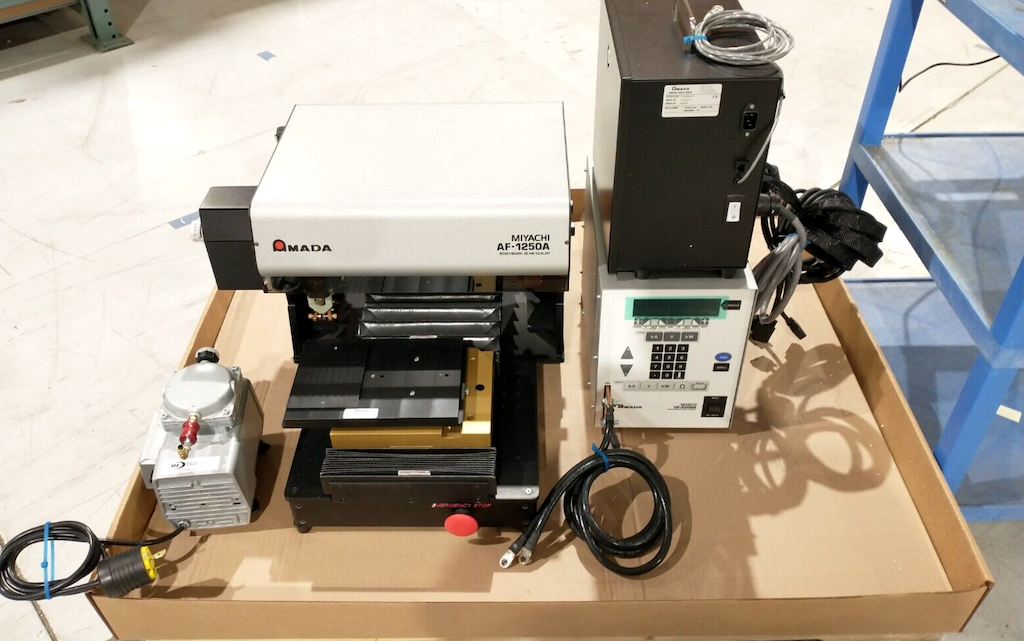
Technical Evaluation Guide: How to Identify a Quality Used, Secondhand, Pre-Owned, Surplus AMADA MIYACHI AF-1250A Autoflow Lid Placement Tack and Seam Sealing Systems made in Japan
1) Overview
- Manufacturer: AMADA MIYACHI Corporation, Japan
- Model: AF-1250A Autoflow
- Machine Type: Automated Lid Placement, Tack Welding, and Seam Sealing System
- Country of Origin: Japan
- Core Application: Hermetic sealing of microelectronic, RF, optical, and sensor packages under controlled atmosphere (typically inert gas or vacuum).
- Construction: Precision-engineered stainless and aluminum frame, integrated robotic lid handling, seam welder head, and environmental chamber system.
- Key Strength: Superior repeatability in weld sealing of hermetic packages; precise alignment between lid and package achieved through servo-controlled stages and vision guidance.
2) Pre-Purchase Documentation Checklist
Before inspection or purchase, request:
- Original specification sheet (model variant, gas system configuration, seam welder power rating, chamber type).
- System layout diagram (vacuum chamber, lid feeder, motion axes).
- Service and calibration logs (especially for weld power calibrations, leak tests, and vacuum gauges).
- Operating hours (vacuum pump and seam welder).
- Software version and license key information (AMADA MIYACHI WeldControl software).
- Equipment manuals and CE/JIS certificates.
- Spare parts list (motors, sensors, seals, weld wheel electrodes).
Avoid systems lacking calibration logs or weld process history — these are critical for process repeatability and vacuum integrity.
3) Mechanical Assembly and Structural Integrity
Frame & Motion System
- Inspect frame and motion rails for corrosion, misalignment, or contamination.
- Check X/Y/Z linear stages for smooth travel and accurate homing (backlash ≤ 0.005 mm).
- Examine servo couplings and ball screws for noise or vibration.
- Verify Z-axis spindle or lifter maintains parallelism under load (< 0.02 mm deflection).
Vacuum Chamber / Gas Enclosure
- Inspect chamber body and O-ring grooves for scratches or dents.
- Confirm lid closes evenly — no tilt or hinge offset.
- Helium leak test recommended: leak rate ≤ 1×10⁻⁹ mbar·L/s.
- Verify viewports are clean, undamaged, and properly sealed.
4) Seam Welding Subsystem
Weld Head & Electrodes
- Inspect seam weld wheel electrodes (typically tungsten or molybdenum alloy) for pitting or flat spots.
- Measure electrode runout (< 0.01 mm TIR).
- Verify electrode pressure calibration within OEM range (often 20–80 N).
- Check electrode bearings for smooth rotation and uniform torque.
Weld Power Supply
- Confirm AMADA MIYACHI seam welding controller boots with no error codes.
- Test output waveform stability under dummy load; current deviation ≤ 2%.
- Inspect weld transformer cooling (air or water).
- Validate electrode-to-electrode isolation — leakage < 1 MΩ.
5) Lid Placement & Handling System
- Examine robotic arm / pick-and-place head for motion precision and vacuum pickup consistency.
- Confirm lid magazine feeder alignment and capacity operation.
- Test vision alignment camera calibration — positional deviation ≤ ± 0.02 mm.
- Check vacuum suction pad integrity and manifold seals.
- Run a test cycle: lid pick, align, place, and hand-off sequence should be continuous without mis-pick or double feed.
6) Control, Electronics & Software
- Confirm controller boots normally; no PLC, servo, or motion alarms.
- Check axis homing sensors, limit switches, and safety interlocks.
- Verify E-stop and door interlocks interrupt motion immediately.
- Inspect weld data storage and recipe system (can log weld parameters per part).
- Backup existing recipes, calibration offsets, and system configuration files.
- Check Ethernet / RS-232 ports for communication (for data export and service access).
7) Gas Flow & Vacuum System
- Inspect gas inlet manifolds for contamination or oil carry-over.
- Confirm mass flow controllers (MFCs) read within ± 1% of rated flow.
- Check vacuum pump noise level (< 65 dB typical) and ultimate pressure (< 5×10⁻⁵ mbar).
- Verify gas purity sensors and oxygen ppm sensors are functional and calibrated.
- Confirm vacuum valves actuate smoothly and no leaks at fittings.
8) Calibration & Precision Verification
| Test | Target | Method |
|---|---|---|
| Stage positioning repeatability | ± 0.002 mm | Dial or laser interferometer |
| Lid placement accuracy | ± 0.02 mm | Vision feedback |
| Seam track straightness | ± 0.01 mm | Coordinate measurement |
| Electrode pressure deviation | ± 5 % | Load cell check |
| Weld current stability | ± 2 % | Power monitor |
| Vacuum leakage rate | ≤ 1×10⁻⁹ mbar·L/s | Helium test |
| Chamber O₂ level | ≤ 50 ppm | O₂ analyzer |
9) Functional Performance Tests
- Dry Run: Execute full auto-cycle (lid pick, align, place, weld, vent).
- Observe for any servo lag, vacuum delays, or gas flow inconsistencies.
- Seam Welding Test:
- Material: Kovar lid to package test coupon.
- Inspect bead continuity, uniformity, and discoloration.
- Measure bead width and penetration: within ± 10 % of target spec.
- Hermetic Test:
- Perform helium leak test on welded sample; pass if ≤ 1×10⁻⁹ mbar·L/s.
10) Wear & Service Life Indicators
| Component | Typical Life | Common Symptoms |
|---|---|---|
| Weld Wheel Bearings | 10 000 – 15 000 h | Rough rotation |
| Vacuum Pump | 20 000 h | Low ultimate pressure |
| MFCs (Gas Controllers) | 5 years | Flow drift |
| Servo Drive | 25 000 h | Following error alarms |
| Electrode Wheels | 5 000 cycles | Burn marks, pitting |
| O-rings / Seals | 2 years | Vacuum leak |
| Vision Camera | 8 years | Dead pixels, drift |
11) Acceptance & Run-Off Checklist
| Inspection Point | Target | Result |
|---|---|---|
| Weld current stability | ± 2 % | |
| Electrode pressure | 20–80 N consistent | |
| Stage repeatability | ± 0.002 mm | |
| Vacuum integrity | ≤ 1×10⁻⁹ mbar·L/s | |
| Gas flow uniformity | ± 1 % | |
| Vision alignment | ± 0.02 mm | |
| E-stop & interlocks | Pass | |
| Alarm history | Clean |
12) Common Issues in Used AF-1250A Systems
- Vacuum pump degradation → slow chamber evacuation.
- Weld transformer insulation wear → unstable current output.
- Camera or MFC calibration drift after long idle periods.
- Chamber O-ring hardening → minor vacuum leaks.
- PLC battery failure causing loss of calibration data.
- Contaminated gas lines reducing purity during sealing operations.
13) Evaluation Summary Table
| Category | Excellent Condition | Acceptable Condition |
|---|---|---|
| Frame & Structure | Clean, no corrosion | Minor cosmetic marks |
| Seam Welder | Current stable ± 2 % | Slight arc variation |
| Motion System | ± 0.002 mm repeat | ≤ ± 0.005 mm repeat |
| Vacuum System | Leak-free ≤ 1×10⁻⁹ mbar·L/s | Minor leak ≤ 5×10⁻⁸ mbar·L/s |
| Vision / Placement | ± 0.02 mm | ± 0.05 mm |
| Gas Flow | ± 1 % uniform | ± 3 % |
| Electrical / Control | Alarm-free | Minor parameter loss |
| Hermetic Test | Passed | Minor re-seal needed |
14) Final Verdict
The AMADA MIYACHI AF-1250A, Made in Japan, is a benchmark system for precision hermetic packaging and seam sealing in advanced electronics manufacturing.
When maintained and calibrated properly, it offers:
- Sub-micron stage precision and reliable automation
- Stable seam weld performance under vacuum/inert conditions
- Proven Japanese engineering and long service life
A used AF-1250A system with verified weld stability, leak-free vacuum, and current calibration can perform as reliably as newer models, representing one of the most dependable Japanese automated sealing systems on the secondary market.