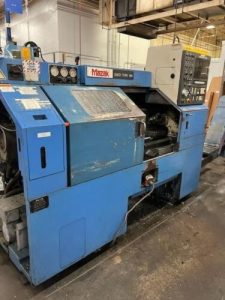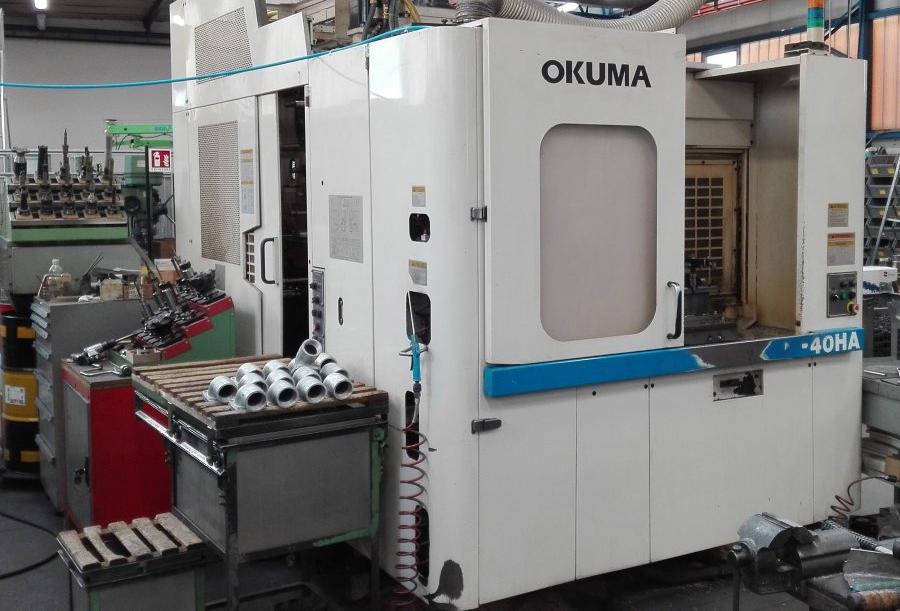
Technical Evaluation Guide: How to Identify a Quality Used, Secondhand, Pre-Owned, Surplus Okuma MX-40HA CNC Horizontal Machining Centre made in Japan
1. Reference Benchmarks & Expected Specifications
Before going to the shop, request the original build / as-delivered specification sheet for that particular machine (serial / options). Use it as your “contractual benchmark.” Meanwhile, here are specs from used / listing sources for the Okuma MX-40HA:
| Parameter | Typical Value(s) | Notes / Sources |
|---|---|---|
| X travel | ~ 22.04 in (≈ 560 mm) | Listings: “Travel (X) 22”” |
| Y travel | ~ 24.01 in (≈ 610 mm) | Listings: “Travel (Y) 24”” |
| Z travel | ~ 22.04 in (≈ 560 mm) | Listings: Z = 22.04” |
| Spindle speed | up to 7,000 rpm (some variants 12,000 rpm) | Listings: “50 – 7,000 rpm” some listings include “50 ~ 12,000 RPM” as spec range |
| Spindle motor power / rating | ~ 20 HP / ~ 15 kW | Listing for MX-40HA: “Motor cont. 20” other machine listing: “Spindle Motor: 26.85 HP” for a variant |
| Tool magazine / ATC capacity | ~ 30 tools | Many listings quote 30 tools |
| Pallet / table / indexing | Pallet size ~ 16 × 16 in, B-axis (pallet rotation) indexing ~1° | Listing says: “Pallet Size 16 x 16, Pallet Indexing (B) 1 Degree” |
| Rapid traverse (X, Y, Z) | ~ 1,181 IPM (≈ 30 m/min) | Listing “Rapid Traverse (X,Y,Z) 1181” |
If the unit you’re inspecting deviates strongly from those values (e.g. much lower spindle rpm, fewer tool pockets, smaller travels), get solid reasons (variant, removed option) and reduce your price accordingly.
2. Documentation & History Review
Start by gathering as much documentation as possible. The more you know, the less you risk.
- Factory build / as-delivered spec / configuration drawing — with serial number, option list (CTS, palleting, rotary axes, control version)
- Maintenance / service logs — history of spindle rebuilds, axis alignments, preventative maintenance
- Operating hours / duty profile — total runtime, hours under cutting load vs idle
- Repair / modifications / upgrades — what parts have been replaced, any crash history, structural welds
- Calibration / geometry / metrology records — prior straightness tests, backlash measurements, tool offset logs
- Tooling / fixture / accessories inventory — which tool holders, pallets, tombstones, probes are included
- Control / CNC backups / parameter archives / alarm logs — helps confirm consistent performance
- Electrical / wiring diagrams, parts list, manuals
If the seller cannot provide credible documentation, elevate the risk — insist on stricter test runs or warranty provisions.
3. Visual & Structural / Cold Inspection
With power OFF, walk the machine carefully and inspect external and accessible internals.
Machine Structure & Base
- Inspect the base, frame, saddle, support structures for cracks, weld repairs, distortions, sagging, misalignment
- Look for corrosion, pitting, rust especially in hidden corners, underside, around coolant or chips
- Ensure all covers, guards, chip shields, splash guards, wipers, bellows, covers are intact — missing covers create contamination risk
- Check bolted joints and structural flanges — none should have looseness, missing fasteners, misalignments
Guideways, Ways, Slides
- Inspect linear guide surfaces / ways for scoring, scratching, pitting, uneven wear
- Check protective wipers, seals, bellows: if they are damaged or missing, likely internal contamination
- Observe transitions at edges, corners, where chips collect — wear intensifies there
Spindle & Spindle Nose / Taper
- Examine spindle nose / taper interface for pitting, dents, wear, discoloration
- Inspect spindle housing / bearing covers for oil staining, leakage, repair marks
Tool Magazine / ATC Mechanism
- Inspect magazine rails, arms, indexing cams, grippers, pocket seats for wear, looseness, damage
- Check alignment, play, broken parts or missing components
Pallet / Rotary / B-axis System
- Examine pallet surfaces, bearing pads, indexing joints, B-axis drive (if present), for wear, backlash, looseness
- Check for smoothness of rotary motion if possible (menially) for binding or play
Wiring / Electrical / Panels
- Open electrical/control cabinets: inspect wiring, connectors, insulation, heat damage, splices
- Inspect cable carriers, motor cables, conduits: no chafing, slack, exposed insulation
Coolant / Lubrication / Chips
- Inspect coolant piping, hoses, valves, nozzles, coolant tank for leaks, corrosion
- Check lubrication lines to axes: confirm intact lines, no leaks or blockages
- Examine chip conveyor, chip guides, collection trays — misalignment or damage is a warning
4. Mechanical / Kinematic / Static Checks (Jog / Manual Moves)
Where allowed, jog axes or move parts in low-speed / safe mode to sense mechanical integrity.
- Jog each axis (X, Y, Z) slowly: feel for binding, variation in resistance, sticky zones, dead spots
- Reverse direction and measure backlash / lost motion via dial indicator (small ± move and back)
- At various positions, mount indicator and test straightness / linear deviation along axis
- Actuate tool magazine (in manual or slow mode): index some stations, observe hesitation or misalignment
- Mount clean toolholder / test bar: gently tap/twist to detect axial / radial play
- Use dial indicator to measure toolholder / spindle taper runout
- Perform a dye / marking compound test: deposit thin film on taper, seat toolholder lightly, rotate slightly, remove and inspect contact patch — uniform contact is good
If you detect large backlash, binding zones, or toolholder play, these are serious red flags.
5. Power-On / Dynamic / Functional Testing
Once safe to power, perform dynamic / motion / spindle tests (with no / light load if possible).
- Power up CNC and control: observe boot sequence, alarm / fault logs, axis enable status
- Test manual / jog / incremental move functions on control interface
- Perform homing / reference cycles for all axes; confirm repeatability and reliability
- Run a motion-only program (no cutting) combining X / Y / Z / rotary / pallet movements — watch for axis stalls, collisions, delays
- Ramp spindle through speed range (from low to max) and listen / feel for vibration, noise, smooth acceleration
- If safe, mount a soft material (e.g. aluminum) and run a light cutting test (milling, drilling) to evaluate surface finish, chatter, stability
- Run full automatic tool change cycles to test magazine / gripper operation, misloads, speed, alignment
- Test pallet / rotary motion under program: index, rotate, observe stability, repeatability
- Warm-up / thermal drift: run spindle + motion for 30–60 min, then repeat reference moves / test cuts to detect drift
During tests, monitor motor currents, axis temperatures, vibration, servo behavior.
6. Metrology / Accuracy & Precision Verification
This is critical to know whether the machine can meet your production tolerance.
- Linearity / straightness: measure deviation along full travel of X, Y, Z axes vs ideal straight line
- Orthogonality / squareness: check whether axes are perpendicular (X–Y, X–Z, Y–Z)
- Backlash / reversal error: measure hysteresis for each axis
- Spindle / tool runout: mount a precision test bar and measure radial & axial deviation
- Tool change repeatability: after tool changes, measure tool tip offsets for variation
- Thermal drift / repeatability: compare before / after warm-up cycle
- Test cutting accuracy: machine a known test geometry; measure dimensional deviation from program
- Surface finish / chatter evaluation: inspect machined surfaces for irregularities, waviness, chatter
Compare your measurements with factory tolerances (if available) and with your required tolerances. If variance is too big or inconsistent, the machine may be unsuitable for precision work.
7. Key Red Flags & Warning Signs
Throughout your inspection and testing, watch for these warning signs — encountering several should significantly reduce your confidence or require price adjustment:
- Excessive or inconsistent backlash
- Binding, sticky or “dead zones” in axis motion
- Spindle bearing noise, vibration, or detectable play
- Toolholder taper wear or inability to achieve full contact via dye test
- Tool change failures, misindex, dropped tools
- Pallet / rotary system backlash, misalignment, looseness
- Strong thermal drift causing geometry changes after warm-up
- Poor repeatability on return-to-zero or repeated moves
- Structural repairs (welds, cracks) in critical casting / frame areas
- Missing or damaged covers, bellows, seals allowing contamination
- Control / CNC memory errors, frequent alarms, unstable behavior
- Overheated motors or drive modules, servo anomalies
- Lack of credible maintenance history or absent spare parts
- Obsolescence in control electronics or unavailability of replacements
If you see several of these, negotiate heavily or walk away from the deal.
8. Risk Buffer / Refurbishment Cost Estimate
Even a “good” used MX-40HA may require refurbishment. In your offer, include contingencies for:
- Spindle bearing repair or replacement
- Regrinding or re-lapping guideways, slides
- Replacement / servicing of ballscrews, nuts, encoders
- Tool magazine / gripper / indexing mechanism overhaul
- Pallet / rotary drive / bearing refurbishing
- Control / servo drive electronics repair or updating
- Re-lubrication, coolant system cleaning / piping replacement
- Cover / bellows / wiper replacement, cable carrier repairs
- Calibration, alignment, metrology checks, test cuts after install
- Installation, leveling, rigging, commissioning
- Contingency margin (10–20 % or more) for hidden damage
9. Contract / Acceptance Safeguards & Test Protocols
To protect your purchase, bake in these safeguards and test requirements:
- On-site / acceptance test period: require full operational demonstration (motion + spindle + tool changes + test cuts) before final acceptance
- Acceptance criteria / tolerance schedule: define allowable limits on backlash, runout, repeatability, drift, test cut error
- Test parts / sample program run: bring representative part(s) and require the seller to machine them so you can measure performance
- Independent inspection clause: allow a third-party metrology / machine-tool expert to audit before final payment
- Warranty / guarantee clause: for critical subsystems (spindle, axes, toolchanger, pallet) for a limited period post-installation
- Holdback / retention clause: retain part of payment until acceptance is confirmed
- Disclosure requirement: seller must reveal known wear, repairs, limitations, or modifications