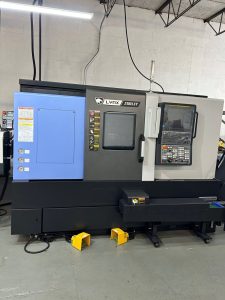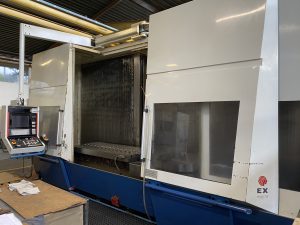
Technical Evaluation Guide: How to Identify a Quality Used, Secondhand, Pre-Owned, Surplus OKK HMC 500 CNC Horizontal Machining Center made in Japan
1. Reference Specs & What “Normal” Looks Like
Before inspection, get the factory spec sheet (for that serial / build). Use it to spot deviations. As a reference, here are published specs for the OKK HMC 500 series (from machine dealers) that you should treat as “target benchmarks”:
| Parameter | Typical / Published Value | Notes / Source |
|---|---|---|
| X travel | ~ 760 mm | listing: “29.9 in (760 mm)” |
| Y travel | ~ 760 mm | Same listing |
| Z travel | ~ 800 mm | Same listing |
| Table / Pallet size | 500 × 500 mm | listing: Table size 500 × 500 mm |
| Table load / max workpiece | ~ 700 kg (optionally) | OKK official listing: “Max loadable weight 500 (OP: 700) kg” |
| Rapid traverse | 63 m/min (≈ 2,480 in/min) | listing: rapid traverse X/Y/Z = 2,480 in/min = 63 m/min |
| Spindle speed (standard) | 15,000 rpm | spec: 15,000 rpm |
| Spindle power | ~ 50 HP (≈ 37 kW) | listing: Spindle power 50 HP |
| Tool magazine capacity | 60 tools standard | list: “Standard Number of Tools 60” |
| Pallet change time | ~ 13 sec (cut-to-cut) | listing: Table Change Time = 13.0 sec |
| Machine footprint / weight | ~ 4,845 × 2,750 mm; weight ~ 10,500 kg | spec sheet: floor space 4,845 × 2,750 mm, height ~2,970 mm, weight 10,500 kg |
These should help you identify when a machine is significantly below spec (e.g. lower speed, reduced travel, missing options). Always compare to the actual build sheet.
2. Documentation & History Review
Before even turning a wrench, get as much documentation as possible. A well-documented machine is a much safer buy.
What to request / examine:
- The original build / as-delivered spec sheet — which options, which spindle, pallet system, coolant, etc.
- Maintenance logs — dates and details: spindle rebuilds, alignment checks, lubrication schedule, major overhauls.
- Operating hours & duty profile — total runtime, cut vs idle, how intensively it was used.
- Repair / modification history — any structural repairs (welds, cast repair), retrofits, control change, spindle swap.
- Calibration / test reports — geometric checks, backlash tests, tool offset verification, axis alignment, spindle runout logs.
- Tooling & accessories included — pallets, fixtures, probes, spare spindles, tool holders.
- Electrical / control backups — CNC parameter sets, alarm history, graphs, control software/firmware version.
- Parts / consumables history — what parts (bearings, seals, motors) were replaced.
If documentation is minimal, you must be more rigorous in your inspection, and demand warranties or discounts accordingly.
3. Visual / External / Cold Inspection
With the machine powered off, inspect everything you can see. Many problems show outward signs.
Machine Structure & Base
- Look for cracks, weld repairs, distortions in base, column, cross beams, supports.
- Check for corrosion, pitting or rust in crevices, hidden areas, underside, around coolant sumps.
- Ensure all covers, guards, doors, chip shields, splash guards are present and in good condition.
- Check structural joints, bolted flanges, stiffeners — none should be loose or warped.
Guideways / Rails / Carriages
- Inspect visible linear guide surfaces (X, Y, Z axes) for scoring, pitting, scratch lines, wear patterns.
- Check the protective wipers / bellows / covers: if they are damaged or missing, internal parts may have been contaminated.
- Check turret slide surfaces, cradles, or bearing surfaces for signs of wear or misalignment.
Spindle / Spindle Nose
- Look at the spindle nose and taper face carefully: pitting, corrosion, discoloration, dents, or uneven wear are red flags.
- Check spindle housing, seals, bearing covers for leaks or signs of repair.
Pallet / Table / Clamping System
- Inspect the pallet(s), clamping surfaces, rails, bearings, whether pallets move cleanly, whether there is play, wear, damage.
- Check the pallet change mechanism, rails, shuttles for smoothness and alignment.
Tool Magazine / Tool Changer
- Inspect tool magazine carousel, rail, tool arms, grippers for damage, wear, play.
- Check for missing or damaged tools or pockets, misalignment in arms, broken sensors.
Wiring / Electrical / Plumbing
- Open control / electrical panels: inspect wiring for burned insulation, poor splices, moisture damage.
- Check cable carriers, conduits, motor cable routing, coolant / hydraulic lines for damage or chafing.
- Inspect coolant piping, hoses, valves for leakage, corrosion, cracks.
Coolant, Chip Handling & Lubrication
- Inspect coolant system: piping, pump housing, nozzles, sumps, filters.
- Check whether lubrication lines to axes are intact, free of leaks, proper fittings.
- Inspect chip conveyor / chip removal mechanism: belts, screw conveyors, slat conveyors, guides for damage or misalignment.
If you see structural damage, missing critical parts, or poor overall condition, these are serious warning signs.
4. Static / Mechanical / Kinematic Checks
Assuming it is safe and permissible to jog or move parts (or even manually move some axes), perform mechanical & kinematic tests. You’re checking for smoothness, backlash, binding, play.
Axis Movement (X, Y, Z)
- Jog each axis (in manual / single-step mode) slowly over a portion of travel. Feel for binding, grittiness, jumps, inconsistent resistance.
- Reverse direction and measure backlash / hysteresis via dial indicator: move +x then -x and see the “dead zone.” It should be small and consistent.
- At multiple axis positions, use a test indicator to check for straightness or pitch deviation along travel.
Pallet / Table Motion
- Move pallet(s) if possible (in manual or slow mode): check for smooth sliding, no binding, consistent motion.
- Reverse direction and note if there’s any backlash or sloppy motion in the pallet mechanism.
Spindle / Toolholder Static Play
- Mount a known, precision toolholder / test bar. Tap or twist to check for radial or axial play. Any measurable play is suspect.
- Use a dial indicator to measure runout at the tool tip / taper area.
- Perform a dye / marking compound test on taper contact: seat tool lightly, rotate, remove, inspect contact patch. Uniform contact is desired.
Tool Changer / Magazine Static Tests
- Manually index the tool changer (if possible) through all positions. Observe for hesitation, binding, misalignment.
- Check the gripper’s motion, whether it grips / releases cleanly.
Drive / Coupling / Gearbox Checks (Static)
- If possible, rotate couplings or gearbox input shafts manually (with safety) and sense any binding, detents, roughness, or looseness.
- Listen / feel for abnormal resistance or rough points.
5. Power-On / Dynamic / Operational Testing
Once safe, power up the machine and conduct dynamic tests under motion, control, and (if safe) light machining.
Control / CNC & Interface
- Power on the CNC and watch initialization, fault logs, axis enable status, alarms.
- Test operator controls: jog, incremental moves, MDI / G-code execution, overrides.
- Execute homing / reference cycles on X, Y, Z, pallet, etc., confirm repeatability.
- Run a motion-only test (no cutting) combining X / Y / Z / pallet movement to check for smooth multi-axis transitions, no axis collisions or stalls.
Axis Motion Under Power
- Run box / ladder patterns (X / Y / Z) and monitor via external indicator or displacement measurement for accuracy, repeatability, hysteresis.
- Test return-to-zero accuracy: move to point, come back, measure deviation.
- Observe acceleration / deceleration behavior: check for overshoot, jerk, unstable motion or servo hunting.
Spindle / Cutting / Live Tool (if equipped)
- Ramp spindle(s) from low to full speed (up to published rpm) while listening / monitoring for bearing noise, vibration, smooth ramp-up.
- If it’s safe, mount a test workpiece and perform a soft-material cut pass to evaluate surface finish, chatter, stability, tool holding behavior.
- If live tooling is present (e.g. milling turret), test a light milling pass or drilling to check stability, tool drive behavior, vibration.
Tool Change / Magazine Cycle Test
- Perform full automatic tool change cycles via CNC: turret indexing, pick / place, tool release / clamp. Watch for errors, hesitation, misloads.
- After several cycles, re-check tool offset stability (i.e. whether tool length / position stays consistent).
- Ensure that tool change is synchronized, collision-free, and reliable.
Pallet / Table Cycling
- Cycle pallets or table movement under program (if any) and observe motion, switching, seating, repeatability.
- Verify correct alignment and seating at each pallet index.
Warm-Up / Thermal Drift
- Let the machine run (spindle + some movement) for 30–60 min or more. Then re-check reference moves, tool changes, axis return accuracy, surface test cuts to detect drift.
- Monitor servo motor / axis / spindle temperatures and observe if geometry or motion changes with thermal expansion.
6. Metrology / Accuracy & Precision Verification
This is the test of real quality. Use precision measuring devices (laser interferometer, ballbar, test bars, indicators) to evaluate.
- Linearity / straightness: over full travel of X, Y, Z axes, check deviations from ideal straight lines.
- Orthogonality / squareness: verify that X–Y, X–Z, Y–Z axes are perpendicular within tolerance.
- Backlash / reversal error: measure hysteresis in each axis with a series of small moves.
- Spindle / tool tip runout: measure radial and axial runout using a precision test bar.
- Tool change repeatability: after tool changes, measure tool offset differences.
- Thermal repeatability: compare geometric / motion offsets before and after warm-up cycles.
- Cutting accuracy: for test cuts, measure features against programmed dimensions (across axes).
- Surface finish / chatter analysis: examine cut surfaces under microscope or profilometer for irregularities.
Compare results with original factory tolerances (if available) and with your production tolerance requirements. Accept small deviations, but large or irregular ones are warning signs.
7. Red Flags & Warning Signs
During your inspection and tests, watch for these critical warning indicators:
- Excessive backlash or play in linear axes, turret, tool changes.
- Binding, stiction, or “dead zones” in axis movement.
- Spindle bearing noise, vibration, or play.
- Uneven taper contact, wear or damage on spindle nose.
- Tool change errors: misindexing, collisions, tool drops.
- Pallet misalignment, poor seating, backlash or looseness.
- Y-axis (if variant) instability, drift, or binding.
- Poor repeatability on return-to-zero moves.
- Large thermal drift: geometry changing significantly upon warm-up.
- Missing, damaged, or contaminated covers, bellows, way wipers.
- Structural repairs / welds in critical castings without good documentation.
- Control / CNC faults, parameter corruption, memory errors.
- Overheated motors, drive anomalies (current spikes).
- Poor or incomplete maintenance history, missing key spares.
- Obsolete / unsupported control / electronic components.
If multiple such red flags appear, the machine becomes a high-risk investment.
8. Refurbishment / Risk Buffer & Cost Estimate
Even a good used OKK HMC 500 may require freshening. When negotiating, include budget for:
- Spindle bearing replacement or overhaul.
- Regrinding or re-scraping guideways or rails.
- Replacement of ballscrews / nuts / encoders.
- Turret / tool changer overhaul (cams, indexing, grippers).
- Pallet / table mechanism servicing (rails, linear guides, bearings).
- Control / servo drive refurbishing / replacement.
- Re-lubrication, fluid / coolant system cleaning and re-certification.
- Calibration, alignment, test runs and metrology validation.
- Repair / replace covers, bellows, wipers, cable carriers, wiring.
- Transport, rigging, installation, leveling, commissioning.
- Contingency buffer (e.g. 10-20 % or more) for hidden problems.
9. Contract / Acceptance Safeguards & Test Protocols
To protect yourself, require the following terms in the purchase / acceptance agreement:
- On-site / on-delivery test / burn-in period: allow you to operate the machine under production conditions (turning + milling) for a set number of hours or cycles before final acceptance.
- Acceptance criteria & tolerance sheet: define allowable limits for backlash, runout, repeatability, thermal drift, test cut tolerance.
- Test part(s) / sample program run: bring your own parts or test geometries to be machined so you can measure real performance.
- Independent inspection clause: allow you to bring in a machine-tool / metrology expert to verify accuracy and condition.
- Warranty / guarantee period: for crucial subsystems (spindles, turrets, axes) after acceptance.
- Retention / hold-back of funds: keep portion of payment until acceptance passed.
- Disclosure demands: seller must disclose known repairs, modifications, or performance limitations.