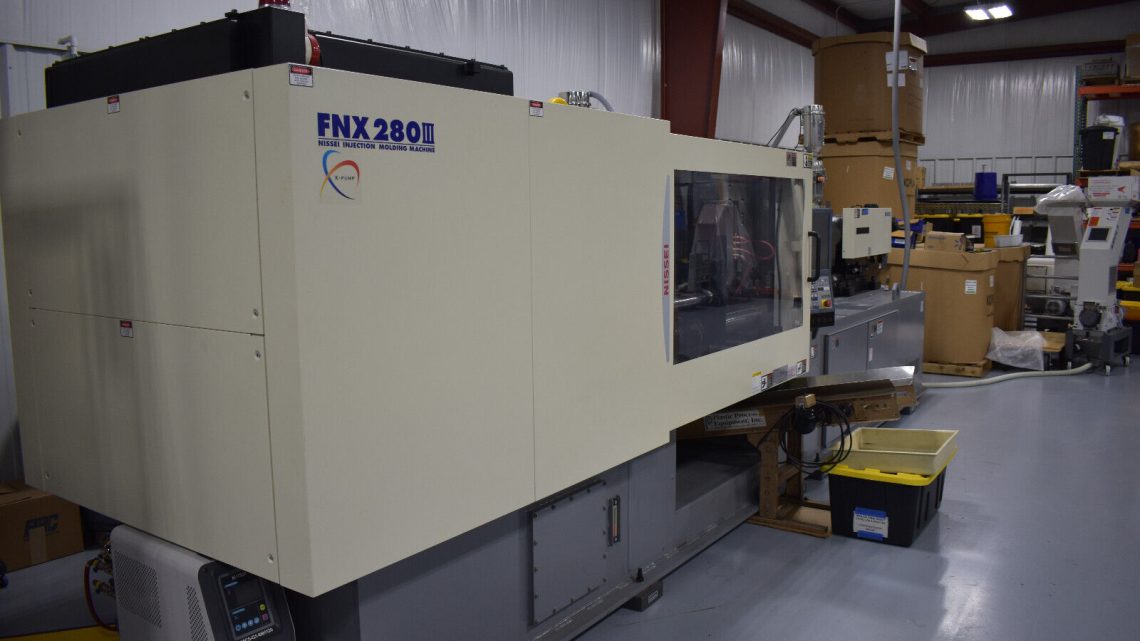
Technical Evaluation Guide: How to Identify a Quality Used, Secondhand, Pre-Owned, Surplus NISSEI FNX280Ⅲ-100A HYBRID Injection Molding Machine made in Japan
Below is a technical evaluation guide / checklist you (or an inspector) can use when evaluating a used / surplus NISSEI FNX280Ⅲ-100A hybrid injection molding machine (a Japanese built hybrid machine). It’s designed to help you find a high-quality machine, avoid costly surprises, and negotiate confidently.
I. Baseline / Reference Specs & Design Features
First, know what a “healthy” new or well-maintained FNX280Ⅲ looks like in spec. Deviations from these should raise questions.
From published spec data for the FNXⅢ series and the FNX280Ⅲ model:
- Clamping force: ~ 309 U.S. tons ≈ 280 metric tons (≈ 2740 kN)
- Screw diameters (for 100A variant): typical diameters might include 2.48″, 2.80″, 3.15″ (i.e. ~63 mm, 71 mm, 80 mm)
- Injection capacities: for “100A” variant, approx 48.5 in³ (≈ 795 cc), 61.6 in³, 78.1 in³ depending on screw size
- Max injection pressures for the 100A: ~ 29,790 psi (≈ 205 MPa) for smallest screw size, lower pressures for larger screws
- Clamping stroke: 32.7 in (≈ 830 mm)
- Min. mold thickness: ~ 12.6 in (≈ 320 mm)
- Maximum daylight opening: ~ 45.3 in (≈ 1,150 mm)
- Tie bar clearance (H × V): ~ 26.0 × 26.0 in (≈ 660 × 660 mm)
- Die plate dimensions: ~ 37.6 × 37.6 in (≈ 955 × 955 mm)
- Ejector stroke: ~ 5.1 in (≈ 130 mm)
- Hybrid “X-Pump” system: The FNXⅢ line uses a hybrid (electric + hydraulic) pumping architecture called X-Pump, combining advantages of hydraulic (force, direct pressure) with advantages of electric (energy savings, fast response)
- Energy / oil reduction claims: e.g. up to ~ 55 % reduction in hydraulic oil / energy compared with conventional machines
- Repeatability, precision, mold control: these hybrid machines aim for good stability, linear injection performance, good holding pressure stability, and so on.
Use these as “target reference points.” If the used machine is significantly off in any of these dimensions, dig deeper.
II. Pre-Inspection / Documentation & History
Before touching or turning anything, collect records, documentation, and background. Much of the “risk” in used machines is hidden.
| Document / Info to Request | What to Review / Red Flags |
|---|---|
| Machine nameplate, serial number, manufacturing date / batch | Confirms the actual model, helps trace parts or an original build sheet. |
| Original user / operations / maintenance manuals, parts catalogs, wiring / hydraulic / pneumatic schematics | These are essential for repair, troubleshooting, and ordering correct parts. |
| Machine service / maintenance logs | Look for records of pump / motor maintenance, screw replacement, sensor calibration, valve overhauls. |
| Major repairs, rebuilds, collisions, leaks or component replacements | A history of problems (especially hydraulic or pump issues) may carry latent risks. |
| Operating hours (if recorded), number of cycles, duty patterns | Heavy usage (continuous, high rate, harsh plastic types) accelerates wear. |
| Included tooling, spare parts, sensor spares, control modules, etc. | Having spare hydraulic seals, sensors, spare motors, or parts is a bonus. |
| Warranty, “as-is” terms, acceptance / trial period | If you have a return window or guarantee, that reduces your risk. |
If the seller cannot provide a plausible history or documentation, treat that as a red warning.
III. Visual / Structural Inspection (Machine Cold / Offline)
Once on site (power off), inspect all major structural, mechanical, and visible components.
Frame, Base, Tie Bars & Platens
- Check the main frame / base casting for cracks, weld repairs, distortions, or “twist.” Structural integrity is critical.
- Inspect tie bars for straightness and absence of noticeable wear or scoring.
- Examine the platen surfaces (fixed platen and moving platen) for flatness, gouges, corrosion, or remachining scars.
- Examine platen surfaces for parallelism and consistency of finish.
- Observe mounting bolts, tie rod anchor points, and platen-to-tie-bar interfaces; if any seems loose, deformed, or shows evidence of slippage, that’s a concern.
Clamping / Ram / Toggle or Direct Drive Assembly
- If this model has a particular clamping mechanism (toggle, direct, hybrid), inspect linkage, pivots, bearings, pins, and bushings for wear or play.
- Look for worn bushes, elongated holes, loose pins, or evidence of misalignment.
- Inspect ram underside (if applicable) and guide surfaces for scoring or wear.
- Examine hydraulic / servo cylinder mount areas, supports, brackets, etc., for signs of distortion or stresses.
Injection Unit (Screw, Barrel, Nozzle, Injection Mechanism)
- Visually inspect the injection barrel & screw if accessible (or via inspection ports) for corrosion, register wear, scoring, or pitting.
- Check for leakage around barrel heater bands, nozzles, manifold, or injection unit seals.
- Inspect coupling, servo motor / drive on injection, and hydraulic or servo pumps / motors for external damage or misalignment.
- Inspect sensor wiring, heaters, thermocouples, pressure transducers, and related instrumentation for intact wiring and no obvious damage.
Hydraulic System, Pumps, Hoses, Valves & Reservoir
- Inspect hydraulic / oil reservoir(s), filters, piping, hoses, ports, and connectors. Look for leaks, corrosion, wear, abrasion, cracked hoses, or fittings.
- Check for signs of oil staining, seepage, or drips under the machine (this may indicate past leakage).
- Inspect pump(s), servo motors for cleanliness, alignment, and condition.
Control Cabinet, Electrical Wiring & Components
- Open (if permitted) the control / electrical cabinet(s) and examine boards, wiring, connectors, relays, fuses, contactors, and drives.
- Look for signs of overheating, burnt traces, corrosion, moisture ingress, insect damage, or dusty / oily buildup.
- Check that cable carriers, drag chains, and wiring harnesses are intact, without broken covers or wires rubbing edges.
Safety Guards, Covers, Mold Area, Ejector & Accessories
- Confirm that all mold area guards, safety interlocks, doors, and covers are present and undamaged.
- Inspect ejector plates, ejector rods, slides, knockout mechanisms for straightness, wear, or play.
- Examine mold mounting surfaces, tie rod clearances, and any supporting features.
Cleanliness & General Condition
- The general cleanliness of the machine—how well maintained it looks—often correlates with internal care. Heavy build-up of plastic residue, colorants, dust, or unattended grime is a warning.
- Inspect corners, under covers, hidden cavities for rust, residue, or signs of past flooding or neglect.
- Look for non-original modifications, patching, or repairs in visible structural areas.
Take photos from multiple angles, focusing on wear, damage, wiring, and the hydraulic / injection assemblies.
IV. Mechanical / Operational Testing (Live / Powered Tests)
Assuming the seller allows powering up and basic motion, carry out functional testing to detect drive, servo, hydraulic, sensor, or control issues.
Always ensure safety: make sure guards are in place, and have emergency stop functionality work.
Power-Up & Initialization
- Power the machine, monitor startup behavior, check for error codes, alarms, or unusual delays.
- Check hydraulic / pump system pressure ramp-up, sound, and stability.
- Observe warm-up behavior, oil pressure stabilization, etc.
Clamping / Unclamping Cycle
- Activate the clamping (close / open) cycle (no mold in place). Observe motion, noise, smoothness, and any binding or hesitation.
- Monitor hydraulic pressures, servo current draw, and consistency (look for spikes or oscillations).
- Reverse cycle and assess whether opens cleanly, without stiction or lag.
Injection / Plasticizing / Metering / Backflow / Hold Phase
- Engage injection sequence (in idle mode if possible) to move screw in / out, pressurize, hold, retract.
- Listen and feel for jerkiness, stuttering, or inconsistent motion.
- Watch whether pressure / velocity charts (if visible on control) are stable and behave smoothly.
- Check for leakage or drop in pressure during hold stage (this may show seal wear).
- Monitor servo or motor current draw, hydraulic load, and temperature behavior under cycles.
Mold / Ejector / Slide / Accessories Actuation
- Operate ejector cycles (extend / retract) and check smoothness, firmness, no binding.
- Activate any mold slides, side actions, core pulls, or special axes (if present) to test their motion, sensors, and limit behavior.
- Move any auxiliary axes (e.g. mold open / close, platens / tie rods) through their full stroke range, watching for anomalies.
Homing, Reference, Limit Switches, Alarms
- Command a full homing / reference sequence and observe the machine’s ability to return to a reference point reliably.
- Jog axes to their limits and verify that limit switches, soft limits, and interlocks are triggered properly (machine should stop or alarm safely).
- For any motion axes, reverse direction and check for backlash, hysteresis or drift.
Test Molding Run (if allowed & safe)
- If the machine can be run with a test mold (a simple mold or dummy mold), run a short molding cycle.
- Observe machine behavior under load: stability, fluctuations, unexpected noises, pressure / temperature variances.
- Inspect the molded part(s) for consistency, visual defects, flash, dimensional stability, and repeatability.
- Monitor cumulative behavior over successive cycles (do the process variables drift?).
V. Accuracy, Calibration & Quantitative Tests
To assess how precise and reliable the machine remains, perform or request measurement checks (using gauges, sensors, or test parts).
- Clamp parallelism / platen parallelism: measure across platen faces under clamping force for tilt or warpage.
- Tie rod elongation / deflection: under clamping load, measure any bowing or bending.
- Injection repeatability: for repeated shot cycles, whether shot volume / pressure / velocity stays consistent.
- Backflow / leak test: during hold stage, see whether pressure decays, which implies leakage.
- Servo position repeatability: command positions and check actual servo axes positions (in injection screw, mold movements).
- Thermal drift / stability: after warm-up cycles, measure whether dimensions or performance vary due to heat.
- Ejector / slide accuracy: check that side actions or ejectors move to commanded positions repeatedly.
- Pressure / temperature sensor check: if possible, validate calibration of sensors by comparison with known standards.
Compare the measured results with what you expect (or what the original spec implies). Significant deviations in precision, repeatability, or stability should justify negotiation or rejection.
VI. Wear, Component Life & Risk Assessment
Even a machine that passes many tests may have “wear” that will need future repair. Estimate what remains:
- Hydraulic seals, valves & pumps: seals degrade over time; leaks or drift are signs of life nearing the end.
- Servo motors, encoders, drives: check age, hours, noise, and signs of thermal stress.
- Screw / barrel wear: especially in injection areas, wear may reduce precision.
- Guide rails, linear bearings, slides (for mold movement, side actions): inspect for scoring, pitting, play.
- Ejector rods / slides: any bend, wear or play is problematic.
- Hydraulic oil condition: check oil color, contamination, presence of water, sludge or metal particles.
- Control electronics / boards: some parts may become obsolete or hard to replace.
- Sensors / thermocouples / wiring: aging wiring or sensors may degrade or fail.
- Backup & spares availability: how easy is it to procure replacement pumps, servo modules, injection unit parts, sensors, control boards (especially for Japanese models)?
- Fatigue in structural areas: look carefully for microcracks, welds, or stress signs around load-bearing joints.
VII. Hidden Risks, Red Flags & Deal-Breakers
Here are warning signs that should raise serious concern. The more of these you see, the more cautious you must be.
- Structural cracks, weld repairs, or distortion in frame, platens, or tie rod areas.
- Excessive scoring, corrosion, or misalignment in platen surfaces, tie rods, or guide rails.
- Leakage (oil, hydraulic fluid) past seals, fittings, or around piston rods.
- Jerky, inconsistent motion, stuttering, or servo behavior issues.
- Pressure drop or leakage during injection hold phases.
- Major deviations in performance (clamp parallelism, injection repeatability) compared to spec.
- Frequent error codes, alarm history, or control instability.
- Overheated / damaged electrical components, burnt wires, corrosion in control cabinets.
- Missing or damaged cover panels, guards, or safety interlocks.
- Non-OEM modifications, hacked wiring, or “jury-rigged” repairs.
- Very poor cleanliness, internal dirt, plastic build-up, or lack of maintenance evidence.
- Refusal by seller to permit motion tests, injection tests, or functional trials.
- Obsolete control modules or lack of spare parts (especially in your region).
- Consistent drift or instability after warm-up or over cycles.
VIII. Commercial & Practical Considerations
Beyond technical checks, remember the business side of the purchase.
- Transport, rigging & installation costs: these machines are heavy, require stable foundations, cranes, leveling, etc.
- Commissioning, calibration, and training: budget time and cost for setting up, calibrating, and training staff.
- Spare parts & supply chain: check how easily you can source critical parts (pumps, servo modules, seals, injection unit parts) in your country or region.
- Control software / updates / licensing: verify which version of the control is installed, whether upgrades are needed or available, and if there are licensing issues.
- Energy & operating cost expectations: since hybrid machines claim energy savings, compare expected vs actual performance.
- Resale / residual value: how in demand are NISSEI hybrid machines in your region? A machine in good condition may hold value.
- Acceptance / trial period: negotiate a period during which you can test and reject the machine if performance is not as promised.