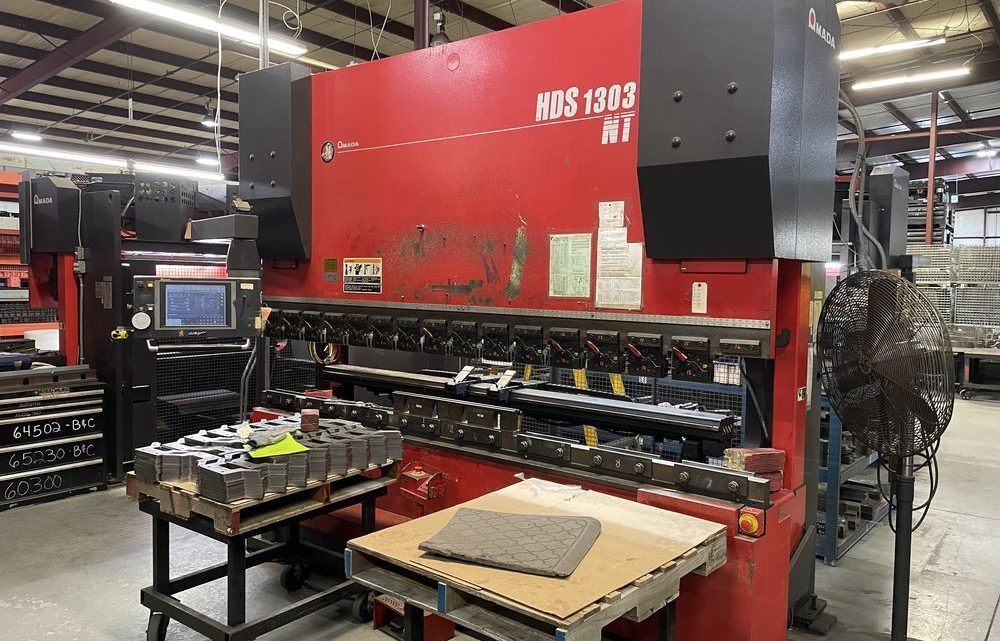
Technical Evaluation Guide: How to Identify a Quality Used, Secondhand, Pre-Owned, Surplus Amada HDS 1303NT CNC Press Brake 143 Tonnes made in Japan
Here is a Technical Evaluation Guide / Checklist to help you assess the condition and quality of a used / surplus Amada HDS 1303NT (143-ton, down-acting servo/hydraulic) press brake (made in Japan) before purchase. Use this to spot hidden issues, quantify wear, and negotiate with confidence.
I. Know the Baseline / Specs
First, know the factory specifications (or typical ranges) so deviations become red flags. Some key specs of the HDS 1303NT / HDS-NT series are:
- 143 tons (≈ 130 metric tons) bending capacity
- Bed / ram (bend) length ~10 ft (≈ 127 in)
- Distance between frames ~106.3 in
- Ram stroke ≈ 7.87 in
- Open height (without tool holders) ~19.7 in
- Ram repeatability ±0.00004 in
- Backgauge travel: ~27.55 in
- Hybrid (servo + hydraulic) drive, CNC backgauge (5+ axes) and AMNC-PC control system
Use those as reference checkpoints: if your candidate machine is far off in these areas, that signals potential issues.
II. Preliminary / Documentation Review
Before physical inspection, collect as much documentation and history as possible. A well-documented machine is safer.
| What to Request | What to Look For / Why It Matters |
|---|---|
| Nameplate, serial number, build year, origin | Confirms model, variant, and production batch. |
| Original manuals, parts lists, hydraulic & electrical schematics | Essential for repair, parts ordering, and understanding internal systems. |
| Service / maintenance logs | Frequent preventive servicing (oil changes, filter replacements, cylinder checks) is a good sign. |
| Replacement history or repair records | E.g. if cylinders, pumps, or valves have been replaced or rebuilt. |
| Usage profile (hours, production types, material thickness ranges) | Helps you estimate wear or stress on components. |
| Spare tooling, dies, backgauge fingers, spare parts included | Increases value and lowers future downtime. |
| Warranty / return or “as-is” terms | If no recourse, you bear all risk — more reason to inspect thoroughly. |
If the seller is unwilling or unable to provide decent documentation, treat that as a red flag.
III. Visual / Structural Inspection (Machine Off / Cold)
Examine the machine closely for signs of obvious wear, damage, or neglect.
Frame, Bed & Structure
- Inspect the main frame, uprights, bed, and side columns for cracks, weld repairs, distortions, or bending. Structural issues are critical.
- Check for alignment / squareness of frame surfaces, especially around the ram guides and frame uprights.
- Look for signs of foundation shimming or excessive leveling adjustments, which may indicate the machine was twisted or misaligned.
- Examine surfaces of ram guides, beam, and the mating faces for wear, scratches, corrosion, or scoring.
Ram / Upper Beam & Cylinder Mounts
- Inspect the upper beam faces and the ram surface; look for wear, pitting, scoring, or corrosion.
- Check cylinder mounting area: whether bolts are tight, whether actuators or links are bent or loose.
- Inspect the seal areas, structural supports, and internal joints for signs of leakage or damage.
Tooling Mounting Surfaces, Punch / Die Areas
- Look at the punch / die holder surfaces, tool seating surfaces: are they even, not gouged or dented?
- Inspect the ram tip / tool interface: wear, burrs, or misalignment can lead to inaccurate bending.
Backgauge & Axis Assemblies
- Examine backgauge arms, fingers, rails, carriages, and guideways. Look for wear, play, bent fingers, damaged rails.
- Check rails and guides for scoring or scratch marks, and whether lubrication lines/ways are intact.
- Inspect the lead screws, servo motors, couplings, belts, or rack systems (as applicable) in the backgauge axes.
Hydraulic Components, Hoses & Piping
- Inspect all visible hydraulic lines, hoses, fittings, valves, manifolds: look for leaks, corrosion, abrasions, kinks.
- Check pump(s), reservoirs, filters, cooling lines: cleanliness, fluid level, and leaks.
- Inspect cylinder rods for corrosion, pitting or scoring, and seals for leakage.
Control Enclosure, Wiring & Electronics
- Open the electrical cabinet (if permitted) and inspect wiring, terminal blocks, relays, capacitors, PCBs: look for burned insulation, corrosion, evidence of overheating, water ingress.
- Check cable carriers, wiring harnesses, and flex cables for wear, chafe, or broken shielding.
- Examine motor and drive enclosures for overheating signs or component replacements.
Cleanliness, Corrosion & General Condition
- A machine that is well maintained tends to be cleaner; heavy accumulation of dust, sludge, chips or oil suggests neglect.
- Inspect internal compartments and underside for corrosion, coolant or hydraulic fluid residue, or signs of flooding.
- Look for non-OEM modifications, welded patches, or areas that seem “touched up.”
Photograph all critical areas (ram face, backgauge, cylinder mounts, control cabinet, hydraulic lines) for reference.
IV. Mechanical / Motion & Functional Testing
If allowed, power the machine and run preliminary functional tests to assess dynamic behavior.
Ram Motion, Smoothness, and Accuracy
- Move the ram up/down (approach, bending, return) at slow and moderate speeds. Listen & feel for binding, jerks, vibration, or stuttering.
- Check whether the ram motion is smooth across the travel, including near the ends.
- Reverse direction and test for backlash or hysteresis—you may feel a dead zone or lag.
Cylinder Action & Hydraulic Integrity
- Extend/retract cylinders slowly and monitor for leaks, cavitation noise, pressure drops, or hesitation.
- With no load, maintain a position and see if the ram drifts (leakage or seal failure).
- Under light load, see if the motion remains stable without sudden deviations.
Backgauge Movement & Multi-Axis Behavior
- Command the backgauge axes (X, Y, Z, R, etc.) to move through their full range. Check for smoothness, consistency, and any binding.
- Reverse direction in each axis and check for backlash or play.
- Program a small movement sequence (if control allows) and observe axes working in concert.
Tool / Ram Tilt / Crowning & Compensation (if equipped)
- If the machine has ram tilt, crowning, or compensation features, test their operation.
- Adjust tilt or crowning commands and see if the machine responds predictably and cleanly.
- Observe how the machine handles compensation commands (does it move smoothly, or is there lag or instability?).
Homing, Reference & Limit Switches
- Initiate the homing / referencing cycle and check for repeatability.
- Jog axes toward end positions and verify that limit switches / safety stops / soft limits engage reliably.
- Ensure no crashes into hard mechanical stops during these tests.
Test Bend / Load Simulation (If Safe)
- If permitted (and safe), perform a light bend test on a thin piece of material (e.g. mild steel blank). See how the ram behaves under small load.
- Observe the accuracy of the final angle, whether bending is uniform across the width, and whether there’s backlash or spring-back deviation.
- After bending, inspect tool surfaces, tool seating, and whether any part of the machine shifts or acts unstable.
V. Accuracy / Calibration / Measurement Tests
To quantify machine condition, perform measurement tests (if you have tools).
- Backlash measurement: Use dial gauges to measure backlash in each axis (ram, backgauge X, Y, Z). Compare with acceptable limits.
- Repeatability / reversibility: Move to a position from positive direction, then reverse, and return—check deviation.
- Ram parallelism / squareness: Across the ram width, measure whether the ram is parallel to the bed or deviations exist.
- Angle accuracy / flatness: After test bends, measure angles, surface flatness or uniformity across the length.
- Thermal drift test: Let the machine warm under idle or motion, then re-measure a known reference to see drift.
- Backgauge positioning accuracy: Command positions and measure actual finger positions with gauge or scale.
Compare measured deviations to what might be reasonable for a machine of this class (e.g. ±0.001 in or better in many axes) and compare to the original Ram repeatability spec of ±0.00004 in as a baseline.
VI. Wear & Component Lifespan Assessment
Your goal is to estimate how much life remains in key components:
- Cylinders & Seals: If cylinders show wear, pitting, or leakage, seal replacement or cylinder rework can be costly.
- Hydraulic pumps, valves & accumulators: Worn pumps or flawed valves degrade performance and accuracy.
- Guideways / rails in backgauge / ram mechanisms: Excess wear or scoring suggests future rebuild needs.
- Backgauge screws / drives: Worn screws, couplings, or belts reduce precision.
- Control & electronics: Obsolete or heavily modified control boards may be difficult to replace in future.
- Tooling seating surfaces & interfaces: Wear in the punch / die seating surfaces compromises bending accuracy.
- Structural fatigue / cracks: any sign of metal fatigue or cracks in structural areas is highly costly to repair.
VII. Hidden Risks & Red Flags / Deal-Breakers
Be alert to these warning signs — presence of several may mean the machine is too risky.
- Major cracks, weld repairs, or distortion in frame, bed, or uprights.
- Excessive wear, scoring, or corrosion on ram, guide surfaces, backgauge rails, or axes.
- Ram vibration, noise, unstable motion, or excessive backlash.
- Hydraulic leakage, cavitation noise, or drift under static load.
- Binding or erratic movement of backgauge axes.
- Ram tilt, crowning, compensation features not functioning or erratic.
- Frequent error codes, alarms, or control faults.
- Electrical panel damage, overheated wiring, corrosion, or tampering.
- Missing or damaged covers, guards, or protective components.
- Non-OEM modifications, jury-rigged repairs, or undocumented changes.
- Seller refuses live tests, motion tests, or test bending.
- Poor cleanliness, internal flooding, heavy sludge, or neglected maintenance.
- No spare parts, obsolete control, or limited service support in your region.
VIII. Practical / Commercial Considerations
Beyond pure technical inspection, consider these real-world factors before finalizing a purchase.
- Transport, rigging & installation: This machine is heavy; plan for cranes, foundations, leveling, anchoring.
- Commissioning / calibration: Expect to perform alignment, calibration, and test bending after installation.
- Spare parts lead times / cost: Cylinders, pumps, valves, control boards, sensors, backgauge components, etc. may be imported from Japan and expensive or slow to get.
- Operator training & maintenance skills: Make sure your staff are familiar (or can be trained) with AMADA control, hybrid servo/hydraulic systems, and maintenance procedures.
- Software / control version / licensing: Ensure the control is not outdated or locked; check whether software upgrades are needed or available.
- Resale / residual value: AMADA machines tend to retain value if well maintained; but condition, service history, and control version matter.
- Acceptance / trial period: Negotiate for a short trial or acceptance testing where you can reject the machine if test results are unsatisfactory.