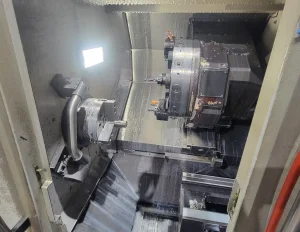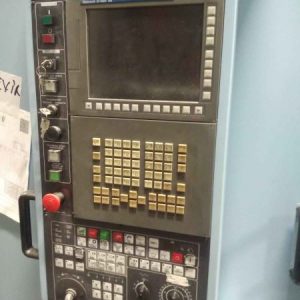
Technical Evaluation Guide: How to Identify a Quality Used, Secondhand, Pre-Owned, Surplus Matsuura H405-MAX CNC Horizontal Machining Center made in Japan
1) Machine Context & Baseline Specifications
Before arriving on site, get the factory spec sheet or original manual for that exact unit. Matsuura’s H.Plus-405 is a well-documented horizontal machining center in their H.Plus series. Some published specs to use as benchmarks:
- Travels: X / Y / Z = 600 × 600 × 600 mm (some sources)
- B-axis rotary: 360° indexing with high precision (0.001° indexing)
- Pallet / Table: 500 × 500 mm pallet size; load capacity per pallet ~ 400 kg
- Max workpiece size: Ø 650 mm × H 750 mm (some published “max work size”)
- Spindle: BT40, 12,000 rpm standard; optional 20,000 rpm on some models
- Spindle motor power: 15 / 22 kW rated
- Rapid traverse (X / Y / Z): ~ 50 m/min (some sources)
- Tool changer: e.g. 51 tools, arm-type ATC
- Pallet changer: 2 pallets (standard), with optional multi-pallet systems available
- Distance from pallet center to spindle nose: 120 – 720 mm (min/max)
- Machine size & weight: Floor footprint ~ 4,430 × 4,014 mm; weight ~ 7,500 kg (for one example unit)
Use these published values to set your expectations and check how far off the used unit is.
2) Documentation & Pre-Inspection Requests
Ask the seller to supply, ahead of the visit:
- The machine’s build / configuration sheet (options, pallet system, spindle type)
- Serial number, manufacture year, and revision history
- Geometry / calibration / laser / ballbar / test reports
- Maintenance / service logs (spindle overhauls, axis repairs, pal et changer service)
- CNC control version, parameter backups, axis compensation tables
- Electrical / hydraulic / pneumatic schematic drawings
- Tooling list (cutters, holders, pallet fixtures)
- Records of crashes, collisions or major repairs
- Documentation of any retrofits or upgrades
These will inform your acceptance criteria and help you distinguish wear vs design deviation.
3) Static & Visual Inspection (Machine Powered Off)
Before powering up, conduct a methodical visual inspection:
- Frame, base & casting: inspect for cracks, weld repairs, distortion, signs of impact or fatigue.
- Way covers / guide shields / bellows: check for tears, chip damage, missing portions, hardened deposits.
- Pallet / Table surfaces: examine for scoring, uneven wear, damage, warping.
- Rotary B-axis housing & table: inspect for signs of play, loose covers, misalignment.
- Spindle nose / taper: look for corrosion, wear, surface defects, damage to seating surfaces.
- ATC & tool magazine: open magazine, inspect tool pockets, grippers, indexing faces, wear or misalignment.
- Cable carriers / hoses / coolant lines: look for brittle insulation, cracks, repairs, dents.
- Electrical cabinet / wiring: open and inspect for signs of overheating, discoloration, modifications, boards in poor condition.
- Coolant tanks, pumps, filters: check for rust, leaks, sediment, visible corrosion in the tank interior.
- Safety doors, guard interlocks: verify door hinges, switches, covers, interlock circuits.
Take extensive photos of all areas—these help when negotiating or later validating wear.
4) Installation, Alignment & Mounting Checks
If the machine is mounted or ready to be positioned:
- Leveling & base anchor: ensure machine is level, the base mounting is solid and not shimmed excessively.
- Mount surface flatness: check the mounting pad or foundation interface for warp or unevenness.
- Spindle radial runout (neutral B-axis position): mount a test bar and rotate spindle to check for runout in the neutral orientation.
- Jog small axis moves (X, Y, Z): observe for binding or rough spots in motion.
- Pallet / B-axis indexing alignment: attach a dial indicator on the pallet or B-axis table referencing spindle centerline; index several angular positions and inspect deviation.
- Distance / center offsets: check that the center-to-spindle distances move smoothly and consistently over the pallet travel range.
5) Power-Up & Functional Motion Tests
With power applied and safety in place:
- Warm-up jogging: systematically move axes for 20–30 minutes to stabilize lubrication and temperature.
- Homing / zero return cycles: verify repeatability and absence of limit faults or reference errors.
- Axis traverse test: move X, Y, Z at various speeds (25 %, 50 %, 100 %) and listen for rough transitions, binding, or vibration.
- B-axis / rotation test: index the B-axis repeatedly; check torque consistency, no binding, clean indexing motion.
- Spindle ramp test: ramp spindle through RPM range (e.g., from low to 12,000 rpm) and monitor vibration, noise, current, RPM stability.
- Tool change cycles: run ATC through tool changes repeatedly (e.g. 20+) to verify reliability and repeat accuracy.
- Coolant & lubrication systems: turn on coolant, check flow, pressure, leaks; activate lubricant systems, check delivery to axes.
- Alarm / error monitoring: watch for servo faults, axis overloads, diagnostic messages; review historical alarm logs.
- Sensor / encoder feedback check: while moving axes, confirm no encoder dropout errors or anomalies.
- Chip handling & conveyor test: if equipped, run chip conveyor or removal systems, verify they work smoothly.
6) Accuracy, Repeatability & Metrology Tests
These tests distinguish a high-quality used machine vs one with worn geometry:
- Linear positioning / straightness verification: use a laser interferometer or calibrated gauge on X, Y, Z axes. Compare commanded vs actual motion.
- Backlash / reversal error: command ±0.01 mm moves and measure discrepancy on direction change.
- Repeatability test: return to a given point multiple times (e.g. 10×) and measure spread of results.
- B-axis indexing repeatability: index multiple angular positions repeatedly and measure angular deviation.
- Combined interpolation tests: program a contour combining motion in X, Y, Z, and rotation (B) and compare physical path vs programmed path.
- Thermal drift test: run the machine under load for 1–2 hours, then recheck reference dimensions to measure drift.
- Hysteresis / drift test: move to a position, dwell, return, and see how far off the position is.
- Pallet-to-pallet repeatability: load the same fixture on both pallets (if dual pallet setup) and compare measured positions of features.
7) Spindle, Tooling & Wear Checks
- Spindle runout & vibration: mount a precision test bar, measure radial runout, and optionally use a vibration analyzer to look for bearing defects.
- Spindle noise / bearing hum: at moderate rpm, listen for abnormal bearing noises.
- Spindle temperature rise: run at mid rpm for ~30 min, then measure temperature drift.
- Tool retention / drawbar force (if applicable): test tool pulling force for tool integrity.
- Taper seating: use dye / blue test to check uniform contact.
- Tool change repeatability: ensure tool offsets return consistently after tool changes.
- Wear of spindle bearings or coupling: examine for play, noise or runout that worsens with speed.
8) Lubrication, Cooling & Auxiliary System Tests
- Coolant system: test pump flow, pressure, cleanliness of coolant, look for leaks or contamination in lines, filters, tank.
- Lubrication / hydraulics / grease system: confirm oil or grease feed to axes, check for blocked or dried lines, leaks.
- Chip removal / conveyor: operate chip conveyor and verify smooth movement, no jam, correct alignment.
- Hydraulic / pneumatic circuits (if any): test pressure response, valve operation, stability, and leaks.
- Filtration & coolant return: examine filters, screens, tramp oil separators, coolant return paths.
- Cabinet cooling: check fans, vents, and internal temperature behavior during operation.
9) Possible Wear Patterns & Common Failure Modes
- Geometry drift or wear on linear guides (especially mid-travel zones)
- B-axis angular wear or backlash creeping
- Tool magazine or gripper wear causing mis-index or slop
- Spindle bearing fatigue leading to vibration/noise
- Loss of lubrication or clogged lube lines
- Coolant leaks leading to internal corrosion
- Encoder / feedback failures or dropouts
- Electronic issues: aging servo amplifiers, capacitor failure, overheating
- Cable harness fatigue or damage in cable carriers
10) Acceptance Criteria & Benchmarks (Sample Targets)
Use these sample tolerances as a guideline; always compare to the original spec sheet:
| Parameter | Target / Acceptable Tolerance |
|---|---|
| Linear positioning accuracy (X, Y, Z) | ± 0.005 mm over moderate stroke |
| Backlash / reversal error | ≤ 0.01 mm |
| Repeatability | ± 0.005 mm or better |
| B-axis angular indexing repeatability | ≤ 0.005° (or as per spec) |
| Spindle radial runout | ≤ 0.005 mm |
| Thermal drift over 1 hr | ≤ 10 µm |
| Tool change / offset repeatability | ≤ 0.01 mm |
| Coolant / lubrication stability | No major pressure drop or flow loss |
| Servo load / current stability | Smooth, no sudden spikes |
If the used machine fails multiple criteria, proceed cautiously, negotiate heavily, or walk away.
11) Red Flags / Walk-Away Conditions
- B-axis consistently mis-indexing or showing backlash
- Spindle vibration, bearing noise, or high runout
- Repeated servo or axis alarms in control logs
- Tool magazine mis-index, gripper slippage, or change failures
- Coolant leaks into critical components or lubrication paths
- Geometry drift or mismatch beyond spec
- Control parameters missing or corrupted backups
- Overheating in drive cabinets, burned wiring, failed electronic components
12) On-Site Quick Buyer’s Checklist
- Serial number, build year, and model variant confirmed
- Spec sheet / build sheet matched vs actual travel & features
- Visual inspection: frame, covers, guides, spindle
- Jog axes (X, Y, Z, B) for smoothness
- Index B-axis / rotation test
- Ramp spindle, measure runout / vibration
- Accuracy / repeatability / drift tests
- Coolant, lubrication & chip systems operational
- Control boot-up, alarm history, parameter backups
- Walk away if too many high-risk issues are present