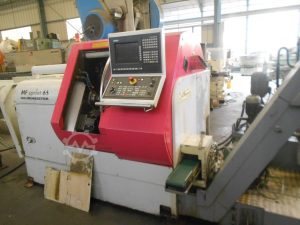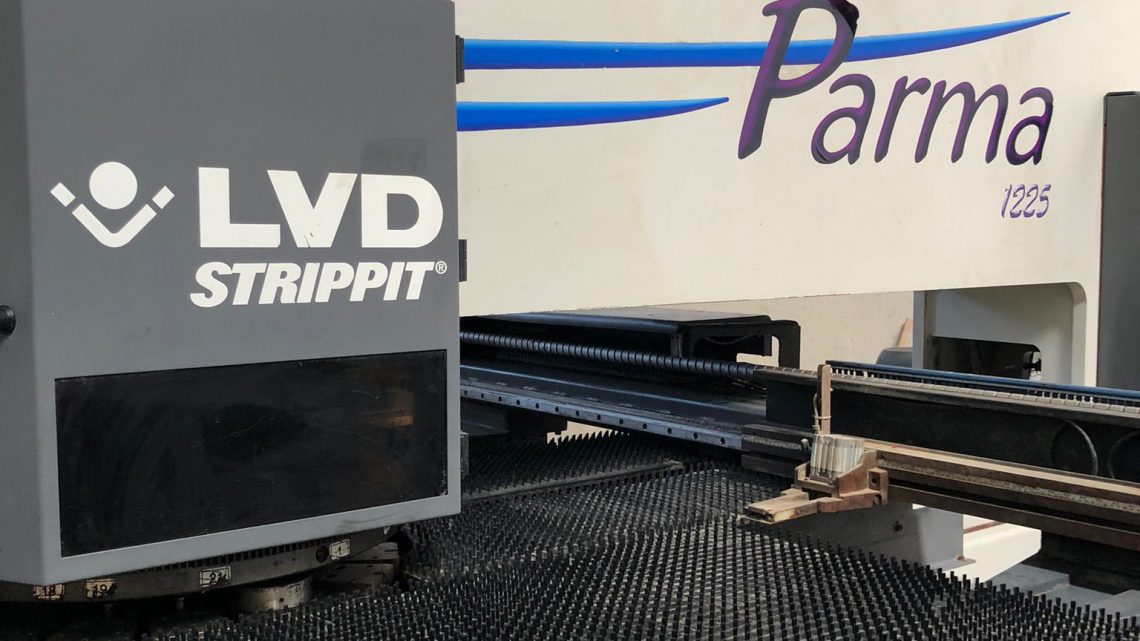
Technical Evaluation Guide: How to Identify a Quality Used, Secondhand, Pre-Owned, Surplus LVD Strippit Parma 1225 CNC Punch Press 20 Tonnes
1) Machine Overview
The LVD Strippit Parma 1225 is a compact, servo-hydraulic CNC turret punch press with a punching force of approximately 200 kN (≈ 20 tonnes).
Built in Belgium, this model combines high punching accuracy, rigid monoblock frame construction, and fast repositioning capability, making it ideal for sheet-metal fabricators and job shops handling steel, stainless, and aluminum up to 6 mm thick.
Typical configuration includes:
- Table Size: 1250 × 2500 mm
- Turret Stations: 21 – 30
- Control System: Fanuc Oi-PC or Siemens CNC
- Maximum Sheet Thickness: 6.35 mm
- Punching Accuracy: ± 0.10 mm
- Manufacturing Origin: LVD Group, Gullegem – Belgium
2) Key Specifications to Verify
| Category | Specification | What to Check |
|---|---|---|
| Punching Force | 20 ton (200 kN) | Verify hydraulic or servo drive pressure reading |
| Stroke Length | 25 – 30 mm | Check smooth ram travel |
| Tool Stations | 21 – 30 turret | Inspect each station for play or misalignment |
| Axis Travel (X / Y) | 1250 × 2500 mm | Move full stroke and check limit switches |
| Reposition Accuracy | ± 0.05 mm | Laser or dial indicator test |
| Max Hit Rate | 600 – 900 HPM | Test with small punch sequence |
| CNC Control | Fanuc Oi-PC / Siemens 840D | Check boot sequence and alarm log |
| Table Type | Ball-transfer brush table | Inspect rollers for wear or corrosion |
3) Mechanical Structure & Frame Condition
- Frame Integrity:
Inspect for cracks, repainting marks, or welded repairs — any distortion compromises punching precision. - Turret Assembly:
Rotate manually; ensure each station indexes smoothly with minimal backlash (< 0.02 mm).
Check punch keyways, bushings, and alignment pins. - Ram & Guide System:
Verify alignment between ram and die holder using a test punch.
Measure clearance with feeler gauges (should be uniform). - Ball Transfer Table:
Move a flat sheet across — it must glide freely without vibration or drag.
4) Hydraulic or Servo-Drive System Evaluation
| Component | Inspection Focus | Acceptable Condition |
|---|---|---|
| Hydraulic Pump | Pressure & noise level | Stable ≈ 200 bar, no whining |
| Accumulator | Pre-charge pressure | Within OEM range |
| Servo Actuator (if equipped) | Position loop | No lag or oscillation |
| Seals & Hoses | Visual leaks | None permitted |
| Cooling System | Oil temperature | Stable ≤ 45 °C under load |
| Hydraulic Oil | Clarity & odor | Clean, no metallic smell |
5) Axis & Positioning Accuracy Tests
| Test | Method | Acceptable Result |
|---|---|---|
| Backlash (X/Y) | Dial indicator, reverse jog | ≤ 0.02 mm |
| Repeatability | Laser interferometer | ± 0.01 mm |
| Squareness (X–Y) | Punch grid test | ≤ 0.05 mm across full sheet |
| Tool Center Alignment | Punch-die concentricity | ≤ 0.02 mm offset |
| Turret Index Time | Stopwatch | ≤ 1.5 s per tool change |
6) CNC Control & Electronics
- Boot Check: CNC must power up without servo alarms.
- Screen & Keyboard: No dead pixels or unresponsive keys.
- Alarm History: Avoid machines with recurring servo or overpressure errors.
- I/O Modules: Verify all turret and clamp sensors register correctly.
- Backup Files: Ensure parameters and tool libraries are saved on CF card or USB.
- Cooling Fans: All cabinet fans must run quietly; no dust buildup on drives.
7) Pneumatic & Clamp Systems
- Clamps: Check gripping force and linear movement along the rail.
- Pneumatic Valves: Listen for leaks; pressure should hold for ≥ 10 min at 6–8 bar.
- Work Clamps Sensors: Simulate open/close and verify status in CNC I/O screen.
- Safety Curtain & Door Interlocks: Ensure emergency stop functions properly.
8) On-Site Inspection Procedure
A. Static Checks
- Inspect machine level and anchor bolts.
- Examine frame paint and inside panels for oil mist.
- Check lubrication lines to turret and ram.
- Confirm hydraulic tank and filter maintenance labels.
B. Power-On Tests
- Home X/Y axes — ensure smooth return.
- Perform dry punches in air at 25 %, 50 %, 100 % speed.
- Run turret index test with random stations.
- Execute clamp reposition cycle.
- Simulate automatic sheet repositioning.
C. Trial Punching
- Use mild steel 1.5 mm × 1000 mm sheet.
- Perform a 10 × 10 hole grid.
- Measure hole center deviation (≤ ± 0.10 mm).
- Evaluate burr height and hole roundness.
9) Common Wear & Failure Points
- Turret bearing or bushing wear → uneven punching noise.
- Ram cylinder seals → oil leakage around upper head.
- Indexing encoder drift → incorrect tool position.
- X/Y ball-screw backlash → offset misalignment on long parts.
- Table rollers or brush wear → sheet scratching.
- Hydraulic pressure fluctuations → inconsistent hit depth.
- Servo amplifier alarms → aging control electronics.
10) Documentation & Records to Request
| Document | Purpose |
|---|---|
| OEM Specification Sheet | Confirms build configuration |
| Geometry / Accuracy Report | Validates machine alignment |
| Maintenance Logbook | Shows oil & filter service dates |
| Electrical / Pneumatic Schematics | Required for troubleshooting |
| Software & Parameter Backup | Restores CNC after reset |
| Punch Tool List | Confirms included turret tools |
11) Acceptance Criteria Summary
| Parameter | Target | Verification |
|---|---|---|
| Punching Accuracy | ± 0.10 mm | Test grid |
| Repeatability | ± 0.05 mm | Multiple hits |
| Turret Index Repeatability | ± 0.02 mm | Dial gauge |
| Sheet Squareness | ≤ 0.05 mm / 1000 mm | Trial part |
| Hydraulic Pressure Stability | ± 2 bar | Continuous cycle |
| Noise Level | ≤ 80 dB(A) | Under load |
| Surface Finish | No visible burr > 0.05 mm | Visual |
| Clamp Holding Force | As per OEM spec | Pressure gauge |
12) Value-Adding Features That Increase Worth
- Automatic repositioning clamps
- Multi-tool stations or indexable tool holders
- Ball-screw driven X/Y axes (vs. rack)
- Updated Fanuc Oi-PC control with Ethernet
- Documented geometry calibration within 1 year
- Full original LVD service history
13) Red Flags — Avoid If
- Excessive oil leakage around ram or turret.
- Turret fails to index or stalls under load.
- Hydraulic pump cycles erratically.
- Servo or “Axis Overload” alarms repeat.
- Tool stations welded or heavily scored.
- Worn clamps causing sheet slip.
- Incomplete parameter backup or locked control.
14) Buyer’s Quick Checklist
✅ Serial number & manufacture year verified
✅ Turret rotation test completed
✅ Sample punching accuracy ± 0.10 mm achieved
✅ Hydraulic pressure stable ≈ 200 bar
✅ Filters, oil, and brush tables recently serviced
✅ CNC screen and buttons fully functional
✅ All safety circuits OK
✅ Documentation and backups included
Pro Tip
A top-quality LVD Strippit Parma 1225 should demonstrate:
- Uniform punching sound across stations
- Stable hydraulic pressure
- Smooth turret indexing
- Consistent hole accuracy ± 0.10 mm
Always request a live punching demonstration with your tooling and sheet material.
Machines kept under LVD preventive-maintenance contracts or used in precision sheet-metal facilities maintain geometry best and deliver the longest service life.