08/10/2025
Technical Evaluation Guide: How to Identify a Quality Used, Secondhand, Pre-Owned, Surplus Ingersoll Masterhead 4th/5th Nutating Spindle 25804 – 45 Unit Milling Head
1) Machine / Head Overview & Key Terminology
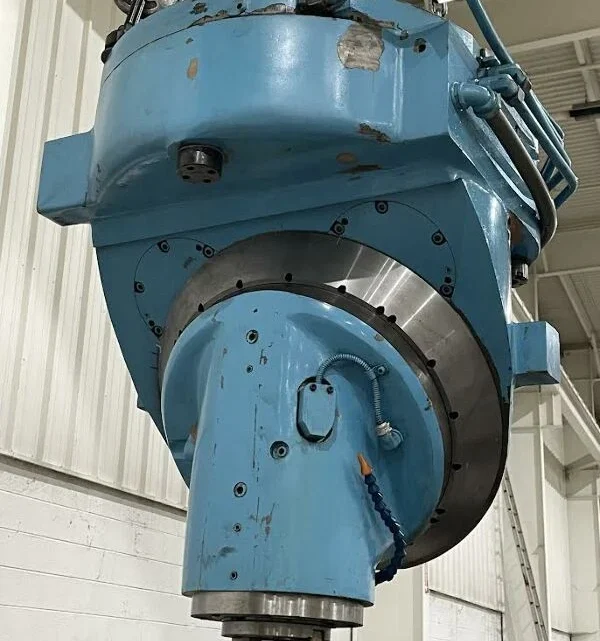
- Nutating spindle (also called “nutating head” or “Masterhead”) is a tilting / oscillating head designed to provide 4th / 5th axis motion (tilt / rotation) in heavy milling machines.
- The Ingersoll Masterhead units are modular spindle heads used on Ingersoll’s large gantry / portal / double-column machines as attachments or head options. (Prestige lists “Masterhead Spindle Units” for Ingersoll machines)
- The “25804-45” designation likely refers to the unit’s internal model / serial / tooling reference (you should obtain the original spec sheet).
- Because they are add-on heads, their performance strongly depends on mounting stiffness, alignment, bearings, lubrication, and tilt accuracy.
Before accepting any unit, the evaluator should understand:
- The head’s tilt angular range, indexing repeatability, spindle speed / power, coolant feed / through-spindle provisions, and mount interface (e.g. CAT, BT, HSK, or custom flange).
- Whether the head is 4th-axis only (tilt) or 5th-axis (tilt + rotation / swivel).
2) Pre-inspection Checklist: Documents & Information to Obtain
Request the seller to supply:
- Full specification sheet or original manufacturer drawing for the nutating head (tilt range, index accuracy, weight, ballast, lubrication circuit, spindle rpm, torque)
- Serial / unit number / build year
- History of usage: hours of milling, frequency of tilt / indexing cycles
- Maintenance logs: bearing replacement, seal changes, lubrication records
- Geometric test / calibration reports (e.g. index accuracy over time)
- Mounting drawings / interface (flange, bolt pattern, alignment pins)
- Any auxiliary systems: coolant-through, air purge, sensors, drive motor / gearbox info
Having those documents helps you know what the “acceptable limits” are for wear.
3) Visual & Static Inspection
With the head unpowered, do:
- Inspect mounting flange and mating surfaces — they must be flat, free of nicks, burrs, corrosion, or uneven wear. Use a surface plate / straight edge to check for warpage.
- Inspect tilt/oscillation bearing housing (gimbal joints, universal joints, or spherical bearings) for cracks, corrosion, grease leakage.
- Check casing / housing for evidence of impact, cracks, weld repairs, or signs of previous damage.
- Inspect all external seals, boots, bellows, covers for damage, tears, or hardened sections.
- Check the spindle taper (if accessible) for wear, damage, or discoloration.
- If there is a lens / sensor / encoder ring for tilt / rotation, inspect for wear or scratches.
- Inspect lubrication ports, lines, and fittings — check for signs of leakage, cross-contamination of oil, or prior repair.
- Check for balance weights or balancing ports and see whether the head has provisions for dynamic balancing.
4) Mounting & Alignment Verification
- Mount the head on a test machine or fixture. Use alignment pins, shims, and bolts to ensure proper alignment.
- With the head mounted, check for axial / radial runout of the spindle when in neutral (no tilt). Use a precision test bar and dial indicator.
- Command tilt / index motion and check whether the head returns to the same spindle-origin reference. Measure deviation.
- Do a “wiggle test” on tilt axes: slowly tilt ± full on each side while monitoring positional drift or hysteresis.
- If possible, use an angular index gauge or autocollimator to test tilt axis accuracy (on each tilt position).
- For a 5th-axis rotation (if present), rotate through full 360° (or limited range) and test repeat indexing accuracy.
5) Dynamic & Motion Tests
Once powered and mounted:
- Run the spindle at low, mid, and maximum rated RPM (or safe ramp) and listen for bearing noise, vibration, whine, or resonance.
- Tilt / rotate the head while the spindle is rotating: check for chatter, oscillation, or movement outside commanded angle.
- Monitor tilt / rotation motor current / torque draw. Spikes or abnormal drag may indicate binding or bearing damage.
- Index the tilt / rotation several cycles (10–20) and measure back-and-forth repeatability; note any drift or cumulative error.
- Command fine incremental movement (small angle steps) in both directions; check for backlash or dead zones in tilt motion.
- Test coolant-through (if included): flow through spindle while tilted, and confirm no leakages, pressure drop, or misalignment of coolant orifices.
6) Accuracy, Repeatability & Metrology Checks
- Angular index repeatability: measure the angular error over 10–20 index cycles. Target as low as possible (e.g., ≤ a few arc seconds, depending on design).
- Tilt linearity / nonlinearity: measure deviation from ideal tilt axis over full tilt span.
- Spindle radial runout at different tilt angles: at neutral tilt and at extreme tilt, measure runout of a test bar (should not increase excessively).
- Combined error test: mount a precision sphere or gauge and command complex tilt + rotation + spindle cut; inspect resulting geometry deviation.
- Hysteresis / drift: after holding tilt in one extreme position for some time, return to neutral and measure shift.
- Thermal stability: run spindle + tilt system under load for some time, then re-check key dimensions to detect drift.
7) Lubrication, Seals & Bearings Health
- Check oil clarity, presence of contaminants (metal particles, sludge).
- Examine bearings / bushings for signs of fretting, pitting, or radial play.
- Check seal integrity (no oil leaking out, no ingress contamination).
- For fluid-circulated bearings (if used), measure flow and pressure in each lubrication line.
- If the head was dynamically balanced, check balance weights or residual unbalance indication.
- Inspect tilt / pivot bearings (gimbals, spherical, universal) for signs of wear or tightening.
8) Electrical & Drive Systems (If Applicable)
- Inspect tilt / rotation servo or stepper motors, cabling, connectors for wear, insulation damage, or overheating signs.
- Check encoder / resolver feedback systems: command a movement and read back actual vs commanded angle; watch for errors or missing counts.
- Verify the control logic / software supports tilt / rotation calibration and compensation.
- Inspect the slip rings, rotary unions, or cable wraps (if present) for wear, continuity, or damage.
- Check sensors (home, limits) for proper function on both tilt and rotation axes.
9) Documentation & Records to Request
- Original specification drawings and calibration data
- Maintenance/service logs (dates of bearing, seal replacement, balancing)
- Calibration / test certificates (tilt index accuracy, runout)
- Spare parts list (bearings, seals, rotary unions)
- Operating manual, control integration manual (tilt / rotation interface)
- Balance reports (if rebalanced)
- Wiring / schematic diagrams, especially for the tilt / rotation drives
10) Acceptance Criteria & Target Values (Example Benchmarks)
| Parameter | Target Acceptable Value | Notes |
|---|---|---|
| Spindle radial runout (neutral) | ≤ 0.005 – 0.010 mm | Depends on original spec |
| Tilt / index repeatability | ≤ a few arc-seconds to tens of arc-seconds | Depends on design tolerances |
| Tilt backlash / dead zone | ≤ 0.005° (or less) | Small hysteresis is acceptable |
| Runout at extreme tilt | Not greatly worse than neutral | E.g. ≤ 0.02 mm might be acceptable based on spec |
| Tilt drift over time | Minimal (< a few arc-seconds after 30 min) | Good for thermal stability |
| Codified angular linearity error | Deviation from ideal tilt | Depends on original manufacturer tolerance |
| Bearing / pivot play | Minimal to none | Measured with dial indicator or feeler |
| Vibration / noise under spindle RPM | Smooth, low levels | No bearing whine or resonance |
| Leak rate (oil / coolant) | None or minimal | Head must be sealed under tilt |
These values must be cross-checked against original manufacturer specs if you can find them.
11) Red Flags / Walk-Away Signs
- Significant bearing noise or vibration at any RPM.
- Tilt / rotation jitter, binding, or inconsistent motion.
- Excessive angular drift after indexing cycles.
- Oil leakage, seal failure or internal combustion of lubricant.
- Runout increases dramatically at tilt extremes.
- Missing or worn encoder / feedback components.
- Mount flange damage, misalignment or non-flat mating surfaces.
- No documentation or calibration history.
- Unrepairable damage to the internal bearings or pivot structures.
12) Buyer’s Pocket Checklist (Printable)
- Verify serial / model number and get the original spec sheet
- Inspect mounting flange and mating surfaces
- Measure spindle runout in neutral / tilt positions
- Index tilt / rotate and measure repeatability
- Run the spindle at various RPMs, monitor noise / vibration
- Check lubrication oil quality, bearing play, and seal integrity
- Command fine tilt increments—check for backlash or dead zones
- Perform drift / hysteresis test (hold tilt, return, measure)
- Test encoder feedback / read-back vs commanded motion
- Verify electrical drives, connectors, slip rings, rotary unions
- Request balance or calibration reports
- Confirm no oil / coolant leakage
- Walk away if major vibration, drift, binding, or missing parts