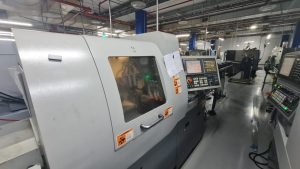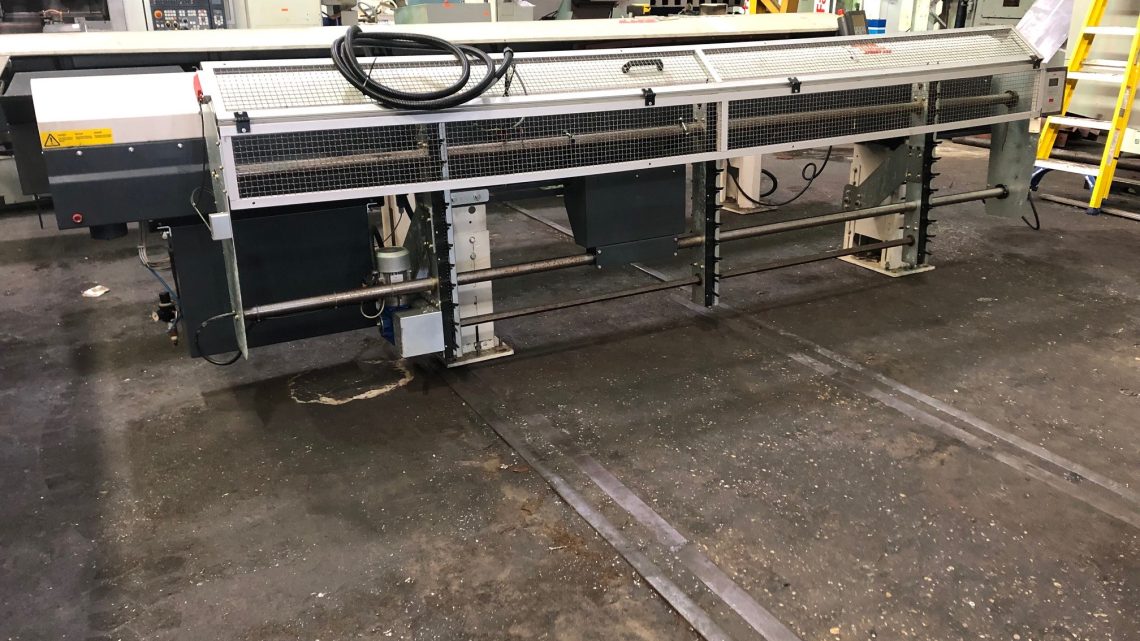
Technical Evaluation Guide: How to Identify a Quality Used, Secondhand, Pre-Owned, Surplus LNS HYDROBAR SPRINT 552-565 Magazine Bar Loader made in Switzerland
1. Known Specifications / Baseline Expectations
Before inspection, attempt to obtain the factory spec sheet (by serial number or model) to use as reference. Meanwhile, here are some published specs / features observed for the Hydrobar Sprint 552-565 / Sprint 565 S2 models. Use these as “checkpoints” to detect deviations or missing capabilities.
| Spec / Feature | Typical / Published Value | Notes / Source |
|---|---|---|
| Bar diameter range | ~ ¼” up to ~ 2-5⁄8″ (≈ 5 mm to 65 mm) | The Sprint 565 S2 spec lists diameter 1/4”-2-5/8” (5 mm–65 mm) |
| Max bar length capacity | ~ 40″ to 12′ 6″ (1.0 m to ~3.8 m) | The spec sheet shows bar length 40″–12′6″ for Sprint 565 S2 |
| Magazine capacity & weight | Large magazine / multiple bars loaded | The “magazine bar loader” style, heavy frame design |
| Front stabilizer type | Hydrostatic or hydrodynamic guiding or automatic stabilizer | The 565 spec mentions “hydrostatic front stabilizer” to support high RPMs with minimal vibration |
| Control / interface | Servo motor & PLC control, parts library, HMI, communication (Ethernet / USB) | Spec mentions “State of the art controls … combined with servo motor and latest PLC technology … Ethernet, USB interface” |
| Changeover time | Relatively rapid changeover between diameters | Spec claims “complete changeovers” in a few minutes (e.g. changeover time in “General Specifications” in listings) |
| Weight / footprint | Several thousand pounds; bulky footprint | New machine spec for Sprint 565: ~3,080 lbs (≈ 1,400 kg) approximate weight |
| Material support during rotation | Automatic stabilizer / retraction mechanism | The front stabilizer and remnant retraction systems are typical features on the 565 series |
When inspecting, deviations from these expected values should trigger further inquiry (has the unit been modified, downgraded, or partially stripped?).
2. Documentation & History Review
Before any physical tests, demand comprehensive documentation from the seller. A strong documentation set significantly reduces risk.
Key documents / records to request:
- Original build / spec / configuration sheet (serial number, model variant, options installed)
- Maintenance logs: date / description for lubrication, repairs, stabilizer servicing, motor maintenance
- Operating hours (runtime), usage profile (intensive vs occasional)
- List of modifications / repairs — any replaced modules (motors, guides, stabilizer parts)
- Cut or production logs: sample bars, number of cycles, feed rates used
- Control / software / parameter backup, error logs, reprogramming history
- Electrical / wiring diagrams, motor nameplates, spare parts included
- Interface / communication specs with host lathe, motion synchronization logs
If the seller cannot provide credible history, treat the unit as higher risk and demand more proof and test cycles.
3. Visual / Structural / Cold Inspection
Begin inspection with the machine powered off. Many signs of wear, damage, or neglect show up visually.
Frame / Base / Structure
- Inspect the overall structural frame for cracks, weld repairs, distortions, sagging, loosening.
- Examine for corrosion, pitting, rust spots — especially in joints, corners, under covers, or areas where coolant / chips settle.
- Check that all covers, guards, chip shields, and cable carriers are present and in good condition; missing or damaged parts indicate possible abuse or internal contamination.
- Inspect mounting / leveling foot pads, base flanges, structural supports for wear or misalignment.
Linear Motion / Rails / Guideways
- Examine all linear rails, carriage ways, guide surfaces for scratches, scoring, pitting, uneven wear.
- Check protective seals, wipers, scrapers, or bellows; damage or missing ones often allow ingress of chips / debris.
- Inspect rail end transitions (where rail sections join) for wear or damage.
Rotary / Chuck / Stabilizer Assemblies
- Check rotary chuck or drive rotor for wear, play, irregular surfaces, binding.
- Inspect stabilizer / clamping jaws for surface wear, alignment, jaw surfaces, pivot joints.
- Look for signs of vibration or rubbing marks on the stabilizer or chuck surfaces (indicative of misalignment or excessive play).
Torch / Feed / Front Mechanism Interfaces (if applicable)
- If the bar loader has a pusher or feed mechanism, inspect rails, guides, sleeves, collet adapters for wear or alignment issues.
- Check the front mechanism that interfaces to the lathe spindle / chuck: alignment surfaces, taper sleeves, interface rails should be clean and in good shape.
Motor / Drive / Cable / Wiring Inspection
- Open drive / motor enclosures, inspect wiring for correct insulation, no burns, spliced wires, or corrosion.
- Check cable routing, cable carriers, conduit paths, hose runs for wear, chafing, slack or damage.
- Inspect servo motor housings, coupling interfaces, motor mounts for looseness, misalignment or corrosion.
Gas / Pneumatic / Hydraulic Lines (if used)
- Inspect any pneumatic lines used for clamping or stabilizers; check for leaks, cracked tubing, loose fittings.
- If any hydraulic or air-actuated parts exist, check hose condition, leakage, pump housings.
- Gas lines (if used for sensors or interface) should be in good shape, no kinks or leaks.
4. Mechanical / Kinematic / Static Checks
If the machine supports jog or manual motion of axes (e.g. loader axis, chuck rotation, pusher axis), perform static tests to detect mechanical issues.
Linear Axis Jog / Motion Tests
- Jog each linear axis (if present) slowly and feel for binding, gritty spots, jumps, variation in resistance.
- Reverse direction and measure backlash / lost motion (use dial indicator) — small, consistent hysteresis is acceptable.
- At multiple positions, place a dial indicator along travel to check whether motion is straight and consistent.
Rotary / Chuck Play / Backlash Check
- Manually rotate or jog the rotary axis; check for play, backlash, binding, or rough spots.
- Reverse direction and sense any slack or motion lag.
Stability / Concentricity Test
- Insert a reference bar / test rod / dummy tube into the loader and chuck interface (if feasible). Rotate slowly and observe runout / wobble — any visible eccentricity indicates misalignment or wear.
- Lightly nudge the bar (if safe) to detect play in stabilizer / chuck clamping.
Feed / Pusher Mechanism Static Checks
- If the loader has a feed pusher / pusher carriage, move it manually and sense smoothness, motion constraints, binding.
- Check jaws / collets / adapter sleeves for tightness, play, wear.
5. Power-On / Dynamic / Functional Testing
Once safe to power up, test the loader’s dynamic behavior under motion and integration with the lathe or main machine.
Control / Interface Initialization
- Power on the loader’s control / PLC system. Watch for boot errors, alarm logs, parameter initialization.
- Test the user interface / HMI, jog / manual control commands, parameter entry, communication interface routines (e.g. to lathe / host).
- Home / reference the loader axes (if applicable) and ensure motion origin consistency.
Axis Motion Under Control
- Run motion-only (no feeding) test programs: move the loader carriage / shuttle, rotary axis (if applicable), and pusher axes. Observe smoothness, transitions, axis stability.
- Perform repeat cycles to test for repeatability and whether any axis wanders or mistracks.
Bar Feed / Advance Testing
- Insert a sample bar (within accepted diameter) and command a feed / advance cycle. Observe pusher action, bar handling, alignment, clamping behavior.
- Run multiple feed cycles, reverse feed, retract / advance, check stability and repeatability.
Integration with Lathe / Host Machine (if possible)
- If the loader is coupled / synchronized with a lathe / chuck, test feed synchronization, handoff accuracy, communication control (signals, interface) under coordinated motion.
- Trigger feed handover and retraction sequences (if the loader supports remnant retraction) and observe whether transitions are clean and timed correctly.
6. Bar Feeds / Cutting / Throughput Tests
If possible, test actual feeding operation under production conditions or near-equivalent work.
- Feed through an actual bar / tube and monitor whether the loader maintains alignment, doesn’t jam, and transitions smoothly at the interface.
- For a test bar, feed it fully through loader and into the lathe (if applicable), measure straightness at the output.
- Perform several cycles (feed, retract, repeat) to confirm consistency and absence of drift.
- Observe whether feed speed matches command values, whether the servo / motion behavior is stable.
- If the loader supports high RPM / high-speed feeding, gradually increase speed (within safe margin) and watch for vibrations, slippage, or chatter.
7. Metrology / Accuracy Verification
To confirm whether the loader can deliver the precision required, perform measurement/reference tests.
- Feed repeatability: command same feed distance multiple times, measure actual displacement variation.
- Bar runout / concentricity: rotate a bar through the loader and chuck (if possible), measure radial deviation (runout) at output.
- Bar alignment / straightness: feed a bar through the loader and inspect whether the bar’s path is straight (no bending, wobble).
- Feed / motion linearity: measure actual displacement vs commanded across the loader’s range.
- Cycle-to-cycle consistency: over many cycles, monitor whether the loader’s motion drifts or diverges.
8. Red Flags & Warning Signs
Throughout all inspection and testing, watch for these serious warning indicators:
- Binding, sticky zones, rough spots in linear axes
- Excessive backlash or inconsistent hysteresis
- Rotary axis play or backlash beyond tolerance
- Significant runout / wobble when rotating loaded bars
- Erratic feed motion, misalignment, jamming during feed cycles
- Weak or failing clamping / stabilizer mechanism
- Motion drift over cycles (lack of consistency)
- Control / software / parameter errors, communication faults
- Missing, damaged, or contaminated covers, seals, wipers (suggesting internal contamination)
- Structural repairs, cracks, welds on frame / mounts
- Motor / drive anomalies: overheating, unusual sounds, vibration
- Lack of maintenance history, replaced drives without documentation
- Obsolete or unsupported control modules or parts
Any multiple occurrences of such red flags should severely reduce your confidence or lower your offer.
9. Refurbishment / Risk Buffer & Cost Estimate
A used bar loader often needs refresh or servicing. When negotiating, include budget / risk for:
- Servicing / rebuilding servomotors, encoders
- Refurbishing rails, guideways, linear bearings
- Replacing or reconditioning stabilizer jaws, chuck components
- Recalibrating motion axes (alignment, backlash tuning)
- Control system refresh or repair (PLC, HMI, wiring)
- Replacement of seals, covers, wipers, protective components
- Integration / interface wiring / communication adaptation with new host lathe
- Comprehensive test runs, alignment verification, cycle tuning
- Installation, leveling, commissioning at your site
- Contingency buffer (10–20 % or more) for hidden damage
10. Contract / Acceptance Safeguards & Test Protocols
To protect yourself, build your purchase agreement to include:
- On-site / acceptance test period: require the loader to be run fully (bar feed cycles, integration, motion) under your conditions before final acceptance
- Acceptance criteria & tolerance schedule: specify acceptable deviations for feed repeatability, runout, alignment, motion errors
- Test piece / sample bar tests: bring several bars or tubes you intend to run, and have the seller prove correct feeding / alignment
- Independent inspection clause: allow a third-party motion / automation expert to verify performance prior to final payment
- Warranty / guarantee clause: for servo motors, stabilizer mechanisms, drives for a defined period post-installation
- Holdback / retainage clause: retain partial payment until acceptance benchmarks are satisfied
- Seller disclosure requirement: seller must list known defects, repair history, modifications, and any performance limitations