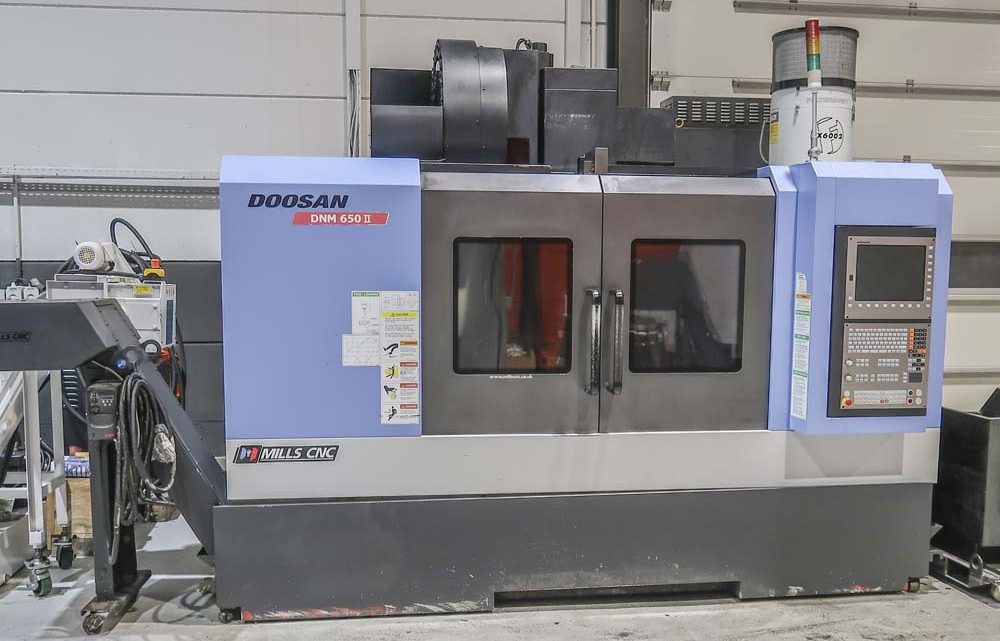
Technical Evaluation Guide: How to Identify a Quality Used, Secondhand, Pre-Owned, Surplus DOOSAN DNM 650 II CNC Vertical Machining Center made in South Korea
1) Machine Overview
The DOOSAN DNM 650 II is a high-performance CNC vertical machining center (VMC) engineered for precision, stability, and productivity. Manufactured in South Korea, it is widely recognized in toolmaking, aerospace, and general machining industries for its rigid construction, reliable spindle performance, and superior surface finish capability.
Its 8,000 rpm (standard) or optional 12,000 rpm spindle, coupled with a BT-40/50 taper, linear guideways, and advanced FANUC or Siemens control, make it a proven production-class machine for both medium and large components.
2) Key Technical Specifications to Verify
Component
Specification
What to Inspect
X/Y/Z Travel
1270 × 670 × 625 mm
Verify full travel limits and smooth movement on all axes.
Table Size
1460 × 670 mm
Check flatness with indicator; confirm no nicks or clamping scars.
Spindle Speed
8,000 rpm (std) / 12,000 rpm (opt.)
Run at multiple speeds; listen for bearing noise or imbalance.
Spindle Taper
BT-40 or BT-50
Measure runout and tool retention force.
Spindle Power
18.5 / 22 kW (25 / 30 HP)
Confirm continuous vs. peak rating; inspect drawbar tension.
Rapid Traverse
36 m/min (X/Y), 30 m/min (Z)
Verify at full stroke without abnormal vibration.
Tool Magazine
30 (40 opt.) ATC
Run tool-change test; check gripper arms and indexing time.
Z-Axis Counterbalance: Run servo trace; confirm stable load during up/down motion.
6) CNC Control & Electrical Systems
Check CNC boot-up time, communication ports (Ethernet, USB, RS232), and I/O signals.
Review alarm and servo error history; repeated axis overloads may indicate mechanical drag.
Inspect servo amplifiers, fans, and heat exchangers for dust or overheating.
Verify backup batteries, parameter files, and ladder logic version.
Ensure the control cabinet is dry, clean, and properly grounded.
7) Lubrication, Hydraulics & Coolant
System
Checkpoint
What to Look For
Central Lubrication
Oil level, distribution block
Continuous flow to each guideway; no leaks or dry lines.
Hydraulics (ATC / Clamping)
Pressure gauge, valves
Stable pressure, no foaming, and clean return lines.
Coolant Tank
Filter & pump
Clear coolant, no metallic chips, odor, or biological growth.
Air Supply
FRL unit
Dry, regulated air between 6–8 bar; drain water traps.
8) Inspection Steps (Step-by-Step Procedure)
A. Static Evaluation
Power off; inspect alignment and general cleanliness.
Use precision level to confirm machine is not twisted.
Check for paint blistering — often indicates oil or coolant seepage from castings.
B. Functional Test
Power up control and warm up axes for 30 minutes.
Home all axes and check for repeatable reference position.
Execute manual feed at 25 %, 50 %, 100 % rapid to detect resonance.
Run spindle from low to high RPMs; listen for bearing noise.
Run ATC cycle 10 × continuously; ensure error-free operation.
C. Accuracy Verification
Conduct laser calibration along X/Y/Z.
Measure orthogonality (squareness) using a granite square or ballbar — tolerance ≤ 0.02 mm over full travel.
Perform face-milling test on a 200 × 200 mm plate; check step marks and parallelism.
9) Common Wear or Failure Signs
Spindle bearing noise or temperature rise after 15 min.
ATC arm mis-timing or slow pocket indexing.
Linear guide scoring or discoloration (lack of lubrication).
Ball screw thrust bearing play, visible in reversal backlash.
Coolant leaks inside column or under base (seal failure).
Axis servo errors during homing or feed moves.
10) Required Documentation
Document
Importance
OEM specification & parameter sheet
Confirms exact build configuration
Geometry & laser test reports
Proof of positioning accuracy
Maintenance records
Validates lubrication & service frequency
Electrical and hydraulic schematics
Essential for troubleshooting
Tool list & manuals
Verify included tooling and accessories
Spindle overhaul or bearing replacement certificates
Key to determining spindle life expectancy
11) Acceptance Criteria Summary
Parameter
Target Value
Note
Positioning Accuracy
±0.005 mm / 300 mm
Measured by laser
Repeatability
±0.002 mm
Bidirectional test
Ballbar Circularity
≤ 0.02 mm
100 mm radius
Spindle Runout
≤ 0.003 mm
At taper gauge
Surface Finish
Ra ≤ 0.4 µm
200 × 200 mm test face
Thermal Drift (2 hr)
≤ 5 µm
Warm-up before testing
Tool Change Time
≤ 3 s
Continuous 20 × test
Noise Level
< 75 dB (A)
Under load
12) Value-Adding Features That Increase Worth
Upgraded 12,000 rpm direct-drive spindle
Heidenhain or Renishaw probing system installed
Chip conveyor and through-spindle coolant (TSC)
30+1 or 40+1 ATC magazine
Full maintenance logbooks and calibration reports
Retrofitted energy-efficient servo drives or inverter coolant pumps
13) Red Flags — Avoid Purchase If
Repeated servo amplifier faults or untraceable parameter corruption
Z-axis drift or failure to hold position when power off
Cracked casting on column or base
Missing spindle chiller in high-speed configuration
Thermal compensation disabled or uncalibrated scales
Unknown control password lockout without OEM support
14) Buyer’s Quick Checklist
✅ Machine serial number & build year photo ✅ Spindle hours and service log verified ✅ Laser or ballbar report available ✅ Spindle & ATC test completed without alarms ✅ Way covers and guideways clean and lubricated ✅ Control keys, display, and emergency stop functional ✅ Coolant, air, and hydraulic systems leak-free ✅ All original manuals and tool holders included
Pro Tip
When buying a used DOOSAN DNM 650 II, prioritize units that were maintained under preventive service contracts and have recent geometry verification reports. Machines from aerospace or die-mold facilities often exhibit the best preservation of accuracy due to controlled environments and light-cutting operations.