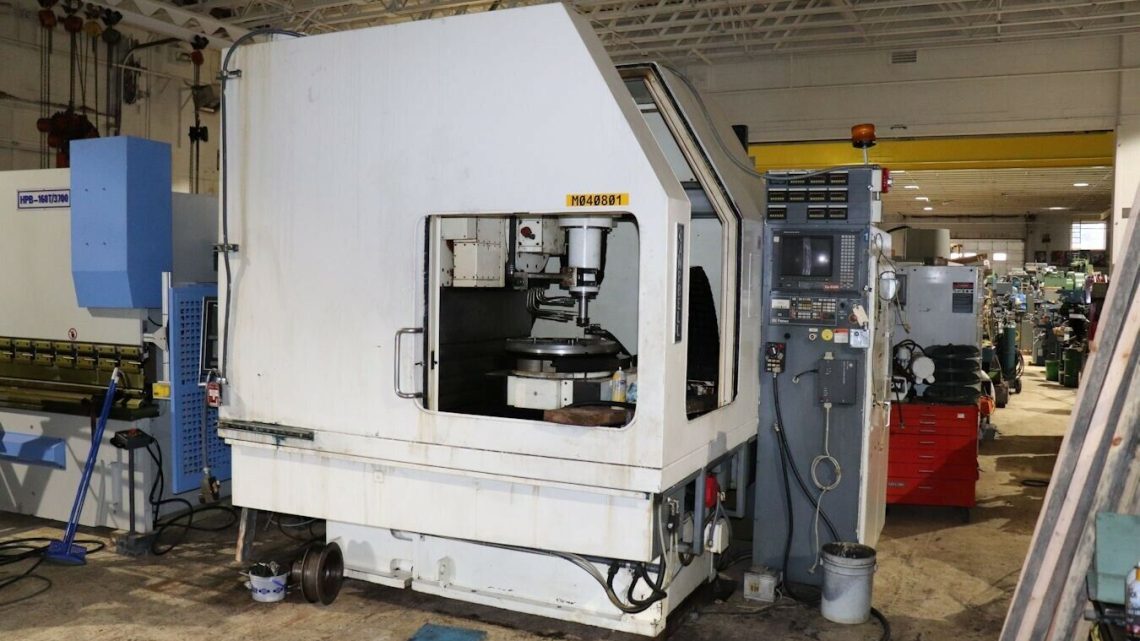
Technical Evaluation Guide: How to Identify a Quality Used, Secondhand, Pre-Owned, Surplus Campbell 930 CBN 5 Axis CNC Form/ Creep-Feed Grinder made in USA
1) Machine Overview & Typical Specs
Before visiting the machine, familiarize yourself with published specs so you know what “good” means. The Campbell 930 series is a vertical 5-axis (X, Y, Z, B tilt, C rotary) creep-feed / form grinder.
Key features typically include:
- 5-axis simultaneous contouring control (Fanuc 31i or equivalent)
- Linear glass scales or direct feedback on all axes
- Rigid frame, box structure, traveling-column style
- High-power grinding spindle (30–60 HP, or up to 100 HP in some versions)
- Very tight accuracy tolerances: ~5 µm in X, Y, Z axes; B & C angular accuracy in arc-seconds
- Optional features: disk or roll form dressers, wheel balancing, tool probing, milling/drilling capabilities, gap eliminator, etc.
Example: a listing of a 930V-30/24/24 (30 HP) model is offered with auto tool changer, reconditioned spindle, GE Fanuc 15-M control, etc.
Use the seller’s spec sheet to pin down your target tolerances, travel ranges, power ratings, and features before you inspect.
2) Pre-Inspection Document Checklist
Ask the seller to provide in advance:
- Full machine specification / build sheet (model version, spindle HP, options)
- Serial number and build year
- Control version and software level
- Maintenance / service logs (spindle rebuild, axis servicing, lubrication)
- Calibration & geometry / test reports (if available)
- List of past crashes, collisions, or repairs
- Spare parts list (dresses, spindle parts, sensors)
- Electrical, hydraulic, pneumatic schematics
- CNC parameter backup, compensation tables, calibration offsets
Having those allows you to evaluate how far out of spec the machine may be and what repair risk exists.
3) Static & Visual Inspection (Machine Power Off)
Walk around and inspect:
- Frame and base for cracks, weld repairs, corrosion, signs of overload or collisions.
- Column, bridge, and traveling-column structure for alignment issues, deflection, or twist.
- Way covers, bellows, guards for damage, missing parts, chip intrusion.
- Table, rotary table / C-axis, pallets: flatness, wear, mounting surfaces.
- Tilt (B-axis) and rotary (C-axis) bearing housings: check casing for cracks or deformation.
- Spindle nose and taper: check for rust, scoring, damage to taper surfaces.
- Dressers (disk or roll): inspect condition (faces, wear, mounting).
- Tool changer, tool magazine, grippers—look for wear, slop, misalignment.
- Cable chains, hoses, coolant lines, pneumatic/hydraulic lines — check for damage, brittleness, previous repairs.
- Electrical cabinet: open and inspect wiring, relays, cleanliness, signs of overheating, dust, rodent damage.
- Safety guards, interlocks, doors, enclosures: verify integrity and function.
4) Installation / Alignment & Mounting Checks
If possible to temporarily mount or interface:
- Check machine level and base mounting — uneven bases lead to geometry errors.
- Use a test bar or indicator to measure runout / alignment at neutral B/C position.
- Command small jogs in X/Y/Z and confirm readback corresponds (if scales or encoders).
- Tilt / B-axis mechanical test: command small tilt motion and observe movement smoothness, binding, or backlash.
- Rotary (C-axis) test: rotate under minimal load and observe encoder readback, smoothness, and load consistency.
5) Power-On & Dynamic Tests
With machine powered and safety protocols in place:
- Warm-up: Jog axes continuously for 20–30 min to stabilize temperature.
- Home / zero return: Check repeatability of reference position.
- Axis motion: Move X, Y, Z at various speeds (25 %, 50 %, 100 %) — listen for chatter, binding, or noise.
- Tilt / B-axis, rotary / C-axis: command motion while machine is idle and ensure smooth, error-free rotation.
- Spindle ramp: Gradually ramp up spindle rpm, monitor vibration, noise, temperature changes.
- Grinding spindle test: Run the spindle under light load (if safe) and verify stable current draw.
- Tool change cycles: Run tool change sequences, test reliability of magazine, gripper, tool pick/place.
- Dressing cycles: Activate dresser (disk/roll) to verify operation, repeatability, and no binding.
- Coolant / lubrication systems: Turn on coolant, monitor flow, pressure, check for leaks, verify lube to axes.
- Controls & alarms: Monitor for servo faults, axis overcurrent, limit switch trips; review alarm history.
- Feedback & scales: If direct glass scales or feedback systems present, move and confirm no dropouts or errors.
6) Accuracy, Repeatability & Metrology Tests
These are critical for form/grinding performance:
- Linear positioning accuracy: Use laser interferometer or calibrated displacement measuring system to check X, Y, Z axes (ideally within ~5 µm or as per spec).
- Backlash / reversal error: Jog small increments (±0.01 mm) and measure difference on reversal.
- Repeatability: Execute multiple cycles (e.g. 10×) of same move and measure deviation.
- Squareness / orthogonality: Test X–Y, Y–Z, X–Z via precision squares or laser collimation.
- Angular index accuracy (B, C axes): Index B and C to nominal positions multiple times, measure deviation in angular position (arc seconds).
- Combined interpolation test: Command complex 5-axis contour moves (tilt + rotate + move) and measure the result vs intended path.
- Thermal drift: Run under load for extended time (1–2 hr), re-check reference features to see shift.
- Hysteresis / drift in tilt / rotary: Tilt to angle, hold, then return to zero and measure offset.
7) Spindle, Abrasive System, Dressers & Tooling Checks
- Spindle runout: Use a high-precision test bar to measure radial & axial runout at the spindle nose.
- Spindle noise & vibration: Use an accelerometer or vibration analyzer to detect bearing defects.
- Spindle temperature rise: Run at moderate rpm for 30 min, measure temperature increase.
- Spindle load behavior: Under light grinding load, current should remain stable, not spike.
- Abrasive / CBN wheel interface: Check wheel mount, locking mechanism, wheel surface condition.
- Wheel balancing: If machine has balancing, test balance function.
- Dresser operation: Engage dresser, check path, repeatability, no binding, no excessive play.
- Tool / nozzle changer (if fitted): Test change cycles, verify alignment and repeatability.
8) Lubrication, Cooling, Filtration & Auxiliary Systems
- Cooling system: Check pump flow, pressure, clarity of coolant/abrasive fluid, leak points.
- Filtration / recirculation: Inspect filters, screens, lumps or abrasive dust accumulation.
- Lubrication system: Confirm oil / grease supply to all axes, check for blocked lines, leaks, or oil contamination.
- Chip / abrasive handling: Check chip conveyors, waste removal, dust / slurry management.
- Hydraulic / pneumatic systems (if present): Inspect pressure, valve behavior, leaks, stability.
- Enclosure, fume / mist extraction: Check that the machine’s guarding, mist / dust collectors, coolant splash protection are intact.
9) Wear Patterns & Risk Areas to Watch For
- Axis guideway wear: dents, scoring, backlash creeping.
- Tilt / B-axis bearing wear: loose swivel, increased angular error.
- C-axis rotary drift or slop: encoder errors under load.
- Spindle bearing wear: increased noise or vibration even at low rpm.
- Dresser head wear or play: inaccurate dressing cycles.
- Coolant / abrasive slurry corrosion: damage to ways, covers, seals.
- Contaminated lubrication: abrasive ingress to bearings, wear.
- Electrical / control aging: failing capacitors, outdated drives, repeated faults in alarm log.
- Cable fatigue or chain damage: broken wires or intermittent sensor signals.
10) Documentation & Records to Collect
Request:
- Calibration / geometry / test reports
- Maintenance / service logs (spindle rebuilds, axis servicing)
- CNC parameter backups, compensation tables, calibration offsets
- Electrical & hydraulic / pneumatic wiring diagrams
- Parts list (dressers, spindle parts, encoders)
- Operator / maintenance manuals
- History of crashes, modifications, or retrofits
11) Acceptance Criteria & Benchmark Targets
Here is a sample target table (adjust per the exact model’s spec sheet):
| Parameter | Target / Tolerance | Notes |
|---|---|---|
| Linear axis accuracy (X, Y, Z) | ± 5 µm or better | As per Campbell catalog |
| Angular indexing error (B, C axes) | ≤ 5–10 arc seconds | Campbell lists 10 arc second for B / C in catalog |
| Spindle runout (radial / axial) | ≤ 5 µm / better | At test bar or gauge |
| Backlash / reversal error | ≤ 0.01 mm | Or as per spec sheet |
| Repeatability | ± 3 µm or better | Over multiple cycles |
| Thermal drift over 1 hr | ≤ 5 µm | Under stable thermal conditions |
| Dresser repeatability | ≤ 5 µm motion consistency | Dressing cycles should be repeatable |
| Spindle vibration / noise levels | Low, no bearing whine | Use analyzer |
| Control system stability / no recurring alarms | Alarms should be rare | Healthy control logs |
If the machine fails multiple criteria, it is risky.
12) Red Flags / Walk-Away Conditions
- Inability to hold angular indexing / tilt accuracy consistently.
- Excessive spindle vibration or noise at idle rpm.
- Frequent servo or axis faults in alarm log.
- Dresser binding, misalignment, or failure to index.
- Coolant leaks, slurry infiltration, corrosion on ways or bearings.
- Non-responsive control keys or missing CNC parameter backups.
- Major repairs without documentation, or obvious crash damage.
- Excessive thermal drift or geometry instability on short testing.
13) Buyer’s Quick On-Site Checklist (for your technician)
- Serial #, model version, control version
- Spec sheet vs actual travel / features
- Frame and structural visuals intact
- Axis motion test (X/Y/Z) smooth
- B / C-axis tilt / rotary motion test
- Spindle ramp & runout check
- Dresser test cycles
- Grinding test or form test piece
- Accuracy / repeatability / thermal drift tests
- Cooling / filtration / lubrication systems functional
- Control boot-up, alarm history, CNC parameter backups
- Cable chains, wiring, sensors, covers, guards
- Walk away if multiple serious deficiencies