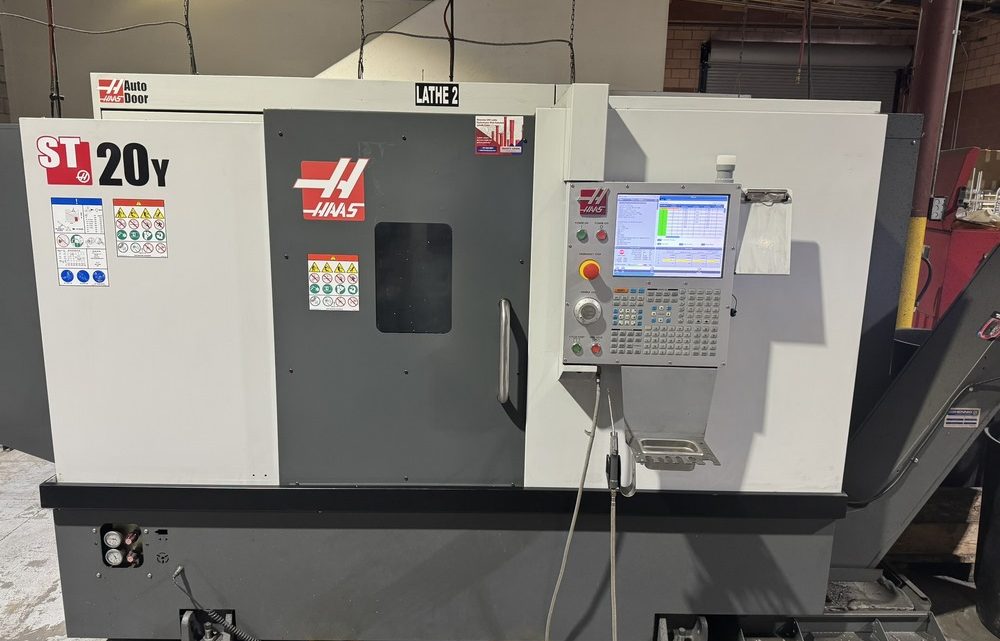
Technical Evaluation Guide: How to Identify a Quality Used, Secondhand, Pre-Owned, Surplus Haas ST-20Y CNC Turning Center with Y-Axis made in USA
1) Machine Overview & Key Published Specs
Before going on site, gather the machine’s spec sheet to set your benchmarks. Some key specs for ST-20Y (Y-axis variant) machines:
- Y-axis travel: ± 51 mm (± 2.0 in) for off-center milling/drilling/tapping.
- Spindle: 4,000 rpm standard (some upgraded units may go higher).
- Spindle motor: 20 hp (~ 14.9 kW) vector drive.
- Chuck size: 210 mm / ~ 8.3″ with A2-6 spindle nose.
- Bar capacity: 51 mm (~ 2.0 in) draw-tube bore.
- X / Z travels: about 236 mm in X, 533 mm in Z.
- Turret & live tooling: BMT-65 turret with live tooling and C-axis capability (for milling / drilling) come standard.
These values give you a baseline: any used ST-20Y must be in the ballpark (± tolerances) of these. If a seller claims wildly different capacities, that’s a red flag.
2) Documentation & Pre-Visit Checklist
Ask the seller to provide:
- Serial number, build year, and configuration (Y-axis version, live tooling, sub-spindle, etc.)
- Original spec sheet / build sheet
- CNC control version, software revision, compensation table backups
- Maintenance logs (spindle rebuilds, Y-axis drives, belt changes)
- Geometry / calibration / laser / ballbar test reports
- Tooling list (live tools, holders, mills)
- Electrical, hydraulic, pneumatic schematics
- Warranty history or service contracts
- Records of crashes or impact damage
Having these documents helps you spot discrepancies during inspection and judge how well maintained the machine is.
3) Visual & Static Inspection (Power Off)
Start with a thorough visual inspection before applying power:
- Frame & Base
Check for signs of cracks, weld repairs, distortions, or casting damage. - Way Covers / Bellows / Guards
Inspect for tears, chip damage, intrusion, or dried coolant. - Turret & Live Tooling Assembly
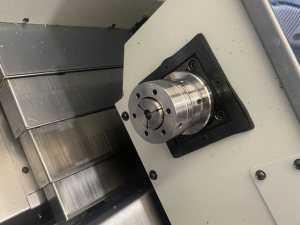
Check turret indexing face, tool pockets, gripper arms, and live tool spindles for damage or play. - Spindle Nose / Taper
Inspect for corrosion, rust, worn surfaces, or chatter marks. - Y-Axis Slide & Guideways
Visually inspect for uneven wear, scoring, or lubrication issues. - Electrical Cabinet & Wiring
Open and look for signs of overheating, dust buildup, rodent damage, discolored insulation, or modifications. - Coolant / Chip Conveyor / Plumbing
Check hoses, fittings, coolant pumps, and filters for leaks or damage. - Safety Guards / Doors / Interlocks
Operate doors manually; check latches, interlock switches, and alignment.
4) Installation & Alignment Checks
If the machine is already mounted or semi-mounted:
- Check the machine level and anchor bolts—a twisted install can hide serious geometry issues.
- Use a test bar / dial indicator at spindle to check radial runout in neutral position (Y = 0).
- Jog small moves in X, Y, Z and verify motion is smooth (no binding) and readback matches commanded moves (if axis scales or positional feedback).
- Manually command a small Y-axis off-center movement and watch for backlash, hysteresis, or tilt in the carriage.
- Inspect turret face alignment to the spindle nose using reference bore or gauge.
5) Power-On & Motion Testing
With machine energized (and safety enforcements):
- Warm-up / motion cycles for ~30 minutes to stabilize temperatures.
- Home / zero return operation—verify consistency and no limit trips.
- Axis stroking at different feed rates (25%, 50%, 100%)—listen for binding, resonance, or harsh spots.
- Y-axis movement in both positive and negative directions—check for smoothness, torque anomalies, or chatter.
- Turret indexing cycles—run the turret through all stations, including under no-load, confirm no mis-index or error.
- Live tooling / spindle milling in C-axis motion test—if live tools installed, run at moderate rpm, check for vibration, proper coolant flow, and steady spindle current.
- Spindle ramp-up test—ramp to maximum rpm (4,000 rpm or rated) while monitoring vibration, RPM stability, spindle current, and heat.
- Control / alarm log review—check for recurring servo faults, alarms, errors, or parameter resets.
- Coolant / pump test—flow, pressure, leaks, pump vibration.
- Chip conveyor & coolant system test—check for smooth operation and no blockage in chip path.
6) Accuracy, Repeatability & Metrology Checks
These are essential to judge the true performance of the machine:
- Linear positioning / straightness tests (X, Z) using laser interferometer or high-precision gauge—compare commanded vs actual.
- Backlash / reversal error: Command small incremental moves (±0.01 mm) and measure the reversal error.
- Repeatability: Do repeated moves (e.g. 10×) and measure the deviation in return.
- Y-axis positioning / repeatability: Command off-center movement and return to center; measure deviation.
- Turret index accuracy: Index repeatedly to each tool station, measure deviation from commanded angle or location.
- Combined milling / turning test: Run a test program that uses turning + Y-axis milling + live tooling; measure features, hole locations, concentricity.
- Thermal drift test: Run under load for 1 hour, freeze, then measure reference points for shift.
- Hysteresis tests: Move Y-axis positive then negative, measure offsets or shift after returning to zero.
7) Spindle, Tooling & Wear Checks
- Spindle runout / vibration: Use a test bar and dial indicator, and optionally vibration analyzer to detect bearing issues.
- Spindle noise / bearing whine: Especially at ramping or high rpm.
- Spindle temperature rise after extended run (30 min) – should be moderate and stable.
- Tool retention force (if applicable): For live tool holders, test pull-out / retention torque.
- Taper surface contact: Perform a blue test to check for full contact, or visual check for wear marks.
- Tool change accuracy / repeatability: Run tool changes and verify tool offsets return properly and with minimal variation.
- Live tool drivetrain: Gearboxes, couplings for runout, slack, vibration.
8) Lubrication, Cooling & Auxiliary Systems
- Way & ball screw lubrication: Confirm lube supply, check for clogging in lines, inspect oil quality or condition.
- Coolant system: Flow, pressure, filters, clarity, leaks, pump sound.
- Chip removal / conveyor / guard path: Run conveyor, observe chip flow, check for hangups or misalignment.
- Hydraulic / pneumatic systems (if any): Check for leaks, valve response, stable pressure.
- Filtration: Inspect coolant filters, screens, and any tramp oil removal systems.
- Electrical cabinet cooling: Fans working, no overheating in control cabinet.
9) Common Failure & Wear Patterns
- Y-axis drive wear or backlash creep
- Turret mis-indexing or worn cam followers
- Live tooling spindle bearing wear
- Control / servo board failures (aging electronics)
- Coolant leaks or contamination
- Lubrication starvation on guides or screws
- Encoder or feedback problems, especially in Y or turret
- Overheating control cabinet, failed capacitors or fans
10) Acceptance Criteria & Benchmark Tolerances
Below are sample acceptable tolerances (adjust them based on the machine’s spec sheet and intended use):
| Parameter | Target / Acceptable Tolerance |
|---|---|
| Linear positioning accuracy (X, Z) | ± 0.005 mm over 300 mm |
| Backlash / reversal error | ≤ 0.01 mm |
| Repeatability (X, Z) | ± 0.003 mm |
| Y-axis repeatability | ≤ 0.01 mm |
| Turret index repeatability | ≤ 0.01 mm (or per spec) |
| Spindle runout (radial) | ≤ 0.005 mm |
| Thermal drift over 1 hr | ≤ 5 µm |
| Live tooling runout | ≤ 0.01 mm |
| Tool change repeatability | ≤ 0.01 mm |
| Coolant stability / pressure fluctuation | Within spec (no major drops) |
| Servo load current stability | Smooth, no spikes |
If the used machine fails multiple of these, it’s a risk.
11) Red Flags / Walk-Away Alerts
- Y-axis showing backlash or slop
- Turret mis-index or intermittent errors
- Repeated servo faults or alarms in the control log
- Spindle vibration or bearing noise at any rpm
- Coolant contamination, leaks, or poor pump performance
- Control or servo board overheating or evidence of burn marks
- Missing or corrupted CNC backups / parameter data
- Tool change errors / gripper slippage
- Evidence of crashes, collision repairs without documentation
12) Buyer’s Checklist (On-Site)
- Confirm serial number, build year, and configuration
- Match spec sheet vs actual travel / feature list
- Visual inspection of frame, guards, way covers
- Jog X / Z / Y axes; listen for binding
- Test turret indexing and live tooling motion
- Ramp spindle, test runout, vibration
- Do a combined turning + milling test part
- Accuracy / repeatability / drift tests
- Run coolant, lubrication, chip conveyor systems
- Review alarm history and control backups
- Walk away if multiple significant faults arise