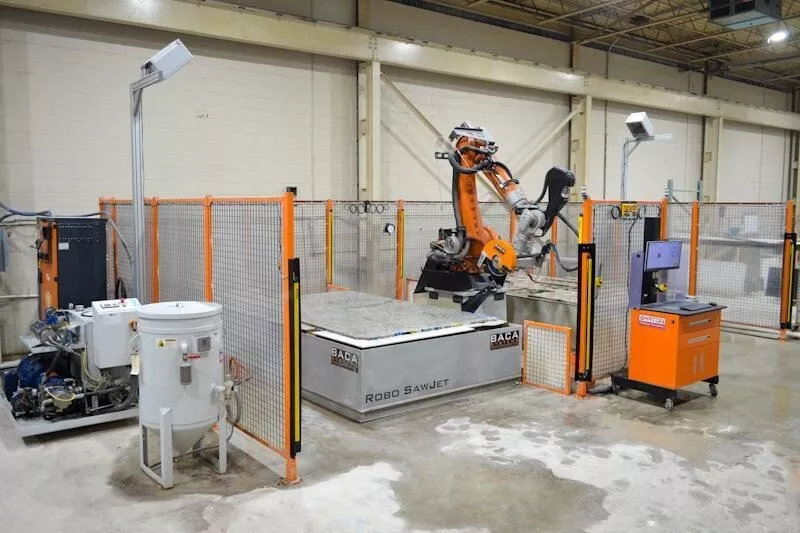
Technical Evaluation Guide: How to Identify a Quality Used, Secondhand, Pre-Owned, Surplus BACA Systems Robo SawJet V2.0 Complete Robot Granite Cutting Saw System
1) Machine Overview
The BACA Systems Robo SawJet V2.0 is a next-generation robotic stone cutting and waterjet system combining 6-axis robotic motion with high-pressure waterjet and diamond blade cutting. Built in the USA, it is engineered for high-throughput countertop and slab fabrication, integrating FANUC robotic precision, KMT or Hypertherm waterjet technology, and BACA’s proprietary software suite for nesting, optimization, and automated loading/unloading.
The Robo SawJet V2.0 eliminates multiple manual setups—cutting straight lines, arcs, and sink openings in one continuous cycle with unmatched speed and repeatability.
2) Key System Specifications
Component
Specification
What to Inspect
Robot Model
FANUC M-20iB / M-710iC
Check motion smoothness, joint backlash, and cable wear
Cutting Head
Dual-function: diamond saw + waterjet nozzle
Verify switching sequence and alignment accuracy
Saw Motor Power
20–25 HP
Listen for bearing or spindle noise during ramp-up
Waterjet Pressure
Up to 60,000 psi (KMT / Hypertherm)
Check pump hours and nozzle condition
Work Envelope
Approx. 3,500 × 2,000 mm slab area
Verify reach and travel clearances
Control
BACA Motion Controller (Windows / FANUC)
Confirm software license and interface operation
Cutting Accuracy
±0.25 mm typical
Confirm using sample test cut
Table Type
Dual or single station
Check vacuum zones, rubber seals, and frame alignment
Electrical Requirement
480 V / 3-phase / 60 Hz
Confirm transformer compatibility for your facility
3) Structural Integrity & Mechanical Health
Robot Arm: Inspect each axis joint (J1–J6) for smooth motion, absence of play, and consistent servo load readings. Look for cracks on the cast arms or base pedestal due to transport or collision.
Cutting Head Assembly: Check the saw spindle bearings, blade flange face, and nozzle holder alignment. Inspect the air/oil lines to the blade guard and waterjet hoses for leaks or stiffness.
Bridge / Frame / Table: Confirm table flatness with a precision straightedge (tolerance ≤ 0.3 mm over 2 m). Inspect welds, frame alignment, and rust, especially on machines stored outdoors.
4) Waterjet Pump & High-Pressure System Evaluation
Component
Inspection Focus
Acceptable Condition
Pump Head (KMT/HYPERTHERM)
Look for cavitation marks or leaks
No visible cracks or oil/water mixing
High-Pressure Seals
Check for moisture or pressure drop
No leaks; pressure holds for 10 min idle
Accumulator
Observe pressure gauge during start/stop
Stable; no excessive fluctuation
Water Filters & RO System
Check maintenance logs
Replaced within past 6 months
Orifices & Mixing Tubes
Visual inspection with magnifier
No taper or blockage
High-Pressure Hoses
Check serial age code
Replace if older than 3 years
5) Motion & Axis Accuracy Tests
Test
Method
Acceptable Range
Robot Repeatability (Fanuc)
J6 cycle test
≤ ±0.05 mm
Blade Parallelism
Edge cut test across 1 m
≤ 0.2 mm deviation
Waterjet Alignment
Coincidence test saw/waterjet
≤ 0.25 mm offset
Vacuum Hold Test
Slab retention
≥ 95 % zone efficiency
Cut Quality
Visual + micrometer
Smooth kerf, no delamination or step
Program Repeat Test
Run same part 3×
Dimensional repeatability within ±0.25 mm
6) Electrical, Pneumatic & Control System Checks
Control Panel: Open and inspect wiring harnesses for corrosion or rodent damage. Ensure cooling fans, relays, and emergency stops are functional.
Robot Controller (FANUC): Power on and check for alarm-free boot. Verify software version (≥ V8.xx) and license keys for BACA RoboMotion or RoboCut.
Remote diagnostics module for service connectivity
Recently replaced high-pressure hoses and mixing tubes
Verified FANUC preventive maintenance contract
Laser calibration report within the past 12 months
12) Red Flags — Avoid If
Robot calibration backup unavailable or corrupted.
Pump pressure drops > 1,000 psi within 5 minutes.
Visible oil in waterjet return lines (seal failure).
Cracked pedestal or misaligned base frame.
Outdated software (pre-V2.0 interface).
Non-functional light curtain or E-stop circuit.
No evidence of professional maintenance or alignment reports.
13) Buyer’s Quick Checklist
✅ Robot joints smooth, no backlash ✅ Spindle and waterjet head operational ✅ Pump holds 60,000 psi pressure steady ✅ Vacuum table fully functional ✅ Control interface boots without error ✅ High-pressure hoses < 3 years old ✅ Safety systems (E-stop, interlocks) functional ✅ Cut test verified ±0.25 mm accuracy ✅ Manuals, calibration data, and backups included
Pro Tip
A high-quality BACA Robo SawJet V2.0 should demonstrate consistent cut accuracy, smooth tool switching, and stable high-pressure output without leaks or noise. Always request a live cutting demo and verify that both saw and waterjet paths are aligned within tolerance across the slab surface. Units with recent pump rebuilds, FANUC controller updates, and active BACA service contracts command premium resale value.