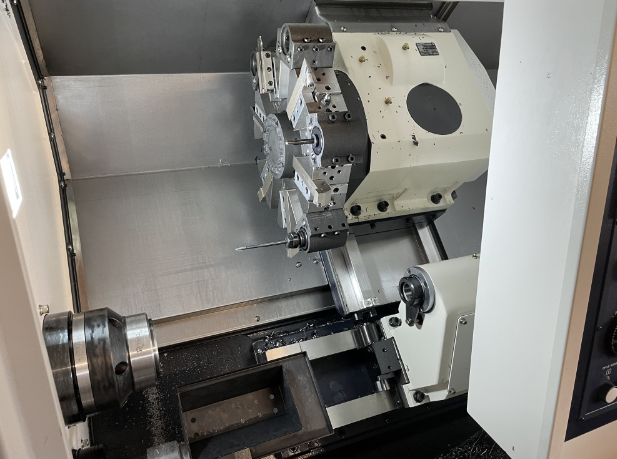
Technical Buyer’s Handbook: Assessing Pre-Owned , Used , Secondhand, Surplus CNC Machines Before Purchase Hwacheon Cutex 160A CNC Turning Center made in South of Korea
Below is a proposed “Technical Buyer’s Handbook / Checklist” for assessing a pre-owned / surplus CNC turning center (with special notes for a Hwacheon CUTEX-160A style machine). You can adapt or expand this list depending on your shop’s requirements, budget, and technical staff.
1. Preliminary & Strategic Considerations
Before even visiting or inspecting, do some homework so you know roughly what to expect and what “red flags” to look for.
| Topic | What You Should Establish Ahead of Time | Why It Matters |
|---|---|---|
| Application fit | What parts do you need to make (size, tolerances, materials, cycle times)? | You don’t want to buy a machine that’s under-sized, over-capable, or mismatched to your needs. |
| Machine history / provenance | Ask seller: age, total running hours, duty cycle, reason for sale, past upgrades / rebuilds | Helps judge wear, risk, and value. |
| Spare parts & support availability | For Hwacheon (South Korea origin), check whether replacement parts (spindle bearings, guideways, control modules) are still available locally or internationally. | If parts are “orphaned,” downtime and repair cost may be very high. |
| Control / CNC compatibility | What control (Fanuc, Siemens, Hwacheon proprietary, etc.) is installed? Will your programmers / CAM environment support it? | Upgrades, retrofits, programming compatibility, spares for control system. |
| Transport, installation & foundations | Weight, dimensions, power / grounding / coolant / pneumatic needs, special foundation or leveling requirements | Sometimes the “hidden” cost of moving and installing a used CNC is as much as a big portion of the purchase. |
| Inspection logistics | Arrange access, bring tools & measuring devices, ideally bring a technician or someone experienced in machine inspection. | First‐hand inspection is key (not just photos). |
2. Specs & Benchmarking: Know the Reference Values for CUTEX-160A / CUTEX-160 Series
Before inspecting the candidate machine, know what the “ideal / factory spec” is for a Hwacheon CUTEX-160 (or the exact model). Here are some reference spec points (for CUTEX-160 / CUTEX-160A) drawn from catalogs and listings.
| Feature | Typical / Design Value | Notes / Variants |
|---|---|---|
| Swing over bed | Ø550 mm | Standard across many CUTEX-160 versions |
| Max turning diameter | Ø300 mm | For standard “cutting” diameter |
| Max turning length | ~300 mm | Some versions (A variant) list 300 mm travel in Z |
| Rapid traverse (X / Z) | 36 m/min | Typical rapid feedrate spec |
| Turret / tool stations | 12 stations | Standard on the machine series |
| Turret indexing time | 0.15 sec/step | Fast indexing spec |
| Spindle speed max | 6,000 rpm (for A version) | Many listings show 6,000 rpm for CUTEX-160A variant |
| Through-spindle hole / bar capacity | ~ Ø45 mm | Many listings and spec sheets show ~45 mm bar through hole in spindle |
| Spindle motor / drive power | 15 kW (or dual motors in some versions) | Some spec sheets list “15 / 7.5” in listings (depending on motor duty) |
| Tool size / turret & driven tool support | 25 × 40 mm (for boring bar), BMT tool turret | Many spec sheets list this standard tool size |
| Weight / footprint | ~3.2 tonnes, dimensions ~2,200 × 1,700 × 1,800 mm (L×W×H) | One listing shows exactly that for a CUTEX-160A listing. |
When inspecting a candidate machine, you should see how near the actual values are to these “factory ideal” specs or whether modifications / wear have reduced capability.
3. On-Site / Hands-On Inspection Checklist
Use the following checklist when you go to see the machine in person. Where possible, test under power, and ideally with your own test bar / sample.
(a) Visual & Structural Inspection
- Check for external damage, cracks, repair welds, dents, misalignment.
- Look for excessive corrosion, especially around slideways, bed, ways, covers.
- Inspect way covers, bellows, guards: have they been replaced? Any indicators of collisions?
- Check for missing covers, missing guards, open access holes (may be a sign of poor maintenance).
- Observe cleanliness: how “clean” is the machine? Very dirty and neglected is a warning sign.
(b) Spindle & Bearings
- Run the spindle at low, medium, and high speeds and listen for abnormal noise or vibration.
- Use a dial indicator to test spindle run-out (front and back of nose) with test bar.
- After running for a few minutes, check if spindle housing feels unusually warm (overheating).
- If the spindle is air / oil / grease cooled, check that those systems function correctly.
- Check whether the original spindle bearings have been replaced (records or tags).
(c) Guideways, Carriages & Ball Screws / Leadscrews
- Manually (or via jogging) move each axis slowly; feel for smoothness, binding, “stick-slip.”
- Move over full travel; listen and feel for “bumps” or tight spots that may indicate wear or damage.
- With indicator, measure backlash in each axis (X, Z) at multiple positions.
- Check for wear marks, scoring, rust, pitting on the guideways / surfaces.
- Inspect lubrication / oiling system: are oil lines clear, pump functional, no blockages?
- Inspect ball screws (if used) for wear, oil seals, signs of slop / play.
- Verify alignment of axes (squareness, perpendicularity) if possible with test fixture.
(d) Turret / Tooling System
- Inspect turret indexing: does it index accurately, smoothly, on time (e.g. ~0.15 sec)? Delay or sloppiness is bad.
- Check turret locking mechanism – is it firm, does it seat correctly, any wear or play?
- Examine each tool station for wear, tool holder condition, broken bits, alignment.
- If live/driven tooling is present, test the driven tool function (rotation, torque, runout).
- If C-axis control is present (for part indexing), test its accuracy and behavior.
(e) Tailstock / Quill (if equipped)
- Check quill travel, smoothness, fullness of locking.
- Test alignment of tailstock to spindle axis (use test bar / dial indicator).
- Inspect taper condition (e.g. MT4 in many cases), check for damage, debris.
(f) Control, Electronics & Wiring
- Power on the machine: check for errors, alarm codes, boot behavior.
- Inspect control cabinet: cleanliness, signs of condensation, rust, burned wires, modifications.
- Check wiring, cable routing, connectors: any obvious hacks, splices, frayed cables.
- Verify existence (or request) electrical and schematic manuals (ladder diagrams, wiring diagrams).
- Test all switches, buttons, E-stop, panel switches, indicator lights.
- Try to run a simple program (e.g. simple straight cut or dwell move) to verify that axes and interpolation work.
- Test portability / communications: does the controller communicate with your PC / network? Can you transfer a G-code or program?
- Ask about control software version, software upgrades, backups, and whether OEM support is still available.
(g) Performance / Cutting Test
- Bring a sample workpiece or test bar of a representative material and perform actual cutting under realistic loads.
- Monitor part accuracy, surface finish, chatter, thermal drift.
- Check repeatability: e.g. multiple runs of the same cut, measure dimensional consistency.
- Test across the travel ranges (near extremes, mid, etc.) to see how behavior changes.
- Monitor temperature drift over a period (e.g. run for 30 minutes, see if measurements “walk”).
- At speed, monitor for vibration, chatter, noise, or power draw anomalies.
(h) Maintenance, Documentation & History
- Ask for maintenance logs, service records, part replacement history, downtime history.
- Request original operator manuals, parts manuals, electrical schematics, control manuals.
- Ask for records of any reconditioning or rebuilds (spindle rebuilds, regrinding, repainting).
- Check whether all (or many) critical parts are original or replaced; for high-wear parts, replacement is not a deal-breaker if well documented.
(i) Check Additional Systems & Accessories
- Coolant / flood systems: does it work (pump, nozzles, filtration)? Check for leaks, corrosion.
- Chip conveyor, chip removal, guards, covers.
- Hydraulic / pneumatic systems (if used) – valves, hoses, pressure gauges.
- Safety systems: interlocks, door sensors, E-stops.
- Tool presetter, probes, workholding fixtures may be included — assess their condition.
- Check if bar feeder (if needed or claimed) works properly and integrates well.
- Check if any custom modifications were made (good or bad) and whether they are serviceable.
4. Assessment, Scoring & Risk Adjustment
After inspecting, you need to translate observations into a risk / value assessment. Here’s how to think about it:
- Wear vs acceptable tolerance: Some wear is expected. The question is whether it stays within the tolerances you need for your parts. If errors or wear exceed acceptable limits, the cost to recondition (ways, regrind, re-scrape) may make the purchase uneconomical.
- Remaining life / “wear horizon”: Estimate remaining life of spindle bearings, ball screws, ways, and other high wear items. If major repairs will be needed soon, that is a future cost you must discount the price for.
- Parts & support risk: If OEM parts for this model (or retrofit equivalents) are still available, risk is lower. If the model is old and parts are scarce, risk is higher.
- Upgrade / retrofit feasibility: If the machine as-is is lacking in features you need (e.g. live tooling, newer control, better spindle), assess how feasible upgrades are and what cost / downtime would be.
- Hidden costs: Transport, installation, leveling, foundation, electrical upgrades, coolant plumbing, and commissioning may all be substantial.
You may develop a simple weighted scoring scheme (e.g. 0–10 across categories: structural, spindle, axes, control, accessories, documentation, overall risk) to help compare multiple candidate machines.
5. Special Caveats & Risks for Surplus / Used CNC Machines
- Some sellers will “dress up” a machine before showing: clean surfaces, paint over wear, hide leaks. Don’t be deceived by just appearance.
- Machines that have sat idle (in storage) may have problems: dried lubrication, seized slides, corrosion in ways.
- Beware of missing internal components (power modules, control boards) especially in “parts / repair” listings.
- Electronics & control systems may have obsolete parts (hard to replace modules).
- Some machines may have had collisions or misuse, which cause subtle misalignments that are hard to detect initially.
- Warranty is usually minimal or none; you will assume all risk for “as-is.”
- Always protect yourself with an inspection period or conditional acceptance (if possible in contract).
6. Example: Applying to a Candidate CUTEX-160A
To illustrate, here’s how you might apply this to a candidate CUTEX-160A you are evaluating:
- Verify model & variant: Ensure it’s a CUTEX-160A (vs B or other variants). The A version often supports 6,000 rpm, while B variants may be limited to lower speeds.
- Check critical dimensions: Measure swing over bed, max turning diameter, travel in X and Z and see how far they deviate from spec.
- Spindle test: Run to 6,000 rpm, test runout, listen / feel for vibrations.
- Axes & way wear: Check backlash, bound spots, smoothness over full length (0 → max in X and Z).
- Turret & tool system: Does the turret index cleanly, quickly, and lock firmly? Are tool stations in good condition?
- Perform a cutting test: Use a bar approx 45 mm diameter (if spindle bore supports it) and machine a few features to test thermal drift, repeatability, and surface finish.
- Docs & support: Request original manual sets and spare parts lists. Contact Hwacheon or authorized agents to verify whether parts for that serial/model are still procureable.
- Estimate recondition cost: If you see wear in ways, ball screws, etc., get rough quotes (locally) for regrinding, re-scraping, bearing replacement, if needed.
- Negotiate price based on observed condition & risks: For example, if turret bearings or spindle bearings are nearing end-of-life, or if control modules look outside of current support, deduct accordingly.