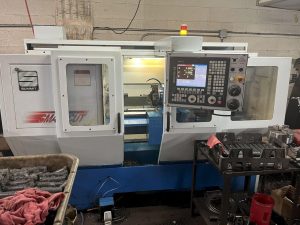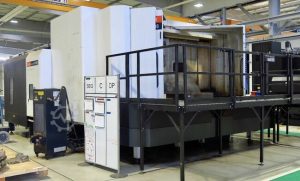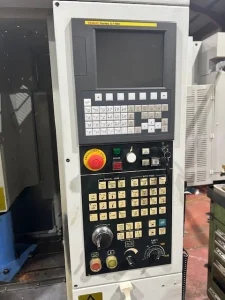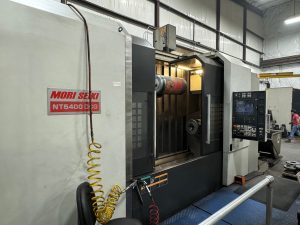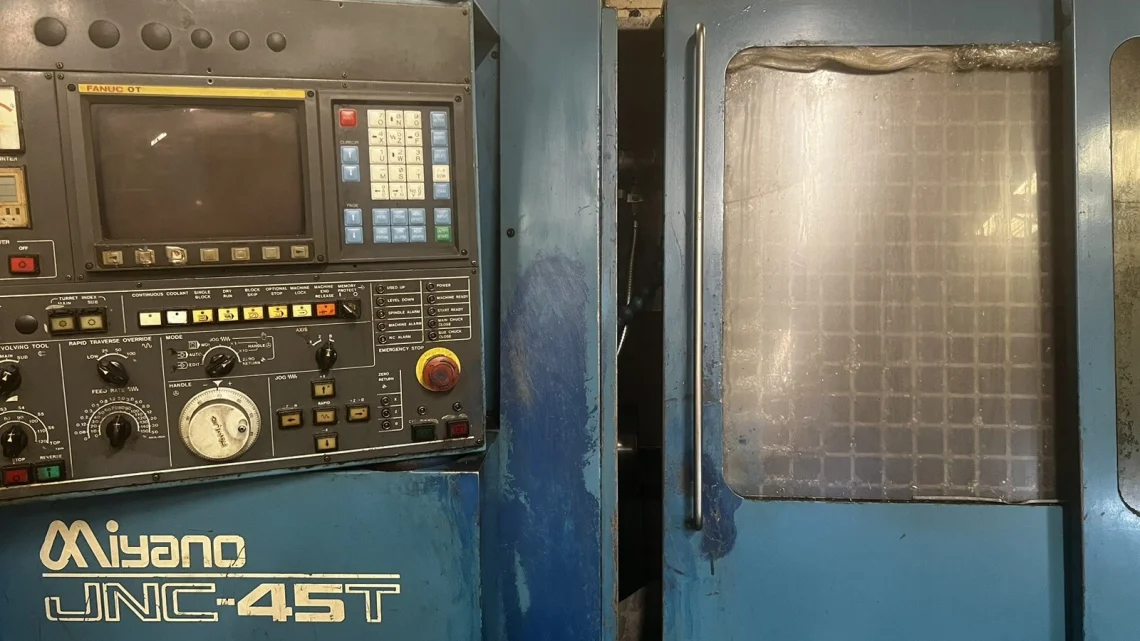
Smart Investment Checklist: Key Factors Before Buying a Pre-Owned, Used, Surplus, Second-Hand Miyano JNC45T CNC Turning Center Double Turret Single Spindle made in Japan
Below is a Smart Investment Checklist you can use when evaluating a pre-owned / used / surplus / second-hand Miyano JNC45T CNC Turning Center (double turret, single spindle). This is tailored to mitigate risk and uncover hidden issues before committing.
1. Know What You Should Expect (Benchmark Specs)
Before you visit, gather the “ideal” or published specs of a JNC45T so you can spot deviations. Some known parameters for JNC-45 / JNC-45T variants:
- It typically supports bar capacity ≈ 1.8125 in (~46 mm) (or similar) in many listings.
- Chuck size: 8″ (3-jaw hydraulic) is common.
- Machining length ~ 18.5″ (Z travel) in many JNC-45 examples.
- Spindle speeds from 40 to 4,000 rpm in many configurations.
- Turret counts: main turret with ~10 positions, sub / lower turret ~6 positions (for the “T” variant).
- Rapid traverse, feeds, control type (Fanuc / Mitsubishi / other) will vary by unit.
These give you your “design window” to verify seller claims.
2. Remote Pre-Screening (Before You Travel)
These are quick filters to eliminate weak candidates and prioritize visits.
- Request full specs: model (JNC45T), serial number, build year, turret counts, spindle motor data.
- Photos & video: turret in action, spindle running, axis motion, control panel, electrical cabinet.
- Ask for a demo or remote axis motion: even just watching turret indexing, axis moves, spindle start is revealing.
- Usage history / hours: number of hours cutting vs idle, what materials were machined.
- Spare parts & consumables status: turrets, drive modules, control boards, tooling.
- Confirm control / CNC compatibility: type, backups, parameter files.
If the seller cannot provide coherent details or denies demonstration, consider it high risk.
3. On-Site Inspection & Technical Audit
Bring measurement tools (dial indicators, test bars, micrometers), flashlight, and test parts or blanks.
A. Mechanical & Structural Checks
- Frame / bed / castings
- Look for cracks, welds, distortion, misalignment.
- Use straightedges / surface plates to verify that bed and saddle surfaces are true.
- Slides / guideways / carriages
- Move axes slowly; check for roughness, binding, “dead zones,” or inconsistent resistance.
- Inspect guide surfaces for wear, gouges, corrosion.
- Ball screws / nut assemblies / backlash
- Measure backlash in X and Z axes.
- Inspect screw threads for wear or pitting.
- Check whether the nut assembly has preloads or anti-backlash designs.
- Turrets (main and sub)
- Cycle both turrets through all stations. Check indexing accuracy, clamping tightness, no mis-index or wobble.
- Check turret drive mechanisms, gear teeth, follower pins, wear.
- Look for turret shocks/damage.
- Spindle / head / bearings
- Mount a test blank / arbor, spin up, and measure radial & axial runout.
- Listen / feel for noise, vibration, bearing roughness.
- Run for some minutes under no load and measure temperature stability.
- Tool holder interfaces / tool change mechanisms
- Inspect tool holders, collets, grippers, turret-to-tool interfaces.
- Test tool change operations under both manual and automatic modes.
- Chip / coolant / removal systems
- Check chip conveyor (if present), coolant pump, piping, leaks, filtration.
- Inspect coolant quality, sludge, contamination.
B. Electrical / Control / Safety Systems
- Control cabinet & wiring
- Open and inspect wiring, connectors, insulation, signs of overheating or repairs.
- Check for burnt wires, poorly spliced cables.
- CNC / control panel
- Power up the control. Navigate interface, access parameters, issue axis commands.
- Review error logs, alarms, diagnostic history.
- Drive units / servo amplifiers
- Inspect servo / drive modules for fault LEDs, overheating, fan operation.
- Test axes under motion to see drives respond smoothly.
- Limit switches / safety interlocks / E-stop
- Trigger each limit, open guards, press E-stop — machine must halt reliably.
- Ensure no bypassed safety circuits.
- Sensors / encoders / feedback
- Verify encoders, limit sensors, feedback loops, signal quality.
C. Functional / Performance Testing
- Dry motion test
- Move axes through full stroke without cutting. Note smoothness, jumps, slop.
- Test incremental moves and check actual motion vs commanded.
- Test turning / machining
- Bring a known blank part material. Run simple turning, facing, contour cuts.
- Measure finished part: diameter accuracy, surface finish, concentricity, run-out.
- Turret / tool change test
- Use full turret capacity in cycles. Test tool change under load.
- If live tooling installed, test milling / drilling.
- Stability / long-run test
- Run multiple cycles (30–60 min). Then recheck key part dimensions to detect drift.
- Monitor drives, spindles, bearings for heat or noise.
- Repeatability / return-to-zero tests
- Command the same point multiple times. Measure deviation.
- Return the turret, retract, re-engage, repeat — measure shift.
D. Documentation, Parts & Support
- Machine identity / serial / build records
- Confirm model, serial number, manufacturing origin (Japan).
- Ask if any retrofits or modifications were done, and whether those are supported.
- Maintenance / repair history
- Inspect records for major repairs, part replacements, rebuilds.
- Look for documented turret overhauls, spindle rebuilds, screw or guide refurbishments.
- Spare parts & tooling availability
- Confirm availability of turret parts, drives, tool holders, CNC modules.
- If obsolete parts were installed, verify alternatives.
- Control / CNC parameters / backups
- Get copies of all settings, offsets, tool tables, program libraries.
- Verify whether the CNC is locked or has modules missing.
- Contractual protection
- Negotiate acceptance period after installation.
- Define which metrics (accuracy, repeatability, run-out) must be met.
- Hold-back payment until performance is validated.
4. Red Flags & Warning Signs
Watch carefully for:
- Excessive turret wobble, mis-indexing, or play
- High backlash or binding in axes
- Spindle bearing noise, vibration, or high run-out
- Control or drive modules missing, faulty, or overheating
- Burned wiring, poorly done repairs or modifications
- Safety circuits disabled or tampered
- Poor coolant / chip systems or contamination
- Obsolete or unavailable critical spare parts
- Seller refusing live tests or performance demos
- Structural damage such as welded repairs to bed or castings
Any combination of these is serious — either require corrective action or walk away.
5. Acceptance Criteria & Decision Benchmarks
Before finalizing, define non-negotiable criteria:
- The machine must meet ≥ 90–95% of its advertised specs (tolerance, surface finish, accuracy).
- Turrets must index accurately and clamping must be tight and repeatable.
- Spindle run-out / concentricity must be within your tolerance on test parts.
- Repeatability (return to zero) must be reliable and within limits.
- All safety and interlock systems must function flawlessly.
- Control, CNC, and drive systems must operate without errors.
- Spare parts for the model must be accessible in your region or via suppliers.
- The cost to repair or refurb the unit (if any) plus transport must still leave you margin.
- Contract must include a conditional acceptance period and hold-back until on-site validation.
If the candidate passes all these, it’s likely a sound investment (if pricing and logistics align).