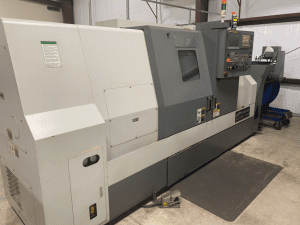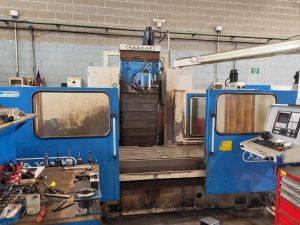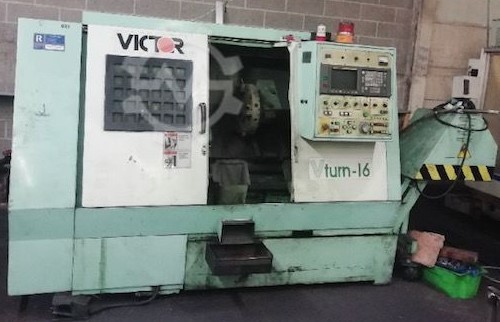
Smart Buyer’s Guide: How to Choose the Right Pre-Owned, Used, Secondhand, Surplus CNC Equipment Before Purchasing Victor VT 16 CNC Lathe made in Taiwan
Here’s a “smart buyer’s guide” (checklist + methodology) you can use when evaluating a pre-owned / secondhand / surplus CNC lathe like a Victor VT-16 (or its equivalents) before you commit. (Some of the suggestions are generic to used CNC machines; others are tailored to what I found on the Victor / Vturn / VT-16 family.)
1. Define Your Requirements Clearly (Before Looking)
Before you inspect any machine, have a clear target spec set. This helps you avoid overpaying or choosing a machine that cannot fulfill your needs.
Key parameters to fix:
| Spec | Why it matters | Target / minimum you should demand |
|---|---|---|
| Swing / turning diameter (over bed / over carriage) | Determines the largest part you can turn | At least your largest part + some margin |
| Distance between centers / max turning length | For longer parts or bar work | Enough for your longest workpiece |
| Spindle speed & power / torque | To produce the necessary cutting speed / feed for various materials | Should suit both light finishing and heavier roughing |
| Spindle bore (through-spindle hole) | For bar work / long parts fed through | If you ever plan bar feeding, this must be sufficient |
| Turret / tool stations (live / driven, index speed, tool capacity) | More tool capability gives flexibility | Decide how many tools / driven tools you’ll need |
| Control / CNC system | Compatibility, operator familiarity, support, spare parts | Prefer controllers you can maintain or source spares |
| Accessories & peripherals (tailstock, bar feeder, chip conveyor, coolant, steady rests, probing, subspindle, live tooling, chuck types) | The machine is only as useful as its peripherals | Ensure you won’t have major missing accessories or plan to pay for them |
For example, one listing for Victor Vturn-16 (similar family) shows max turning length 610 mm (≈ 24″) and a spindle max speed of 6,000 rpm.
Also, control: Victor’s lathe “Victor VT-NP16” listing shows Fanuc Oi-TF control as standard.
Having your requirement sheet lets you objectively reject machines that fall short, rather than being swayed by price.
2. Research the Model / Brand & Spare Parts / Support Situation
- Brand reputation & parts availability — Victor (Taichung) is a known brand; check whether spare parts (gears, motors, control modules, servos, chips, wiring) are readily available in your region (Turkey / Europe).
- Control & electronics support — If the machine uses a popular controller (Fanuc, Siemens, etc.), servicing and spare parts are easier. If it uses a custom or obsolete controller, risk is higher.
- Existence of aftermarket / third-party support / user community — This helps with troubleshooting, retrofits, upgrades.
- Know previous versions / revisions — Sometimes manufacturers introduce improvements over time (e.g. better spindle bearings, stronger ball screws). If you can identify the machine’s revision / build year, you can assess relative desirability.
- Check for known weaknesses of that model — Look up forums, user reviews, threads on “Victor lathe issues”, or “Vturn / VT-16 reliability”.
3. Inspect (On-Site / In-Person If Possible)
Use a disciplined inspection. Here’s a structured checklist adapted from “7-step guide to inspecting a used CNC” and other sources.
A. Visual & Exterior Condition
- Look for physical damage, cracks, gouges, corrosion on bed, castings, carriage faces.
- Check for signs of repair, welding, patching, repainting (may hide issues).
- Look for missing covers, panels — absent protection is a red flag.
- Check the machine’s leveling / foundation — a warped or poorly leveled installation can cause misalignment.
B. Spindle & Bearings
- Run the spindle at various speeds (low → high). Listen/feel for abnormal noise, vibration, or heat.
- Check for axial & radial play in spindle — any looseness is concerning.
- Check spindle taper and contact surfaces for wear, scoring, or abnormalities.
- If possible, check bearing temperature under load.
C. Guideways, Ways & Slides
- Visually inspect bed, slideways, carriage ways for scoring, wear, rust, pitting.
- Manually move axes (X, Z): Does movement feel smooth? Any sticking or rough spots?
- Check way covers / bellows condition — torn or missing covers allow contamination.
- Inspect lubrication system and lubrication lines on ways: Are they intact, working, clean?
D. Ball Screws / Lead Screws & Drive Systems
- Check ball screws (or leadscrews) for backlash, play, wear, and smoothness.
- Listen for grinding or binding as axes traverse full travel.
- Inspect drive motors and couplings to screws: Are couplings tight? Any looseness?
- Check for backlash in transmissions, if present.
E. Electrical & Wiring
- Inspect wiring harnesses, control cabinet: frayed wires, burn marks, loose connections, corrosion.
- Check drive modules, servo amplifiers, control boards — any signs of heat damage, replaced modules, mismatch brands.
- Check power supply, fuses, breakers.
- Turn on the control and check whether alarms or errors appear immediately.
F. CNC Control, Software, and I/O
- Boot up the CNC, run through menu and diagnostics.
- Check whether custom macros, offsets, parameter settings seem abnormal.
- Try jogging axes via the control — do all axes respond properly?
- Test tool change (automatic turret / tool changer) — any mis-indexing, slop, slow indexing.
- Verify that necessary I/O (probes, interlocks, sensors, safety circuits) are functioning.
- Request to see alarm history, error logs — see if there are recurring faults.
G. Test Cutting / Demo under Load
If possible, run a test cut (rough & finish):
- Monitor cutting behavior: chatter, tool deflection, surface finish.
- Check dimensional accuracy of test parts (measure carefully).
- Try heavy cuts, and also light finishing passes — machine must handle both.
- Monitor thermal stability: does the machine drift as it warms?
- Observe how stable the axis motion is under load (any “hunting” or vibration).
H. Documentation, History & Records
- Ask for maintenance / service logs / repair history — knowing how often it was maintained is critical.
- Ask for original manuals, parts list, wiring diagrams, parameter books.
- Serial number, manufacturing date — helps you understand the age and whether parts are obsolete.
- Ask what major components have been replaced (drive modules, spindle, motors, guides).
- Ask about the environment it was used in (e.g. heavy dust, coolant, contaminants) — poor environments cause accelerated wear.
4. Assess Remaining Useful Life & Risk (Wear, Technology Obsolescence)
- Estimate remaining life of major wear parts (ways, ballscrews, spindle bearings).
- Factor in cost of replacing or refurbishing such parts — if they need replacement soon, subtract that from your “acceptable price.”
- Consider whether the controller / electronics are obsolete, unsupported, or upgradeable.
- Evaluate how much retrofit / refurbishment will be needed (rewire, re-scrape, regrind, reball-screw).
- Consider the downtime risk and repair lead times in your region for parts and service.
5. Pricing & Value Negotiation
- Use comparable sales of similar machines (same model, similar age, condition) to benchmark.
- Subtract “cost to get to acceptable condition” (repairs, refurbishment) from your offer.
- Leave margin for surprises (hidden flaws).
- If seller is a dealer or refurbisher, expect a markup; if private sale, more room to negotiate.
- Check whether the seller provides some form of warranty, acceptance period, or support — that adds value.
6. Logistics, Installation & After-Sale Considerations
- Transport / shipping / rigging costs — heavy machines are costly to move.
- Foundation & leveling: the new site must be prepared (concrete, grouting, alignment).
- Power, utilities, coolant, air, chip disposal — ensure your facility supports what the machine needs.
- Commissioning / test / alignment post-installation — sometimes sellers include it, sometimes not.
- Warranty / support / spare parts after sale — negotiate what the seller will provide.
- Consider training for your operators / maintenance team to use that specific model and controller.
7. Use a Third-Party Expert / Inspection
- If you’re not fully confident, bring in an experienced machine tool inspector or service technician (ideally familiar with Victor / Taiwanese lathes).
- They can do more precise measurements (straightness, alignment, backlash, vibration analysis).
- They may detect issues you’d miss (e.g. microcracking, electrical degradation, hidden wear).
8. Specific Considerations for Victor VT-16 / Vturn-16 Type Machines
From what I found:
- The Victor / Vturn lathe family (e.g. Vturn-16, Vturn-16/20) advertise box slideways hardened to ~HRC 55 for heavy cutting.
- The Vturn brochure states a max turning length of 610 mm for the 16 / 20 series.
- Typical spindle speeds up to 6,000 rpm.
- Victor’s NP16 variant advertises Fanuc Oi-TF control, servo turret system, compatibility with automation.
- A listing for a “Victor Vturn16 CNC Lathe (serial ~1998)” shows swing 450 mm, turning diameter ~160 mm, 12-station turret, programmable tailstock, spindle A2-5, 6,000 rpm, etc.
Thus, when you inspect a used VT-16 / Vturn-16, check all those promised specs are still valid (e.g. is the spindle really 6,000 rpm, is the turret still 12 stations with full functionality, is the slideway hardness still intact, etc.).
Also confirm whether it was upgraded, retrofitted, or modified (some older machines may have had electronics swapped or performance de-rated).
9. Red Flags to Avoid / Deal Breakers
Here are some warning signs you should avoid (or use as strong negotiating leverage):
- Spindle bearing noise or play, or obvious spindle issues
- Worn, scored, rusty slideways
- Missing covers, open wiring, evidence of electrical damage
- Obsolete, unsupported control electronics with no spares
- Missing critical accessories (tooling, chuck, steady rest, tailstock) that you need
- No documentation, no maintenance history
- Severe vibration or chattering during test cuts
- High cost to refurbish expected wear parts
- Seller refuses inspection, demo, or return options
10. Final Acceptance Checklist Before Paying / Shipping
- Negotiate terms in writing (what is included, support, acceptance period).
- Do a final run / demo just before removal.
- Ensure you get all manuals, wire diagrams, part lists.
- Get the machine’s “as-is” condition documented (photos, serial numbers).
- Arrange proper packaging, crating, rigging and shipment.
- Plan for re-leveling, alignment, and test cuts after installation.