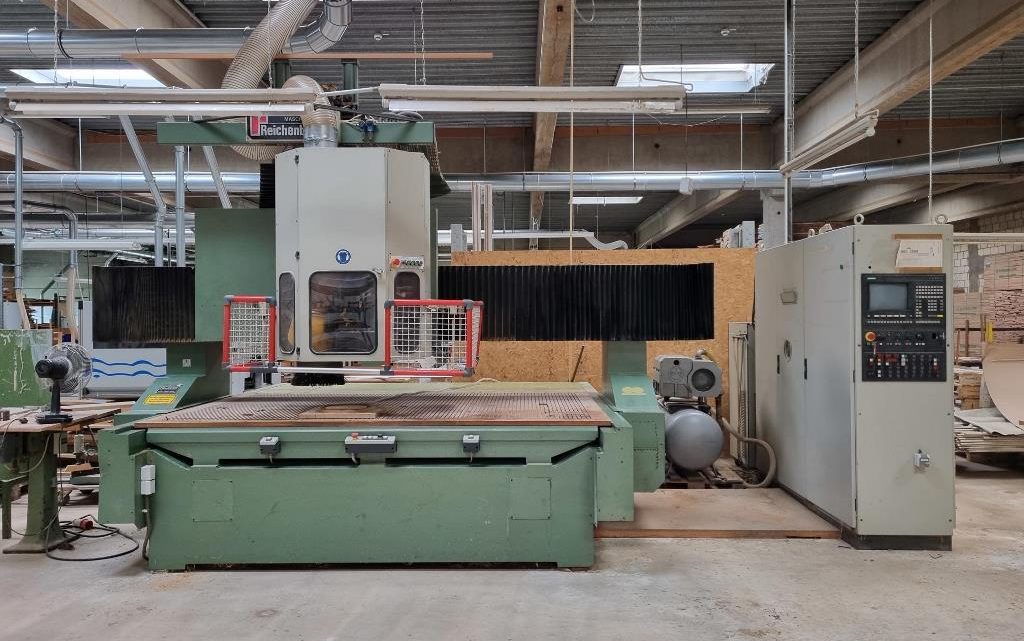
Smart Buyer’s Guide: How to Choose the Right Pre-Owned, Used, Secondhand, Surplus CNC Equipment Before Purchasing Reichenbacher RANC516PW CNC Router made in Germany
Below is a Smart Buyer’s Guide you can use (and adapt) when evaluating pre-owned / used / surplus CNC equipment — with particular attention to a machine like the Reichenbacher RANC-series (e.g. “RANC516PW”) from Germany. Then I’ll walk through how to apply that to your specific case.
I. Big-Picture Strategy Before You Visit
- Define your needs exactly
Before you even inspect machines, get clarity on:- Maximum workpiece size (X × Y × Z) you’ll ever need
- Types of materials (wood, plastics, composites, light metals)
- Desired tolerances, surface finish, and throughput
- Whether you need 3, 4, or 5 axes, tool changers, C-axis, etc.
- Available power (voltage, phase, current) and ceiling / floor load limits in your workshop
- Budget not only for purchase but installation, transportation, spare parts, software upgrades, etc.
- Do your homework on the model / brand
For a Reichenbacher RANC machine, learn its original specs, common configurations, and known weak points.- The “RANC” series machines were produced roughly from the late 1970s up to the mid-1990s.
- They came in different variants (A, AE, AM, MC, etc.), with various table sizes, number of router heads or tool changers, sometimes multiple aggregates.
- Over time, replacement parts, electronics, control systems, and wear components may become scarce.
- Locate trustworthy sellers / refurbishers
- Prefer sellers who let you inspect in person, run tests, see service logs
- Refurbished machines (by specialist firms) tend to reduce risk
- Ask for clear documentation (manuals, wiring diagrams, part lists, maintenance / repair history)
- If possible, bring an expert or a technician familiar with CNC and Reichenbacher machines to help you assess.
II. Key Areas to Inspect / Test (On-site)
When you visit, go through these systematically. Bring measuring tools, gauges, laptop, etc.
| Area | What to Check | What Problems or Red Flags |
|---|---|---|
| Frame / Structure | Look for cracks, distortions, weld repairs, surface corrosion, alignment of beams | Warping or repairs may indicate heavy abuse |
| Gantry / Bridges / Columns | Check movement, straightness, rigidity | Sagging, chatter, looseness |
| Linear Guides / Ways / Rails / Carriages | Inspect wear, scoring, lubrication, smoothness, play / backlash | Excessive play or binding |
| Ball screws / lead screws / drive screws | Check backlash, wobble, spindle coupling point | Worn balls screws are costly to repair |
| Spindle & Motor | Run spindle at various speeds; listen for noise, feel vibration; check runout; check cooling, bearings, lubrication | Bearing noise, vibration, irregularity, overheating |
| Tool changer / magazine / tool holders | Test that it functions reliably, aligns tools properly | Misfeeds, misalignment, stuck tools |
| Electrical & Control Cabinet | Look for clean wiring, proper grounding, dust, signs of overheating, modifications | Bad wiring, burned components, messy modifications |
| Control system / CNC controller | Identify the controller brand / model, test jogging axes, screen, I/O, limit switches | Obsolete controller or no software support |
| Motors & Drives / Amplifiers | Test each axis’s motor under motion, check for overheating or errors | Drive failures, lack of spare parts |
| Sensors / Encoders / Feedback systems | Ensure encoders respond correctly, axis homing is operational | Encoder glitches cause drift or loss of precision |
| Coolant / lubrication / hydraulic systems | For machines that have these, inspect the state of pipes, seals, pumps | Leaks, contaminated fluid, nonfunctional pumps |
| Safety / Guards / Covers / Way covers | Check for presence and condition of protective guards, bellows, covers | Missing covers can lead to debris ingress and damage |
| Test cuts / trial run | If possible, run a sample program to test accuracy, repeatability, smoothness | Axis stuttering or deviations are red flags |
| Documentation & Logs | Ask for service (repair, preventative maintenance) history, electrical drawings, spare parts lists | No documentation increases risk |
Also, ask to see the alarm / error history logs of the machine (if the controller maintains such history). That may reveal recurring faults.
From community wisdom:
“Check the general condition of the machine: how worn are the contact surfaces, condition of the table, way covers … Run the spindle at several speeds to hear bearings … The most expensive fixes are spindle, gearbox, ball screw replacements, axis drives.”
“If the machine has run the same part its whole life … If the wear on any ballscrew is excessive … Anything less than 5 k hours is low IMO.”
III. Special Considerations for a Reichenbacher RANC-Series Machine
Because the RANC series is a legacy German-built machine, here are extra risks and checks.
- Age & parts obsolescence
These machines may be 20-40+ years old. Parts such as motors, control boards, drives, tool changers, spare parts for the spindle, etc., may no longer be manufactured or may have limited support. - Electronics retrofits
Very likely, the original electronics (PLC, drives, controllers) have been modified or replaced over the years. Investigate whether those modifications were done cleanly or haphazardly.- Are newer replacements compatible?
- Are wiring diagrams preserved?
- Are the retrofitted components industrial grade or “ad hoc”?
- Machine configuration variant
The “RANC516PW” designation suggests a specific subtype — check whether it’s a gantry over long side, or portal over shortest side, table dimensions, tool changer or multiple heads, etc. Confirm that the physical layout matches your workshop constraints. - Cumulative wear & creep
Over time, repeated thermal cycles, mechanical loads, and fatigue may degrade accuracy. Check for “creep” or drift by running long moves or thermal tests. - Re-commissioning effort
Even if mechanically sound, the machine may require:- Calibration and re-linearization
- Rewriting or replacing the CNC software / control
- Replacing bearings, seals, belts, motors, wiring
- Support in Germany / Europe
Because the machine is German-built, it might still have better spare-part networks in Europe (especially Germany) than elsewhere — check whether there are specialist firms still servicing Reichenbacher machines.
IV. Financial & Logistical Considerations
- Total cost of ownership (TCO) matters more than the sticker price. Include:
• Transport, rigging, foundations
• Electrical upgrade (voltage, power capacity)
• Infrastructure (floor loading, overhead cranes, anchoring)
• Spare parts inventory
• Installation, calibration, test cuts, commissioning
• Operator training
• Downtime risk - Depreciation / resale value
Legacy machines may depreciate heavily. Consider your exit strategy — can you resell it later? - Warranty / guarantee
For used machines, you may get a limited warranty (often 30–90 days) from the seller, but rarely less. Negotiate this when possible. - Shipping & logistics risk
Heavy CNC machines require careful disassembly / reassembly, alignment, packing, etc. Mistakes in transport can damage precision parts (spindles, bearings, guides). - Inspection clause / return rights
If buying sight-unseen (e.g., at auction), include conditional inspection or right-to-return clauses in the contract.
V. Decision Framework — What to Accept vs Reject
- Accept only machines with structural integrity, acceptable wear, good spindle test, working drives, clear control, and documented history.
- Negotiate discount if:
• Some wear found (but still fixable)
• Missing documentation or drawings
• Some electronic components are outdated or modified
• Needs calibration, alignment, or refurbishing - Reject if:
• Major structural damage or cracks
• Spindle or drives emit alarming noise / excessive vibration
• Control is completely obsolete / no chance of replacement
• No opportunity to test runs or motion
• Wiring is dangerously modified or undocumented
VI. How This Applies to “Reichenbacher RANC516PW”
Putting it all together:
- Try to confirm the exact specification of RANC516PW (table size, axes, spindle data, tool-change configuration). The “516” might imply a 5 × 16 (i.e. 5 m × 1.6 m) bed, though that’s speculative.
- Insist on seeing service history, wiring schematics, original manuals (if available).
- Run diagnostic tests: move axes full travel, check for backlash, run spindle at several speeds, do trial cuts if possible.
- Pay attention to retrofit components — modern drives or controllers may be present; ensure they are well integrated (not “jury-rigged”).
- Check parts availability in Germany / EU for key replacement components (motors, bearings, CNC control modules).
- Build into your offer the expected repair / calibration budget — especially when dealing with legacy machines.
- If possible, bring an experienced technician familiar with German CNCs (or Reichenbacher machines) to help you appraise.