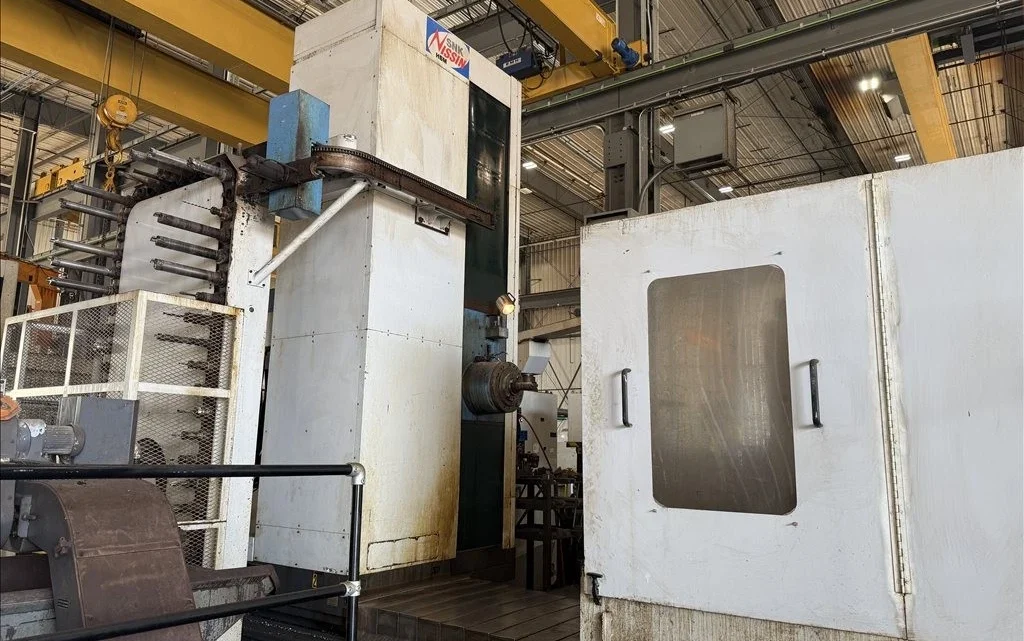
Smart Buyer’s Guide: How to Choose the Right Pre-Owned, Used, Secondhand, Surplus CNC Equipment Before Purchasing SNK Nissin HBM BP130/3.5 CNC Horizontal Boring & Milling Machine 3.5 Meters made in Japan
Here is a Smart Buyer’s Guide for evaluating pre-owned / used / surplus CNC horizontal boring & milling machines like the SNK Nissin HBM BP130/3.5 (3.5 m travel class) — plus how to apply it to that model. Use this as a checklist and decision framework when you go inspect, negotiate, or plan installation.
I. Understand the Machine’s Spec Baseline (What to Expect)
Before inspecting, be sure you know—or at least have a reference spec sheet—for the BP130/3.5 (or its variants). That gives you a benchmark to compare what the seller claims vs what you measure.
Key baseline/specs for SNK Nissin BP130/3.5 / HBM series
From available sources, here are typical specs to expect:
- Table (work surface) size: ~ 70.86″ × 63.00″ (≈ 1,800 × 1,600 mm)
- Optional larger table size: ~ 86.61″ × 63.00″
- X-axis travel: ~ 137.80″ (3,500 mm)
- Y-axis travel: ~ 98.43″ (2,500 mm)
- Z-axis travel: ~ 62.99″ (1,600 mm)
- W-axis (quill / spindle extension) travel: ~ 27.56″ (700 mm)
- Spindle / motor: standard ~ 35 HP (≈ 26 kW) with 5–2,500 rpm speed range
- Maximum table load: ~ 22,000 lb (≈ 10,000 kg) standard, optionally up to ~ 33,000 lb (≈ 15,000 kg)
- Accuracy & feedback: The BP130 family is typically equipped with linear scales / position feedback, backlash compensation, and thermal drift compensation sensors.
- Rotary (B axis) indexing table as part of the machine: 5-axis capabilities (X, Y, Z, W, B)
These numbers tell you what is “normal” for a well-maintained machine. If what the seller claims deviates wildly (e.g. lower travel, missing axes, or strange spindle speed limits), that’s a red flag or an indication of heavy modification.
II. Pre-Visit Planning & Requirements
Before you visit the machine in person, prepare:
- Define your operational envelope
- What is the largest part you will ever need to machine (in X × Y × Z)?
- What weight can your floor or foundation support in the machine’s location?
- What spindle speed, torque, and cutting power do you need for your material mix?
- Power, utilities, and infrastructure
- What electrical supply is required (voltage, phase, current)?
- Is coolant, compressed air, chip handling, drainage already present?
- Is there overhead crane / lifting capacity / floor loading in your shop?
- Space clearance: plan for service access, removal of covers, and machine footprint (including chip conveyors, enclosures, etc.).
- Documentation request ahead
Ask seller for:- Original manuals, wiring diagrams, parts catalogs
- Maintenance logs and repair history (spindle rebuilds, drive replacements, axis work)
- CNC controller make / model, software version, parameter backups
- Any retrofits or modifications (e.g. aftermarket drives, spindle changes)
- Electrical schematics
- Bring measurement tools / instruments
- Dial indicators, straight edges, levels, feeler gauges
- Vibration meter (if possible)
- Multimeter, oscilloscope (for checking signals)
- Laptop or interface to connect to the control if possible
- Define your “must-haves” vs “deal-breakers”
Prepare a checklist of features you require (e.g. 5-axis simultaneous motion, minimum spindle rpm, tool changer, table size, etc.) and what you will refuse (e.g. missing axis, no spindle lines, extreme wear).
III. On-Site Inspection / Test Checklist
When you are physically at the machine, work your way systematically through mechanical, electrical, control, and performance tests.
| Subsystem | What to Inspect / Test | What to Look For / Red Flags |
|---|---|---|
| Frame / Castings / Structure | Inspect castings, welds, supports, base, column, cross-rail for cracks, deformation, repairs | Any cracks or weld repairs around load-bearing areas are serious. Distortion or misalignment is a warning |
| Guideways / Box Ways / Ways Covers | Check each linear axis guide for smoothness, lubrication, wear, pitting, scoring. Inspect way covers, seal integrity | Uneven wear, metal debris in covers, signs of “scoring” or binding |
| Ball screws / leadscrews / drives | Check backlash in each axis, wobble, coupling alignment, end bearing condition | Excessive backlash or side-play indicates wear or bearing failure |
| Spindle / Quill / Head Assembly | Run spindle at multiple speeds, listen for noise, check vibration, measure runout, feel for stiffness, heat, bearing noise | Unusual vibration, bearing hum, runout beyond spec are serious faults |
| Tool changer / tool magazine / tool holders | Operate tool change cycles, inspect magazine integrity, check for misfeeds or jamming | Misalignment, collisions, stuck tools, sloppy changing |
| Rotary / B-axis table | Check indexing (e.g. move B-axis), angular accuracy, backlash, drive integrity | Inaccurate index, backlash, loosening or interpolation errors |
| Electrical / Control cabinet | Examine wiring neatness, signs of overheating, burnt wires, modifications, fuses, safety circuits | Messy wiring, undocumented modifications, missing covers |
| CNC Controller / CNC software / I/O | Power on control, jog axes, test limit switches, homing cycles, parameter screens, error logs | Missing axes on controller, inability to jog, broken display, no backup memory |
| Servo / drive amplifiers / feedback systems | Test axis movement under load (jog, feed), check for errors, overheating, anomalies | Drives that drop out, overheat, trip, or cause chatter |
| Sensors / encoders / feedback scales | Check linear scale readouts (if present), homing accuracy, consistency | Broken or missing scales, encoder faults, drift or loss of position |
| Coolant / lubrication / hydraulic / pumps | Inspect piping, seals, pumps, filters, cleanliness, leaks | Stains, leaks, clogged filters, pump failures |
| Safety and guards | Ensure guards, interlocks, covers, way covers, splash guards are intact | Missing safety covers or interlocks is a liability |
| Trial run / cutting test | Run a test part or standard program, measure dimensional accuracy, repeatability, smoothness of motion | Axis stutter, deviation, chatter, inability to complete cycle |
| Thermal / drift check | Let machine run idle or under light load for a while, observe any drift in zero or position | Large drift or instability suggests thermal compensation issues or worn parts |
| Alarm / error logs / diagnostics | Check stored error history in controller, see recurring faults | Repeated errors on same axis or drive indicate underlying issue |
Bring a checklist sheet and mark off each test, making notes, taking photos, and recording readings.
IV. Risk Factors & Particular Considerations for BP130/3.5
Because horizontal boring/milling machines (especially large ones like BP130 class) are heavy, complex, and often undergo high loads, there are special risks and points to watch.
- High structural stress zones
Over time, stresses around the spindle head, column, and cross rail may cause micro-cracks or deformation — especially if misused or overloaded. - Wear in long axes
The X-axis (3,500 mm travel) is long; even small cumulative wear or misalignment will give measurable deviation at the far ends. - Drive and servo stress
The heavy torque loads of boring can stress drives and motors; verify that servo amplifiers, motor wiring, and cooling are in good condition. - Spindle / quill wear
The W-axis (quill or spindle extension movement) is subject to wear, backlash, and alignment issues especially in heavy drilling/boring duty. - Software / control obsolescence or retrofit
Many older machines may have had aftermarket retrofits (new controllers, drives, feedback systems). Evaluate how clean, documented, and maintainable those retrofits are. - Thermal compensation / sensors
Large machines are susceptible to thermal expansion; verify the thermal growth compensation system (temperature sensors, feedback adjustments) is functioning and reliable. - Parts / spare availability
Large-capacity machines like BP130 have sizable components — motors, servo drives, guideway blocks, bearings — which may be expensive or long lead time to replace. Make sure you can source or have spares. - Transport, rigging, and site preparation risk
These machines are extremely heavy and large. Mistakes in crippling, moving, releveling, or reassembly can damage precision parts (spindles, guideways). Factor in risk.
V. Valuation, Negotiation Strategy & Total Cost of Ownership (TCO)
When you understand condition, you can evaluate fair pricing more confidently. Also, always think TCO, not just purchase price.
Factors to adjust pricing
- Condition of axes / drives / spindle: any signs of wear or needed replacement should discount heavily.
- Age and hours of operation: lower hours / more recent machines command a premium.
- Completeness / accessories: inclusion of tool changer, coolant-through spindle, workholding, fixtures, probes, spindle attachments, rotary tables etc. adds value.
- Controller / electronics condition: intact, original or well-executed retrofits add value. Junk or missing electronics drastically reduce value.
- Documentation: machines with full manuals, wiring, part drawings are more valuable (less risk).
- Transport / installation costs: heavy machines cost a lot to ship, rig, level, calibrate. Deduct for that cost or insist seller share.
- Warranty / guarantee: if seller will offer a limited warranty or acceptance period, you can pay more. Without that, factor risk discount.
Estimate resale / lifespan value
Given the size and specialty nature of a BP130/3.5, the resale market is narrower. A machine in good condition with maintained electronics may retain value better than one in poor condition. But depreciation tends to be steep for large machines with obsolescence risk.
Negotiation tactics
- Show your checklist and point out specific wear or needed repairs to justify discount.
- Propose that any repair you need to do becomes your cost, and reduce price accordingly.
- Ask for a trial / acceptance period (say 30–90 days) after installation before final payment.
- Ask seller to handle safe transport or guarantee reassembly / alignment.
- Consider asking for spare parts inventory (bearings, belts, guides) included in deal.
VI. Example — Applying This to a Real-World BP130/3.5 Listing
Let’s take a real listing as an example to see what clues it gives, and how you’d probe further.
From Tramar Industries, a used SNK Nissin BP130/3.5 listing:
- 2,602 hours of use
- Fanuc 31i-B5 CNC control
- Table size 86.6″ × 62.9″
- Full 4-axis contouring, built-in rotary B-axis
- Travel (X/Y/Z/W): 137.8″ / 98.4″ / 63″ / 27.5″
- Spindle speed up to 2,500 rpm, CAT 50, 35 hp motor
- 60-station ATC, chip conveyor, full enclosure, coolant system
This listing seems reasonably well-equipped and not extreme in hours. But that doesn’t guarantee mechanical health. What you must verify:
- Are the axes still within tolerance across full travel?
- Has the spindle been reconditioned or does it have excessive bearing wear?
- Are the drives / servo amplifiers originals or replaced? Are spares available?
- How well has the machine been maintained? Are the cooling, chip handling, lubrication, and safety systems functional?
- Are the retrofit control / wiring / electronics neat, documented, robust?
- What is the cost to ship, rig, and re-level in your location?
If everything checks out, this is a strong candidate. But you have leverage to ask for reductions if you find any minor defects.
VII. Final Decision Framework / “Pass / Conditional / Reject” Criteria
Here’s a decision rubric you can apply when comparing potential machines:
| Verdict | Conditions Met | Conditions That Might Trigger Rejection |
|---|---|---|
| Accept / Offer | Structural integrity is good, axes are within tolerances across full travel, spindle is healthy, electronics are functional and documented, accessories present, and price + transport + repair allowance are acceptable | |
| Conditional / Contingent | Some minor wear or reduction in performance, but repairable; offer reduced price or require seller to fix; insist on trial / guarantee | If major wear in multiple axes, spindle damage, missing axes, or control cannot be restored, be wary |
| Reject / Walk Away | Serious structural damage (cracks, repairs), spindle showing alarming symptoms, missing or nonfunctional critical axes, control missing or irreparable, or transport cost so high that it kills ROI |
You should always walk away if the deal’s risk is beyond your capacity to remediate, or if the seller refuses to allow thorough inspection.