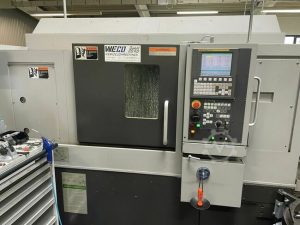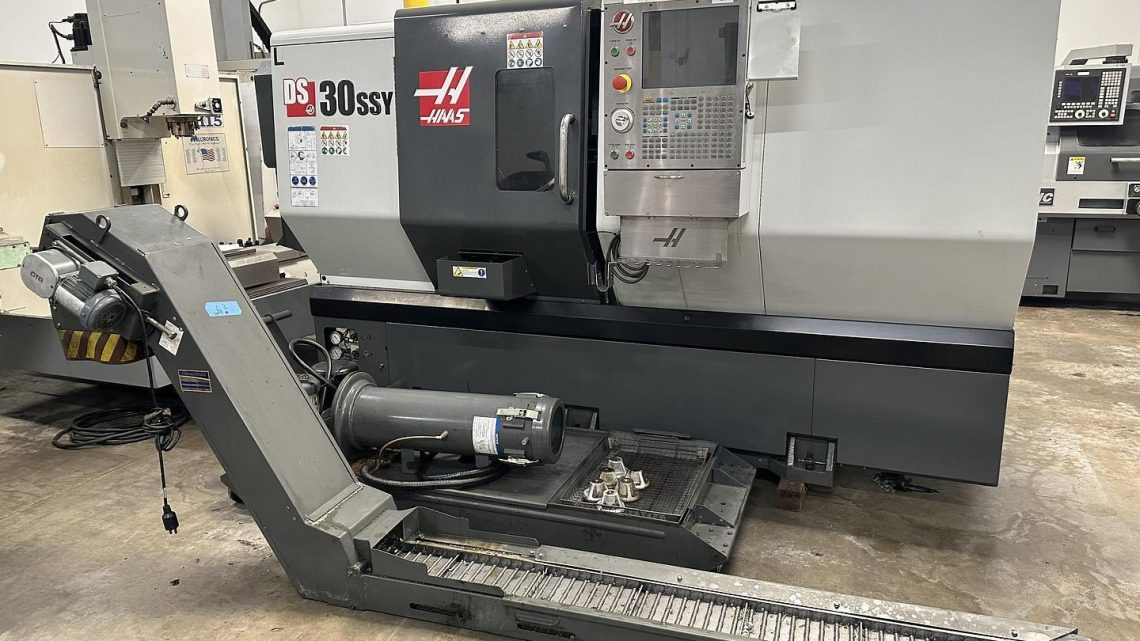
Smart Buyer’s Guide: How to Choose the Right Pre-Owned, Used, Secondhand, Surplus CNC Equipment Before Purchasing Haas DS-30SSY CNC Turning Cente made in USA
Here’s a Smart Buyer’s Guide tailored for pre-owned / used / surplus CNC turning / turn-mill centers, specifically for machines like the Haas DS-30SSY (dual-spindle, Y-axis / live tooling) made in the USA. Use this as a systematic checklist and decision tool when you evaluate, negotiate, and decide.
I. Understand the Baseline Spec & Capabilities (Know What You’re Buying)
Before inspection, arm yourself with the nominal specifications of the Haas DS-30SSY so you can compare what the seller claims vs. what you observe or measure. Some key specs are:
| Specification | Typical Value / Range (from datasheets & used-machine listings) |
|---|---|
| Max Turning Diameter | 16 in (≈ 406 mm) |
| Max Turning Length / Z-axis travel | 23 in (≈ 584 mm) |
| X-axis travel | ~ 12.50 in (~ 317.5 mm) |
| Y-axis travel (off-center) | ±2.00 in (±50.8 mm) |
| Main Spindle | 30 hp (≈ 22.4 kW), 4,800 rpm, A2-6 nose |
| Sub-Spindle | 20 hp, 4,800 rpm, A2-5 nose |
| Tool turret | 24-station hybrid (12 VDI + 12 bolt-on) with live tooling & C axis |
| Bar capacity / spindle bore | Around 3.0 in bar for main, 2.0 in for sub spindle |
| Other features/options commonly seen | 1,000 psi high-pressure coolant, parts catcher, chip conveyor, probes, rigid tapping, early power-failure detection |
Knowing these will help you detect when a machine is under-spec’d, modified, or degraded.
II. Pre-Visit Preparation
Before you go see the machine:
- Define your production envelope
- What is the largest part (diameter, length) you need to turn or mill?
- Do you need full utilization of both spindles, or will you rarely use the sub-spindle?
- What are your milling / live-tooling / Y-axis demands?
- What tolerances do you require (especially for done-in-one multiaxis work)?
- Check infrastructure & utilities
- Power: voltage, phases, current, grounding
- Cooling / coolant systems, chiller, filtration
- Chip handling / conveyor / scrap disposal
- Shop floor capacity, crane / lifting, foundation (vibration isolation)
- Access space around the machine for service / maintenance
- Request documentation ahead
Ask seller to send:- Operation & maintenance manuals, wiring diagrams, parts lists
- Service logs (spindle rebuilds, drive replacements, retrofits)
- Backup of CNC parameters / control (software version, backup files)
- History of crashes, axis repairs, or incidents
- List of included accessories: probes, tool sets, fixtures, chucks
- Bring inspection & measuring tools
- Dial indicators, test indicators, more accurate measuring tools
- Vibration meter (if available)
- Multimeter, oscilloscope, etc.
- Laptop / interface to connect to CNC (if allowed)
- Camera / smartphone to take photos
- Prepare a “must-have / deal-breaker” checklist
Rank features and tolerances you require, so you know what compromises you’re willing to accept or reject.
III. On-Site Inspection / Test Checklist
When you arrive, go through a methodical inspection of mechanical, electrical, and control components, and do performance tests.
Mechanical / Structural Checks
- Frame & bed: Inspect for cracks, repairs, distortion, excessive wear in critical castings.
- Spindle housings & slideways: Check for wear, play, scoring, pitting.
- Guideways / ways / carriage movement: Smoothness across full travel, check for binding or unevenness.
- Turret & live tool mechanisms: Operate the turret, rotate through all stations, activate live tools, check for backlash, runout, misalignment.
- Spindles (main & sub): Run at different RPMs, listen/feel for bearing noise, vibration; measure runout; check cooling / lubrication systems.
- Tool changing / tool clamping: Ensure reliable tool exchanges, no jamming, tightness of clamping.
- Y-axis / milling operations: Move the Y-axis, test interpolation with live tool, check alignment in off-center machining.
- Axis backlash / reversal / interpolation: Use dial indicators to test backlash in each axis, especially in combined moves (X+Y).
- Encoders / feedback / scales: If the machine has linear scales or feedback systems, verify their readings, homing accuracy, drift.
- Coolant / lubrication / fluid systems: Inspect pumps, lines, filters, cleanliness, leaks.
- Chip conveyor, guards, covers, safety: Are guards in place, interlocks working, way covers intact?
Electrical / Control / Electronics Checks
- Control cabinet & wiring: Look for clean wiring, proper grounding, signs of overheating, modifications, missing documentation.
- CNC control: Power up, test motion in jog mode, check each axis, limit switches, emergency stops.
- Error / alarm history: Review logs for repeated or chronic faults.
- Drive amplifiers / servo systems: Under light loads, command axis moves and watch for anomalies, current spikes, axis dropouts, overheating.
- Interface / software / backups: Check that configurations, tool offsets, macros, user parameters are present and accessible.
- Sensors / switches / interlocks: Verify that home switches, limits, safety doors, probes, tool break detection (if present) function.
Performance & Trial Tests
- Test program / trial cut: Run a typical or representative part or test routine covering full axis movement. Check for chatter, deviations, surface finish, axis synchronization.
- Thermal drift test: Let the machine run idle or return to zero positions repeatedly over 30–60 minutes to see if there’s drift or creeping.
- High-speed / high-load test: Push the machine toward its limits (within safe margin) to see if any axis struggles or errors occur.
- Synchronization / part pass-off (dual-spindle transfer): If dual-spindle handoff is critical for you, test the pass-off operation (main → sub).
- Live-tooling / milling under load: Perform some drilling / milling with live tools under realistic cutting loads.
Take detailed notes, photos, and measurement logs. Use your checklist to mark acceptable vs marginal vs failing items.
IV. Special Considerations for the DS-30SSY (Dual-Spindle + Y + Live Tooling)
Because the DS-30SSY is a relatively complex turn-mill center, it has extra points of risk. Keep these in mind:
- Dual-spindle synchronization & reliability
The part transfer between main and sub spindles needs to be precise and reliable — look for any mismatch, slippage, or misalignment in handoff operations. - Y-axis and off-center milling stress
The Y-axis moves the turret or tools off the centerline — any misalignment or wear here can severely affect milling accuracy. Because the carriage shifts in Y, the combined movement of X+Y+Z must remain stable under load. - Live tooling & C-axis health
Because the machine supports milling / drilling operations through live tools, the tool drives (bearings, motors, cabling) are under wear and stress. Check for play or degradation in live tool spindles. - Retrofitted or modified electronics
Being a high-capability machine, many used units may have had control or drive retrofits. Scrutinize modifications: Are they robust, documented, maintainable? Or are they ad-hoc and risky? - Parts & access for wear components
Because of complexity (two spindles, live tooling, Y-axis), there are more wear-prone parts. Spindle bearings, turret drives, toolholder mechanisms, linear bearings, servo packs — check availability of spare parts for your region. - Transport / setup risk
Turn-mill centers are precision machinery. Any misalignment or shock during transport (especially to the spindle, turret, axes) can degrade accuracy. Be sure rigging, packing, and re-assembly are done by experienced professionals.
V. Valuation, Negotiation, and Total Cost of Ownership (TCO)
Buying used is always about balancing risk. Here’s how to think about value:
Adjustment factors for pricing
- Operational condition: Machines in excellent working order command premium; machines needing rebuilds / calibration should be discounted.
- Age vs hours: Low hour machines or recent models are more desirable.
- Completeness & accessories: Included probes, tooling, chucks, fixtures, bar feeder, parts catcher, chip conveyors add tangible value.
- State of electronics / controller: Original intact control systems are preferable; heavily modified or unstable controls reduce value.
- Documentation & support: Machines with full manuals, wiring, spare parts lists, maintenance history are less risky.
- Transportation / installation / calibration cost: Deduct from your offer the real cost to move, re-level, calibrate, test the machine at your site.
- Warranty / acceptance period: If the seller offers 30–90 day acceptance or limited warranty, you can pay more for that assurance.
Estimating resale & lifecycle value
Given the complexity of DS-30SSY models, resale appeal is limited to firms needing dual-spindle turn-mill capability. A clean well-maintained unit will retain value better than a neglected one. But advanced models tend to depreciate faster as newer models with better control, higher speeds, or more axes come along.
Negotiation tactics
- Present specific findings from your inspection (wear, repairs needed, missing parts) as basis for price reductions.
- Ask seller to include spare parts, tooling, or support services (e.g. commissioning, calibration).
- Request a trial / acceptance window at your site before final settlement.
- Negotiate that seller handles (or discounts) part of the transport, reassembly, leveling.
- Incentivize seller for taking responsibility for certain repairs or rebuilds discovered later.
VI. Decision Rules / “Pass / Accept / Reject” Criteria
Here’s a decision rubric as you compare candidate machines:
| Verdict | Accept if … | Reject / Walk Away if … |
|---|---|---|
| Accept / Make Offer | Structural integrity is good; axes within tolerance; spindles run clean; control & electronics are functional and documented; accessories included; risk is manageable given price + transport + repair allowance | |
| Conditional / Contingent | Minor wear or defects that you can accept or remediate (with price discount); ask for seller to remedy or provide guarantee; include acceptance trial period | Multiple axes with serious wear, spindle problems, control missing or unstable, no opportunity to test, or repair cost exceeds your margin |
| Reject | — | Major structural damage, excessively noisy spindles, missing critical axes or control, no documentation, or transport / installation risk so great that overall ROI is negative |
If at any point your “deal-breaker” criteria are violated (e.g. dual-spindle synchronization failure, control boards missing, spindles with serious vibration issues), best to walk away rather than incur unknown risk.