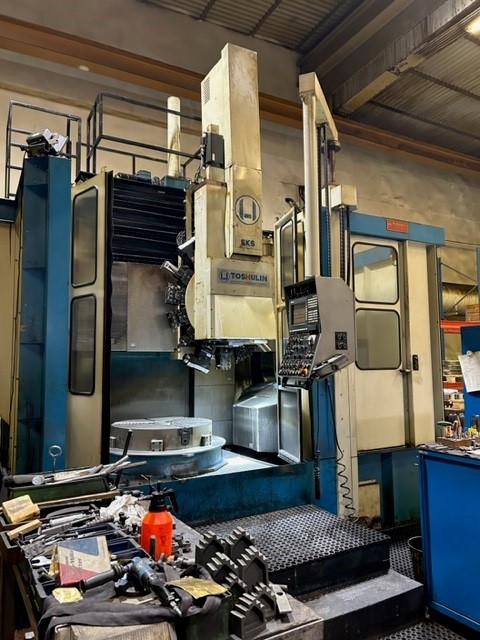
Smart Buyer’s Guide: How to Choose the Right Pre-Owned, Used, Secondhand, Surplus CNC Equipment Before Purchasing Toshulin TOS SK10 CNC Vertical Lathe C Axis
Here’s a Smart Buyer’s Guide for acquiring a pre-owned / used / surplus TOS SK10 (or SK-series) vertical lathe / vertical turning center with C-axis capability (or equivalent TOS SK CNC vertical lathe). While I didn’t locate firm public specs for “SK10 CNC vertical lathe C axis”, the SK / SKJ / SK12 family of TOS vertical turret lathes provide useful reference points. Based on that, I’ll walk you through how to evaluate a candidate—what to demand, inspect, test, and negotiate—so you don’t get stuck with a machine that’s too worn or unsupported.
0. Reference / Benchmark Data & What You Should Know Up Front
Because you’ll need reference baselines to judge wear and deviations, here are some representative specs from TOS vertical lathes (SK / SKJ / SK12 models) as proxies and what they imply:
Representative Spec Examples from TOS SK / SKJ Series
- TOS SKJ 10
• Plate / faceplate diameter ~ 1,000 mm; maximum turning diameter ~ 1,150 mm; work height ~ 850 mm
• C-axis / table rotation spindle speed: ~2.5 – 200 rpm, main drive 30 kW
• Max part weight (on plate) ~ 5,000 kg in some listings
• Machine weight ~ 13,000 kg - TOS SK12 (or SK 12 family)
• Faceplate / table diameter ~ 1,180 mm; swing ~ 1,400 mm; turning height ~ 1,000 mm
• Workpiece weight: ~ 4,000 kg in listings
• Motor power ~ 37 kW in some listings
• Machine weight / bulk is substantial (tens of metric tons)
These are reference points — your particular SK10 CNC with C-axis may differ in scale, speed, power, or options (ram, turret, CNC, drives). When you inspect a candidate, you’ll want to verify how closely it approximates its original spec envelope, and what has degraded or been modified.
From the broader class of vertical turret lathes / vertical turning machines, the more subsystems (C-axis, turrets, ram, drives) a machine has, the more potential points of failure. The presence of a C-axis means you’ll also need to check rotary accuracy, backlash, encoder feedback, and coupling between the plate and the drive.
1. Pre-Inspection / Information to Request Before Visiting
Before even traveling to the machine, ask the seller for all the following. The quality of these documents and data will let you filter out bad candidates and prepare your test instruments.
| Requested Info / Documentation | Why It’s Important |
|---|---|
| Exact model / variant (SK10, SKJ, SK10C, etc.), serial number, build year, revision / options | To know the baseline spec you expect (size, speeds, table, etc.) |
| Configuration / options list | E.g. whether the machine has C-axis drive, servo upgrade, turret, ram, automation, tool changer |
| Operating hours / cycle counts | To assess wear — e.g. how many hours the rotary table, spindle, axes have been used |
| Maintenance & repair history | To see what’s been replaced or rebuilt (bearings, motors, guides, coupling) |
| Modification / retrofit history | Non-OEM changes can complicate future repair or support |
| Complete documentation | Mechanical drawings, electrical schematics, wiring diagrams, control manuals, parts list / BOMs |
| CNC / control, firmware, backups, parameter files | You need control access, parameter memory, backup files, and version info |
| Tooling, fixturing & spare parts | Any included chucks, fixtures, spare motors, gears, encoders, coupling parts |
| Photos / videos of the machine in operation | Visual evidence of motion quality, vibration, smoke, leakage |
| Utility & foundation / installation info | Power requirements, floor loading, anchoring details, previous transport history |
| Reason for sale, last working condition & faults | Helps uncover hidden issues or neglect |
If some of these are missing or the seller won’t provide them, it should raise your risk premium or cause rejection.
2. Mechanical & Structural Inspection Checklist
Once on-site, your inspection must be thorough and systematic. A vertical lathe with C-axis has many subsystems: table / rotary system, axes, turret / tooling, spindle, drives, control, etc. Below is a layered checklist.
A. Structure, Base & Frame Integrity
- Examine the base, column, bed castings for cracks, repair welds, distortion, symmetry errors.
- Check leveling, mounting to foundation, presence of shims, whether base is still rigid and stable.
- Inspect guarding, chip enclosure, covers; missing parts could have allowed contamination.
B. Rotary Table / C-axis System / Bearing / Drive
- Rotate the table / faceplate (C axis) through its range (slow, medium speed) and feel for smoothness, binding, variations in load.
- Check for vibration, resonance, noises, or torque fluctuations during rotation.
- Use dial indicator or test probes to measure radial and axial runout of the table / plate at multiple radii.
- Test repeatability: rotate to a fixed angle multiple times and see how close it returns.
- Inspect drive coupling, gear trains, belts, splines, backlash in the rotary drive.
- Inspect the C-axis encoder / feedback system: wiring, signal quality, connectors, shielding.
C. Axes / Slideways / Rams / Guideways
- Visually inspect linear guideways (if used) or box/gib/way surfaces: look for scoring, pitting, embedded chips, corrosion.
- Jog each linear axis (vertical slide, radial ram, cross slide, etc.) across full travel; feel for smoothness, zones of friction, sticking.
- Reverse small moves and measure backlash or deadband with dial indicators.
- Use precision straight edges, test bars, or alignment tools to check straightness across travel.
- Check ball screws or other drives (if applicable) for play, noise, binding.
- Inspect couplings, alignment between motor and ball screw, or drive shafts.
D. Turret / Tooling / Turret Slide & Tool Post
- Cycle the turret (if present) through all tool stations; check indexing accuracy, speed, smoothness, repeatability.
- Check turret drive mechanism—servo drives, motor couplings, indexing gear, bearings.
- Inspect tool holders, clamping surfaces, retention mechanisms for wear or looseness.
E. Spindle / Chuck / Faceplate
- Spin the spindle (if it rotates separately from table) or the facing area (if built in) at various speeds; listen for bearing noise, vibration.
- Use test bar or indicator to measure runout at multiple radii.
- Inspect spindle interface (taper / surface / mounting) for wear, damage, misalignment.
- Check spindle drive system: motor, coupling, transmission, belts (if applicable).
F. Hydraulics / Pneumatics / Cooling / Lubrication Systems
- Inspect hydraulic lines, valves, cylinders (for turret, ram actuation) for leaks, wear, seal integrity.
- Examine lubrication / oil delivery system: oil lines, pumps, filters, reservoirs, cleanliness.
- Examine cooling systems (if present): coolant pipes, chillers, coolant flow to table, bearings.
- Check piping, connections, valves, regulators.
G. Electrical / Control / Drive Cabinets
- Open up control / drive cabinets; inspect for dust, coolant ingress, corrosion, burn marks, discoloration.
- Check wiring harnesses, connectors, shielding, strain relief, labeling.
- Inspect servo drives, motor drivers, power modules, fans, heat sinks.
- Inspect sensor wiring (encoders, limit sensors, feedback cables) for integrity, shielding, continuity.
- Power up the controller / CNC: check boot logs, errors, alarms, communication status.
H. Environmental / Setup Conditions
- Evaluate whether the machine is installed on a vibration-isolated foundation; check for interference from nearby machines.
- Check thermal environment: temperature fluctuations, drafts, heating / cooling conditions.
- If the machine has been moved, verify whether alignment, leveling, calibration have been restored.
During mechanical inspection, document numerical deviations, photographic evidence, and anomalies to review later.
3. Functional / Performance Testing & Validation
Mechanical checks are necessary but not sufficient. You must run the machine, cycle it, and test actual machining or turning performance including C-axis functions if present.
A. Motion & Jog / Axis Tests
- Jog each axis (radial, vertical, cross, ram) through full travel at slow, medium speeds; monitor for smoothness, no jitter, no hesitation.
- Reverse direction into fixed points to check hysteresis or backlash.
- Run extended motion cycles to detect drift or zones of uneven friction.
B. Table / C-axis Rotation Tests
- Rotate the table / C-axis under control: low, medium, high speeds; check for stability, torque consistency.
- Index to defined angles repeatedly (e.g. 0°, 90°, 180°) and check for repeatability.
- Under load (if safe), perform small cuts while rotating (e.g. for milling on the faceplate) to detect coupling or backlash impact.
C. Turning / Machining Test Part
- Mount a test workpiece (e.g. a cylindrical piece) and perform turning operations.
- Use the C-axis (if applicable) for milling or cutting operations on radial or circumferential features (if that’s part of intended use).
- After machining, measure critical dimensions (diameter, height, surface finish, concentricity) with gauges / micrometers / CMM.
- Repeat machining on same workpiece multiple times (e.g. change tool, remount) to check consistency / reproducibility.
D. Accuracy & Repeatability Checks
- Reposition to known coordinates and measure deviation.
- After power-up / warm-up / cold start, perform the same test and compare to see drift.
- Check positional accuracy in radial and vertical directions over travel span.
E. Interrupt / Fault / Recovery Tests
- Pause a cycle mid-process and resume; verify correct offsets and interpolation.
- Simulate or trigger soft limits, alarms, or faults and observe how the system recovers or enters safe mode.
- Power off / power back on, re-home and verify reproducible reference positions.
F. Long-run / Thermal Drift Test
- Run a multi-cycle test over 30 minutes or more, letting the machine heat.
- Re-measure previously measured parts or reference surfaces to detect drift.
- Monitor axis offsets or encoder readouts for drift; also monitor bearing / motor temperatures for anomalies.
Record all deviations, drift, trending error, and performance under load.
4. Spare Parts, Control / Software, Support & Maintainability
Even a machine that tests well today can become unusable if you can’t maintain or repair it tomorrow. So assessing supportability is crucial.
- Ensure the seller delivers all technical documentation: mechanical prints, electrical schematics, wiring diagrams, parts / BOM, control manuals, calibration records, torque / performance data.
- Confirm that the CNC / control software, parameter files, backup / archive programs, and licensing or firmware rights are transferred to you.
- Check whether servo modules, drives, motors, encoder modules, coupling parts, gearboxes, and control boards are still manufactured or serviceable.
- Evaluate whether there are aftermarket or third-party replacements or retrofits for obsolete parts.
- Investigate whether TOS (or its successor) or local service companies support SK / SK10 VTL models and whether parts are still available.
- Identify critical wear parts (bearings in table, rotary drive gears, guideways, seals) and check if spares are accessible.
- Ensure tooling / fixture / chucking hardware (faceplates, clamping systems) are standard or supportable.
- If modifications or custom retrofits exist, assess their documentation and supportability.
- Check whether calibration, alignment, or metrology tools (test bars, indicators, reference standards) are available or included.
A machine is only as good as your ability to keep it running long term.
5. Risk / Cost Budgeting & Decision Factors
When assessing a used TOS SK vertical lathe (with C-axis), you must weigh purchase price + refurbishment + integration risk vs benefit. Below are key risk and cost factors to incorporate.
| Risk / Cost Item | What to Estimate / Question | Impact / Threshold |
|---|---|---|
| Refurbishment / repair cost | Cost to recondition table (bearings, gears), rebuild bearing, re-scrape guideways, replace coupling or encoders | If these approach ~20–30 % (or more) of budget, risk is high |
| Parts / module obsolescence | Are servo / encoder / control modules discontinued or hard to source? | One failed module may disable the entire system |
| Calibration / alignment / commissioning cost | After shipping & installation, cost for alignment, calibration, test parts, adjustments | Often underestimated in initial budget |
| Transportation / rigging / heavy lifting cost | Crating, disassembly, crane, shock protection, leveling | Poor planning here can blow your budget |
| Downtime / integration / programming effort | Time to debug C-axis integration, program synchronization, train staff | Buffer your project timeline |
| Wear margin / drift headroom | Even if machine passes now, wear may erode precision margin over time | Prefer machines with margin beyond minimum tolerances |
| Alternative / newer / refurbished option cost | Compute total “landed cost” (purchase + refurb + downtime) vs buying a more modern or refurbished lathe with warranty | Sometimes paying more upfront yields less long-term risk |
Most seasoned used-machine buyers budget 20–30 % (or more, for complex, precision machines) of the purchase price as a contingency for renovation, spare parts, calibration, and surprises.
6. Contract Protections & Acceptance Clauses
Because of the high risk, your purchase agreement should include guardrails and protections.
- Acceptance / Performance Clause: Final payment contingent on the machine passing your defined mechanical, functional, and machining tests in your shop.
- Hold-back / Escrow: Retain a portion (e.g. 10–20 %) of the purchase price until successful commissioning and acceptance.
- Limited Warranty / Guarantee: Request warranty for critical subsystems (table bearings, C-axis drive, servo modules, control).
- Spare Parts / Tooling Package Clause: Insist the seller deliver a kit of spare parts (drive modules, encoders, coupling parts, control boards) or discount accordingly.
- Documentation & License Transfer: Certify that all manuals, wiring diagrams, parameter files, control licenses, calibration data are delivered and legally transferable.
- Latent Defect / Repair Clause: Define remedies if defects manifest post-installation (repair, replacement, partial refund).
- Transport / Damage Liability: Clarify who is responsible for damage during shipping, disassembly, reassembly, and alignment errors.
A well-constructed contract shifts much of the risk back to the seller.
7. Red Flags & Deal-Breaker Conditions
If you encounter any of the following during inspection or negotiation, tread very carefully—or walk away unless repair or warranty is guaranteed.
- The rotary table / C-axis exhibits vibration, non-uniform torque, or excessive runout.
- The C-axis drive coupling or encoder systems show excessive backlash or play.
- Axes show binding, inconsistent friction, stick-slip, or zones of poor smoothness.
- Large backlash or wear in guideways, ball screws, or linear drives.
- Spindle / chuck area exhibits excessive runout, bearing noise, or damage.
- Turret / tool indexing or clamping mechanisms are sloppy or unreliable.
- Hydraulic / pneumatic systems leaking, worn, or inadequate.
- Control cabinet or electronics with signs of corrosion, water ingress, burnt boards, or missing modules.
- Missing or nonfunctional feedback devices (encoders, sensors) or wiring in bad condition.
- Proprietary or undocumented modifications that complicate service.
- No documentation, missing schematics or parameter files, or locked control systems.
- Price is so close to a refurbished or newer machine that you have no margin to absorb surprises.
If any of those red flags appear and cannot be satisfactorily mitigated or discounted, that machine may become a financial trap.