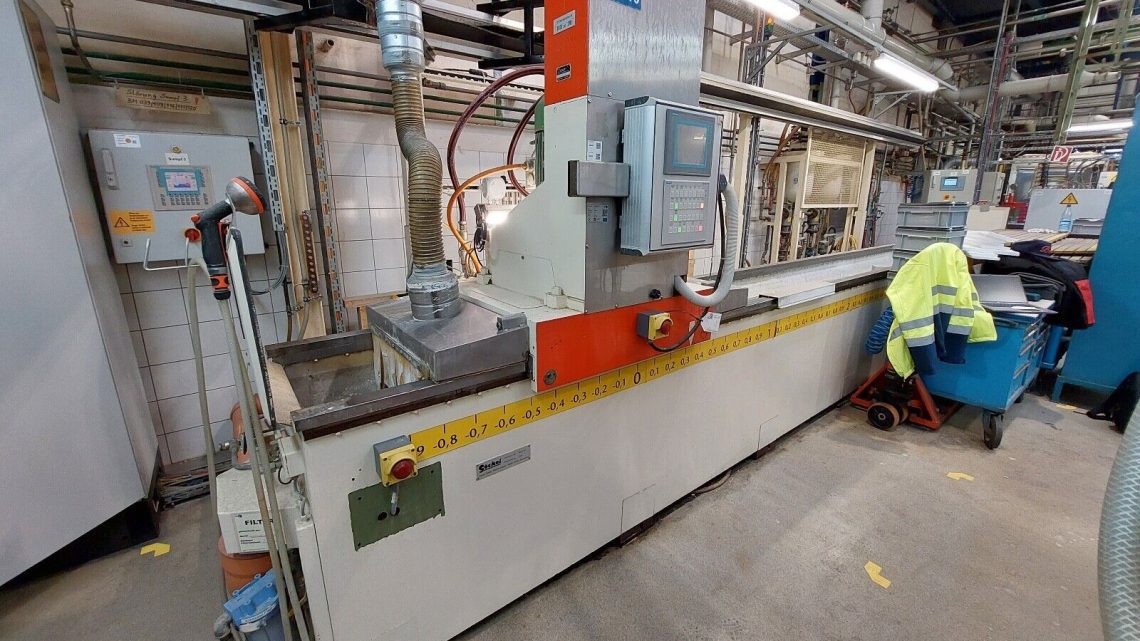
Smart Buyer’s Guide: How to Choose the Right Pre-Owned, Used, Secondhand, Surplus CNC Equipment Before Purchasing GÖCKEL GB 65 PL Knife Grinder made in Germany
Here is a Smart Buyer’s Guide for evaluating a used / surplus GÖCKEL GB 65 PL (knife / blade / straight knife grinder) machine. Because GÖCKEL (Göckel) machines are high-precision grinding / knife / blade grinding equipment, your inspection must emphasize accuracy, rigidity, condition of guides, wheel systems, and control. I’ll start with what is known (to set benchmarks), then give you a field checklist, test protocols, risk analysis, and red flags to watch out for.
1. What Is “GÖCKEL GB 65 PL” — Key Reference Details & Benchmark Specs
Before inspecting, you need to know what the machine should be capable of (or close to), so you can spot excessive wear or missing features.
- According to a listing of discontinued models, GÖCKEL GB 65 PL is one of the older (no longer made) grinders in Göckel’s lineup.
- Göckel’s “PL” suffix refers to a flat fixed table version (versus “EL” versions which use electromagnetic rotating tables). From Göckel’s own product descriptions: “PL = Flat fixed table”
- In Göckel’s product literature, “PL” machines have the structure:
• Welded construction, precision machining of the base & guideways
• Guide ways of various types: hardened / ground way bands, box ways, or linear ways depending on the model.
• Grinding motor is hollow shaft style, with precision bearings, and tiltable for radial / cross grinding.
• Coolant / flushing via hollow motor shaft and external coolant piping.
• Optionally NC / CNC control, automatic wheel wear compensation, automatic sizing, etc. - For reference, the “GB65” series (which includes PL, EL versions) is described as “heavy duty production grade grinding machine with 40-hp grinding motor and aggressive segment grinding head with latest linear way / drive systems.”
- In a used listing, a Göckel GB 65 EL (electromagnetic table) is offered with a 30 HP grinding drive, grinding length ~100″, width ~10″.
- Another listing for a Göckel blade grinder: grinding length ~4,100 mm, width 250 mm, height 200 mm, engine power 30 kW.
So, while your exact unit (GB 65 PL) might be older or differ in options, those numbers set rough expectations for scale, motor power, table size, etc.
2. Pre-Inspection: What to Request from the Seller / Broker
Before arriving onsite, try to gather as much data as possible. Good pre-inspection information helps avoid surprises and enables you to bring proper measuring tools.
Ask the seller for:
| Information / Document | Why It Matters |
|---|---|
| Model / variant / serial number / build year | To know which generation, revision, and expected feature set |
| Grinding motor specs (kW or HP, RPM) | So you know expected power and speed envelope |
| Length / width / height capacity (grinding table stroke) | To confirm that the machine can do your intended workpieces |
| Table type (PL fixed, EL rotating, etc.) | Because the table motion type deeply affects usage |
| Guideway type (box way, hardened bands, linear guide, etc.) | The type of guide determines wear, rigidity, and repair options |
| Maintenance / repair history | To see what has been overhauled or replaced (spindle, guides, motor) |
| Any modifications, retrofits, or non-original parts | To anticipate compatibility or repair difficulties |
| Calibration / alignment records | To see how well the machine was kept within tolerance over time |
| Spare parts / consumables included | Grinding wheels, bearings, motor spares, etc. |
| Documentation: mechanical, electrical, wiring, control, manuals | Lack of documentation significantly increases risk |
| Control / automation / CNC / wheel wear compensation systems | To know whether you can use or maintain those features |
| Photos / video of machine in motion | To spot obvious defects, wear, noise, or misbehavior |
| Utilities / setup requirements | Power, coolant, floor support, alignment history |
| Reason for sale / condition at shutdown | Useful for diagnosing latent issues |
If the seller cannot furnish good documents or history, that is a red flag — at best you negotiate a discount, at worst you reconsider.
3. Mechanical / Structural Inspection Checklist (On-Site)
When you’re physically at the machine, do a methodical inspection. Because grinding machines are precision machines, even small flaws can ruin usefulness.
Below is a checklist organized by subsystem.
A. Structure, Frame & Base
- Inspect the base, bed, machine frame, column (if present) for cracks, distortions, weld repairs, fatigue.
- Check the alignment / level of the base; warps or twist can introduce measurement errors or binding.
- Check guarding, shields, enclosures, covers for missing or damaged pieces (chips, exposure, corrosion).
- Any movement, looseness, or vibration in the frame is a serious concern.
B. Guideways, Carriage Motion & Slide Mechanisms
- Visually examine guideways / rails: look for scratches, pitting, corrosion, wear marks, metal chips embedding in surfaces.
- Move the grinding carriage and table (if applicable) over full travel by hand or jog: look for binding, zones of increased friction, “dead spots.”
- Use small reverse motions to detect backlash or loose slides (e.g. move ± small increment).
- Use precision straightedge or test bar to check linear straightness or slope deviation over travel (if possible).
- Inspect lubrication: check whether oil lines, wicks, guides are properly fed, whether blockages exist, whether oil is clean or contaminated.
- Check way covers, wipers, scrapers — missing or damaged ones allow debris ingress which accelerates wear.
C. Grinding Head, Motor, Spindle Assembly
- Turn on the grinding motor (no load) at its range of speeds; listen for bearing noise, windage, vibration, uneven running.
- Mount a test bar or indicator and check radial & axial runout at multiple positions.
- Inspect the spindle nose / collet area for wear, scratches, burrs, damage.
- If the grinding head or motor is tiltable (for radial or cross grinding), check the tilt mechanism for smoothness, backlash, locking stability.
- Inspect motor coupling, drive belts or transmissions (if any), ensure alignment and no looseness.
D. Table / Workholding / Fixture System
- For a fixed table (PL version) verify the table surface is flat, free of significant wear or distortion.
- Check clamping or fixturing mechanisms for robustness, alignment, repeatability.
- If there is any table traverse (some designs have slight motion), test that motion for smoothness and backlash.
- Examine table guideways (if present) for wear, contamination, looseness.
E. Coolant / Fluid / Filtration / Pumping System
- Inspect coolant tanks, pumps, plumbing, piping for leaks, corrosion, sediment, blockage.
- Check coolant delivery to grinding zone; make sure cooling is consistent and sufficient.
- Check filters, screens, coolant recirculation quality, contamination levels.
- Inspect hoses, nozzles, flow control, coolant overflow / drainage.
F. Electrical / Control / Cabin / Wiring
- Open control / drive / electrical cabinets; inspect for dust, coolant ingress, corrosion, heat damage, discoloration.
- Check wiring harnesses, connectors, labels, strain reliefs, shielding.
- Inspect motor drives, power electronics, cooling fans, heat sinks.
- Confirm all modules (control boards, amplifiers, I/O boards) are present and in good physical condition.
- Test control interface (if accessible): buttons, manual jog controls, display, axes display, fault LED’s.
G. Environmental & Setup Checks
- Verify whether machine is on a stable, vibration-minimal floor (nearby heavy machines may cause vibration).
- Temperature environment, airflow, drafts, thermal gradients: grinders are sensitive to thermal drift.
- Alignment: if machine was moved recently, check whether leveling, base shimming, anchor bolts have been disturbed.
Document all observed deviations, unusual wear, or mechanical compromises. Use photos and notes.
4. Functional / Performance / Test Protocols
Mechanical inspection is necessary but not sufficient — you must test how well the machine actually grinds under working conditions. Use test samples, instrumentation, and repeated operations to detect latent defects.
- Axis / Motion Tests
• Jog traverse motions (if table move exists) at multiple speeds; observe smoothness, no stutter.
• Approach known positions from different directions to detect hysteresis.
• Cycle back and forth to detect drift, stick zones, or increasing friction. - Spindle / Grinding Motor Tests
• Run at multiple rpm values (low, mid, high). Observe vibration, bearing noise, temperature drift.
• Use test bar / indicator to detect radial & axial runout at different points along the spindle.
• Check if there’s any instability (runout changes with rpm, unusual noise). - Grinding / Test Workpiece Operation
• Use a known reference block (e.g. steel, tool steel, blade stock) and perform a light grinding pass.
• Measure before and after dimensions, surface finish, flatness, consistency.
• Repeat multiple passes to detect change or drift over time. - Repeatability / Accuracy / Wear Drift
• Remove and remount the same workpiece; re-grind or measure to see how much error is introduced by reclamping.
• After several passes or hours of operation, remeasure critical dimensions to see drift.
• Test across full traverse length — e.g. grind at different ends of travel and see whether performance is consistent. - Tilt / Radial / Cross Grinding (if supported)
• If the machine supports radial or cross grinding via tilting head, test those functions.
• Check whether the tilt mechanism holds position under load without deflection. - Coolant / Thermal / Long-Run Drift Test
• Run grinding cycles over extended periods (30–60 minutes or more) and remeasure critical tolerances.
• Monitor temperature of motor, spindle, structure; see how thermal drift impacts precision.
• Check dimension stability after warm-up. - Fault / Recovery / Interrupt Tests
• Pause or interrupt a grinding cycle, then resume — verify that the machine recovers correct offsets.
• Trigger a soft limit or error; see whether the control handles it gracefully.
• Power off / on; check whether calibration / zeroing remains valid or whether re-referencing is required.
Document every measured deviation, drift, and inconsistency. Compare against tolerances suitable for knife / blade grinding (often tight).
5. Spare Parts, Control / Electronics & Long-Term Support
A used machine’s value is as much in its maintainability as in its current performance. Before purchase, analyze supportability.
- Documentation: Ensure you get full mechanical, electrical, wiring diagrams, parts lists / BOM, maintenance manuals, control manuals, calibration records.
- Control / automation systems: Check whether the control is original, or if retrofitted. Verify whether you get the control software, parameter backups, source code (if needed).
- Critical spare parts: Grinding motor, spindle bearings, guideway components, ball screws (if any), couplings, control modules, wiring harnesses, pumps, sensors.
- Obsolescence risk: Some control boards or modules may no longer be manufactured — check whether substitutes or aftermarket support exist.
- Manufacturer / service support: Investigate whether GÖCKEL (or its successors) or third-party service providers still support this model.
- Grinding wheel / tooling supply: Ensure the correct wheel types (ring, segment, CBN, diamond) are still available.
- Calibration / alignment tools: Check whether alignment jigs, test bars, master blocks or calibration tools are included or available.
- Retrofit / upgrade path: If future improvements (e.g. CNC retrofits, control upgrades) are desired, assess feasibility.
If a single module fails and is unserviceable, the machine could become unusable — factor that risk heavily.
6. Risk / Cost Budgeting & Decision Logic
When comparing used GÖCKEL grinders, you need to estimate hidden costs, risk, and whether the machine is worth purchasing relative to alternatives.
| Risk / Cost Factor | What to Estimate / Ask | Decision Implication |
|---|---|---|
| Refurbishment / repair cost | Cost to recondition spindle / motor, refurbish guideways, restore head tilt mechanisms, replace bearings, re-lap surfaces | If repair cost is ~20–30 % or more of your budget, the deal is high risk |
| Parts / module obsolescence | If critical control boards, electronics or components are no longer supported, replacement could be expensive or impossible | That can turn a seemingly good machine into scrap |
| Calibration / alignment / commissioning | After transport, you’ll need to realign axes, calibrate carriages, run test parts | Add conservative buffer to your total cost-of-ownership |
| Transport / rigging / installation | Crating, disassembly, shock control, leveling, anchoring | Underestimating this often causes budget overrun |
| Downtime / integration / operator training | Time needed to debug, tune, train operating staff | Buffer your production plan accordingly |
| Wear / drift margin | Even if the machine performs now, wear may already be near the precision limit | Favor units with “headroom” not ones already near failure |
| Alternative / newer / rebuilt machines | Cost comparison: used + refurb vs buying newer or refurbished with warranty | Sometimes paying more avoids long-term risk |
As a rule of thumb, many used machine buyers allocate 20–30 % (or more for precision machines) of the purchase price for refurbishment, spares, alignment, and contingencies.
7. Contract & Negotiation Safeguards
To protect your purchase, your contract should include robust acceptance & warranty clauses.
- Acceptance / Performance Test Clause: Final payment is contingent on the machine passing a defined test protocol (accuracy, repeatability, grinding performance) in your facility.
- Hold-back / Escrow: Retain a portion (e.g. 10–20 %) until full commissioning.
- Limited Warranty on Key Subsystems: E.g. motor, spindle, guideways, tilt head, control electronics (30–90 days).
- Spare / Consumable Package: Insist the seller include spare components (bearings, coupling parts, motor spares, control modules) or discount accordingly.
- Documentation / License Transfer: Ensure full transfer of manuals, wiring diagrams, control software, parameter backups.
- Latent Defect / Repair Clause: Define remedies for defects discovered after installation (repair, replacement, partial refund).
- Transport / Damage Liability: Clarify responsibility for damage during shipping, loading/unloading, alignment errors.
These clauses shift risk back to seller and ensure recourse if defects appear.
8. Red Flags & Deal-Breakers
Here are conditions or defects you should treat as serious warning signs, or even walk-away triggers, unless heavily discounted or pre-repair is guaranteed.
- Grinding motor exhibits noise, vibration, runout beyond acceptable limits.
- Tilt / radial grinding head is misaligned, wobbles, or loses position under load.
- Excessive wear in guideways, scoring, damage, or binding in carriage motion.
- Tilt axis backlash or play exceeding small tolerances.
- Fluids leaking from coolant, motor housing, bearings, or plumbing.
- Electrical cabinet with signs of water ingress, corrosion, burnt boards, or missing modules.
- Missing or damaged control / electronics / wiring, or undocumented modifications.
- The seller refuses to allow full functional tests (grinding passes, positioning, tilt).
- Critical spare parts, grinding wheel types, or consumables are no longer available.
- The price is too close to that of a refurbished or newer competition, leaving little margin for repair risk.